
What Is a Vertical Market? Definition, Examples & How It Works in 2026

You have a product, a plan, and maybe even a price. But if you are selling to “everyone,” you are probably reaching no one well. Vertical markets fix that.
This guide walks you through what a vertical market actually is, how it works, where it shows up in the real world, and how to figure out if one is the right lane for your business.
TL;DR
- A vertical market is a niche-focused market where businesses serve a specific industry or customer group with tailored products or services.
- It is the opposite of a horizontal market, which sells broadly across multiple industries.
- Verticals allow premium pricing, lower marketing costs, and stronger customer loyalty.
- The trade-off is a smaller addressable market and higher vulnerability to industry-level shifts.
- There are three structural types: corporate, administered, and contractual vertical markets.
- Common examples include health and wellness, consumer electronics, organic grocery, and SaaS for specific industries.
- Entering a vertical requires product-market fit research, honest cost analysis, and a clear understanding of who your buyer is.
What Is a Vertical Market?
A vertical market is a defined group of businesses and customers sharing the same industry, profession, or specialized set of needs. Companies operating in a vertical do not try to serve everyone. They go deep into one lane.
Think of it this way. A company selling accounting software to law firms is in a vertical market. The software addresses a specific workflow for a specific profession. A company selling generic spreadsheet tools to everyone is not.
The term “vertical” comes from the idea of moving up and down a single industry’s supply chain rather than cutting across many industries. A vertical market provider understands the language, regulations, pain points, and buying behavior of one defined audience. That focus is exactly where the value lives.
Vendors in vertical markets often develop products that would make little sense outside their niche. MRI scanner manufacturers, for instance, sell almost exclusively to hospitals and diagnostic centers. Cat food brands serve only pet owners. Medical billing software targets healthcare providers. None of these products need to appeal to a broader crowd. That narrowness is a feature, not a flaw.
How Does a Vertical Market Work?
Vertical markets work because they replace broad guesswork with focused precision.
A business operating in a vertical learns everything about its segment: the buyer’s daily frustrations, the industry’s compliance requirements, the seasonal demand patterns, and even the language the buyer uses internally. That level of contextual knowledge shapes every product decision, every marketing message, and every customer support interaction.
Here is a simple example from the Reddit community that captures it clearly. A vegan food delivery app targets vegan consumers specifically. It markets through vegan blogs, nutritionists in that space, and plant-based lifestyle channels. It does not advertise on general grocery platforms. Every decision flows from one question: what does this specific audience need, and where do they already spend their time?
This focused approach directly impacts operations. Because the customer base is narrow and consistent, the business can streamline inventory, product development, and communication into repeatable, efficient systems. Marketing spend goes further because targeting is tighter. Support teams develop deep category knowledge. Sales cycles, while sometimes longer in B2B verticals, produce higher-value and more loyal clients.
Vertical markets also benefit from word-of-mouth within a tight community. When your buyers all know each other, a satisfied client’s referral carries far more weight than a cold advertisement. The product travels through trust networks naturally.
Vertical Market vs. Horizontal Market
A horizontal market sells broadly. A vertical market sells deeply. Both are legitimate. Neither is inherently better. What matters is which one fits your product, your resources, and your goals.
Walmart is a horizontal market player. It serves nearly every consumer demographic and partners with thousands of suppliers across unrelated categories. Whole Foods is a vertical player. It focuses specifically on organic grocery buyers and organic product suppliers. Same general industry. Entirely different strategic approach.
Amazon is horizontal. Etsy, which focuses on handmade and vintage goods for a community of creators and collectors, leans vertical. The difference is not about size. It is about specialization.
Key Differences at a Glance
| Factor | Vertical Market | Horizontal Market |
| Customer base | Narrow and defined | Broad and diverse |
| Product focus | Highly specialized | Standardized |
| Competition | Intense within niche | Broad across many industries |
| Marketing | Targeted and efficient | Wide-reach and costly |
| Pricing power | Higher (premium pricing) | Lower (price competition) |
| Customer loyalty | Stronger | More transactional |
| Risk exposure | Concentrated in one sector | Spread across many |
| Scalability | Slower, requires niche mastery | Faster with volume |
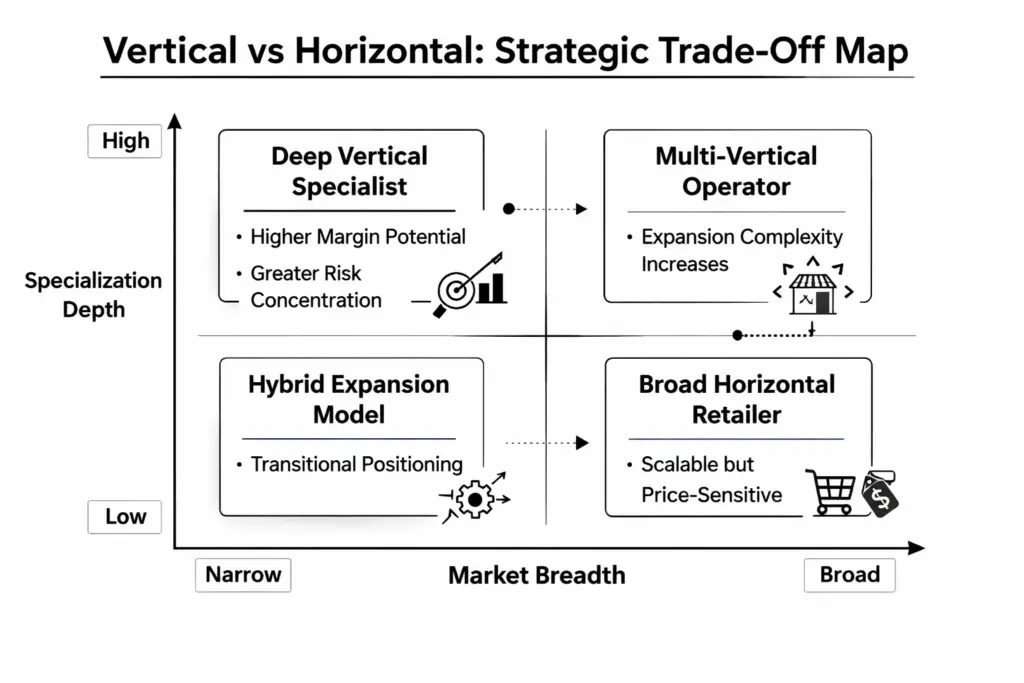
One important note from a Reddit thread on this topic: a company can serve several verticals without becoming a horizontal business. A clothing manufacturer with product lines in women’s swimwear, maternity wear, and wedding gowns is serving three verticals.
It operates with different messaging, channels, and product logic for each. That is not horizontal market strategy. That is multi-vertical positioning. A horizontal business would just sell all types of clothing to all consumers without niche-specific tailoring.
Vertical Marketing Systems (Structural Models)
According to business literature, vertical markets are generally classified into three structural types means structural supply-chain forms. Do not confuse that with market segmentation types. But, understanding them matters if you are evaluating how to enter or organize a vertical.
- Corporate vertical markets exist when a single company controls multiple stages of production and distribution within one ownership structure. A fashion brand that designs, manufactures, and operates its own retail stores is a corporate vertical.
- Administered vertical markets are coordinated by one dominant company that holds enough size and influence to direct the behavior of other players in the chain. A large retailer that sets the shelf requirements for its suppliers is a practical example.
- Contractual vertical markets are formed when independent companies across different stages of production legally agree to coordinate their activities. Franchise systems are a textbook example of this. Each franchisee operates independently but follows brand and operational standards set contractually.
For most store owners and eCommerce builders reading this, the contractual and corporate types are the most relevant. Whether you are building a niche product business or a platform that serves one industry, you are participating in a vertical structure.
Common Examples of Vertical Markets
Vertical markets are everywhere once you know what to look for. Here are real, high-relevance examples across categories. To see how vertical logic plays out in real markets, look at these examples.
5 Different Vertical Markets Examples
- Health and wellness is one of the fastest-growing verticals in eCommerce globally. The global health and wellness market was valued at approximately $6.8 trillion in 2024, according to the Global Wellness Institute. Forecasts from Fortune Business Insights project it reaching $11.57 trillion by 2032 at a 6.8% CAGR, while SkyQuest estimates a broader $14.18 trillion by 2033 depending on scope. Brands like BUBS Naturals, supplement stores, and wellness tech companies like Fitbit all operate within this vertical.
- Consumer electronics global eCommerce market generated approximately $650.6 billion in 2024, placing it among the largest online retail verticals worldwide. Companies like Skullcandy and Wyze Labs serve defined niches within it.
- Organic grocery is a textbook vertical. Whole Foods does not try to sell everything. It sells to organic-conscious buyers and sources from organic suppliers. The organic pet food segment alone follows the same logic at a niche level within the broader pet care vertical. That alignment from shelf to supply chain is vertical market logic at work.
- SaaS for specific industries is one of the most profitable vertical plays today. Accounting software built for dental practices, project management tools built for construction firms, and HR platforms built for restaurants all operate in verticals. They charge premium prices because generalist tools cannot match their depth. The vertical SaaS market was valued at $91.19 billion in 2023 and is projected to reach $317.49 billion by 2032, reflecting the scale of demand for industry-specific software.
- Pet care is another strong vertical. The US pet care market grew from $90.5 billion in 2018 to $147 billion in 2023, according to industry expenditure data. Globally, the pet care market reached approximately $195.69 billion in 2024 and continues to grow at a steady pace, making it one of the more resilient consumer verticals. Cat food, premium dog nutrition, and pet wellness brands all operate within a defined vertical audience: pet owners who treat their animals as family members.
Benefits of Operating in a Vertical Market
1. Premium pricing power
Specialized products command higher prices. Buyers in a vertical are not comparison shopping against generic alternatives. They are paying for a solution that fits their exact context. Value-based pricing is the norm in verticals, where the question is not “what does this cost to make” but “what is this worth to this specific buyer.” Vertical market products are also among the most consistent sources of high profit margin returns precisely because of this pricing dynamic.
2. Lower marketing costs
Reaching a narrow audience is cheaper than reaching everyone. You know exactly which channels, publications, communities, and events your buyers use. Less spend goes to waste. Campaigns perform better because the message is precise.
3. Stronger customer loyalty
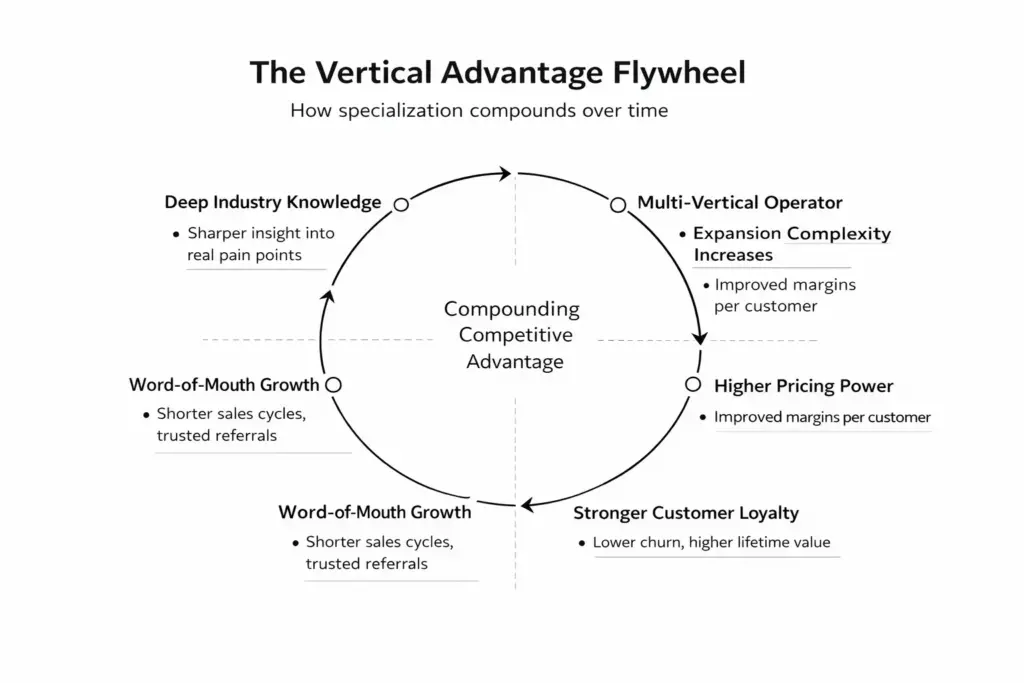
BigCommerce notes that customers in a vertical market typically rely on a single service provider to meet their long-term needs. When a company speaks your language, understands your problems without explanation, and delivers solutions tailored to your workflow, switching costs go up naturally.
4. Competitive depth over time
Every month a business operates in a vertical, it builds more expertise than a generalist competitor. That accumulated knowledge becomes a moat. Competitors entering the space must invest heavily just to reach parity.
5. Word-of-mouth efficiency
Within a vertical, buyers know each other. An endorsement from a trusted peer travels through the community quickly and at no cost to the seller. This is particularly powerful in B2B verticals like healthcare software, legal tech, or industry-specific tools.
6. Cleaner SEO and keyword competition
From a digital perspective, vertical market businesses often face lower paid and organic keyword competition. Less competition in niche search terms means faster and cheaper visibility.
Challenges of Vertical Markets
Every vertical comes with real constraints. Entering one without understanding the downsides leads to expensive surprises.
- Limited market size. The very thing that makes a vertical valuable, a narrow and defined audience, also caps your revenue ceiling. If the audience is small or growing slowly, scaling becomes difficult without expanding into adjacent verticals or new products.
- Risk concentration. A vertical market business depends on the health of one industry. Regulatory changes, economic downturns, or technological disruption in that sector can hit a vertical player much harder than a diversified business. The movie rental industry is the clearest modern example. Blockbuster, once dominant, collapsed rapidly when streaming disrupted the vertical. Redbox survived by finding a specific sub-niche within the same dying industry.
- Harder to pivot. The deep specialization that creates value in a vertical also makes it expensive to leave. Infrastructure, messaging, product logic, and team expertise are all built around one sector. Pivoting to a new vertical means rebuilding a substantial portion of the business.
- Innovation pressure. Niche markets have informed, demanding buyers. Because your audience knows their industry deeply, they expect you to keep up. Falling behind on product updates or industry developments is harder to hide in a vertical than in a broad market.
- Sales cycle length. In B2B verticals especially, sales cycles can be longer and more complex. Buyers are making investments in tools deeply embedded in their operations. Due diligence takes time.
Vertical Market Pricing Strategy
In a vertical market, price reflects value to a specific buyer, not the general cost of production.
Generalist products compete on price because buyers can easily substitute. A niche product built for a specific context has no direct replacement. That shift in buyer psychology unlocks premium pricing.
There are two pricing realities in a vertical. First, customization costs more to build. Development, compliance integration, customer support, and niche-specific features require investment. That investment is justified by a smaller but higher-paying customer base. Second, buyers in a vertical often have strong spending power and are willing to pay for solutions that reduce friction in high-stakes workflows.
Value-based pricing is the standard approach. You set prices based on the perceived business value to the buyer, not the cost of production or what horizontal market competitors charge. A dental practice management software that saves a clinic 10 hours per week and reduces billing errors by 30% does not compete with generic spreadsheets on price. It prices against the value delivered. If you are working through your own pricing logic, first, you need that full framework in practical terms.
One Nuance Worth Understanding
In some verticals, there are fewer direct competitors, which gives pricing more flexibility. In others, the niche has become crowded, and differentiation through product depth matters more than price. Knowing which environment you are entering is essential before setting your pricing model.
How to Identify and Enter the Right Vertical Market
Choosing a vertical is one of the most important early decisions a business makes. Getting it wrong is costly. Getting it right creates a compounding advantage.
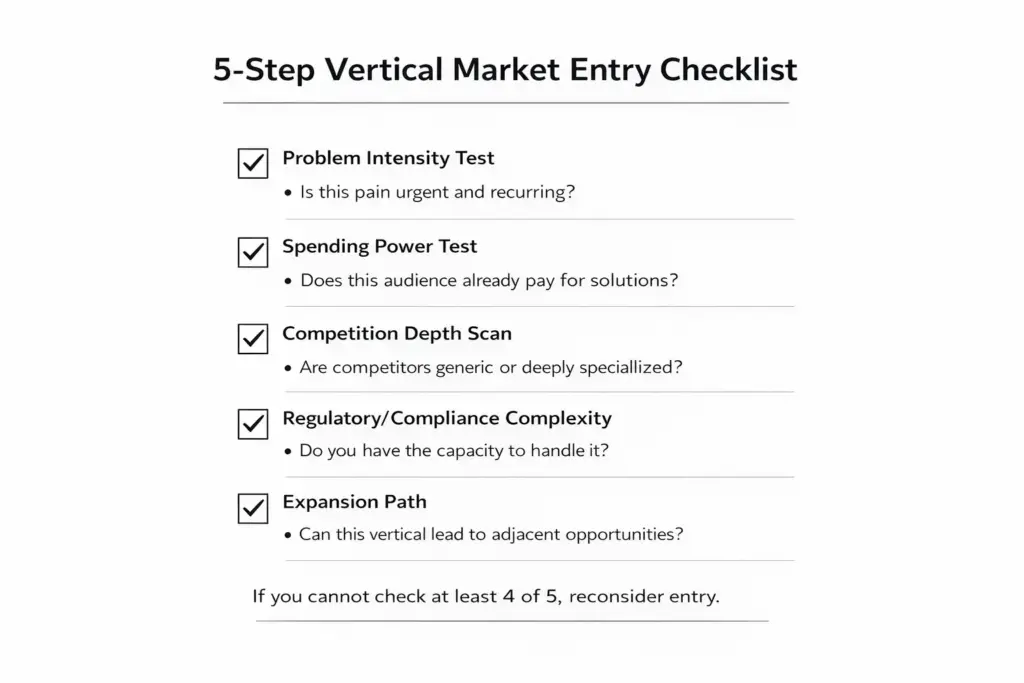
- Start by evaluating your product’s natural fit. What specific problem does it solve? For whom does it solve it best? What industry context makes the problem more acute? The answers usually point toward a natural vertical. If your product already has early adopters, look closely at what they have in common.
- Research the market’s size and growth trajectory. A vertical needs to be large enough to sustain a viable business. Even smaller verticals like premium organic food or specialty pet care represent multi-billion dollar opportunities. Use publicly available data, industry reports, and Google Trends to validate that demand is real and growing.
- Understand the competition. Reduced competition is a benefit of most verticals, but some niches are now saturated. Evaluate not just how many competitors exist but how specialized they are. A structured way to think through this is to map supplier power, buyer power, and threat of new entrants; the core questions behind Porter’s Five Forces. Even informally, before committing. A generic competitor in your niche is a weaker threat than one with deep vertical expertise.
- Calculate the real cost of entry. Vertical markets often require upfront investment in product customization, compliance, and community building. The entry barrier is a moat once you are inside, but it is a real cost before you get there. Be honest about whether your runway supports a slower, higher-investment entry.
- Test before you commit fully. Launch one product, target one narrow audience, gather real signal. LastObject, for example, started with a single reusable cotton swab. That product validated the zero-waste personal care vertical before the company expanded its product line.
Launch in your vertical with FluentCart
If you are ready to build the store infrastructure that supports a vertical market strategy, or trying to figure out how to make a website to sell products, you need some practical setup from store architecture to fulfillment. FluentCart is built specifically for store owners who need full control over their product catalog, checkout flow, and customer data without being locked into a platform that takes a cut of every sale.
So, whether you are launching a niche digital product store or a specialized physical goods business, this ecommerce system is designed to adapt to your business model, not the other way around.
Wrapping Up
A vertical market is not a limitation. It is a choice to go deeper rather than wider. The businesses that dominate their verticals do so because they understand their buyers better than anyone else in the room. That understanding compounds. It shows up in product quality, in retention rates, in pricing power, and in the trust buyers extend over years of doing business together. If your product solves a real problem for a defined audience, a vertical market is probably the clearest path to building something that lasts.
Once In a Lifetime Offer
Frequently Asked Questions
1. Can a vertical market business expand into other industries later?
Yes, but only after mastering its first niche. Depth creates credibility, systems, and cash flow. Expansion works best when it moves into adjacent verticals with overlapping needs.
2. Is a vertical strategy better for startups?
Often, yes. Startups rarely win on scale, but they can win on specialization. A vertical strategy narrows competition and increases the chance of building authority faster.
3. How do you know if a vertical is too small?
Size alone is not the test. Look at purchasing power, repeat demand, and long-term growth potential. A smaller, high-value niche can outperform a broad, low-margin market.
4. Can a personal brand be built around a vertical market?
Absolutely. Focus accelerates authority. When you consistently serve one defined audience, trust builds faster than it ever could in a broad, unfocused market.

Deputy Marketing Lead, published literary author, and musician. I thrive on marketing for tech companies while composing music, collecting books of lasting depth, exploring cinema with a discerning eye, and studying the arts and history.

Subscribe now
Related Articles and Topics
-

Bundle Marketing: An eCommerce Guide for Store Owners
Bundle marketing guide: types, pricing math, examples, and a FluentCart setup.
-

Membership Affiliate Programs: The Cost-effective, Integrated Setup
Run membership affiliate programs on WordPress with one integrated stack.
-

WordPress Coupons: How to Create and Manage Discounts
Set up a WordPress coupons plugin and manage discount codes in minutes.



Add your first comment to this post