
What Is an Anchor Store? Why It Makes or Breaks Malls

Anchor stores have shaped how we shop for decades. If you have ever walked into a mall and headed straight for the big-name department store at the far end, you already understand what an anchor store does, even if you did not know the term. These large, recognizable retailers do more than sell products. They pull people in, keep them there longer, and send them off to explore every other shop along the way.
In this blog, we will cover the anchor store definition, how these stores work, real-world examples, their impact on surrounding retailers, and what the future looks like for them.
TL;DR
- An anchor store is a large, well-known retailer that drives foot traffic to a shopping center or mall
- Common examples include Macy’s, Walmart, Target, Nordstrom, and Best Buy
- They benefit nearby smaller retailers through spillover foot traffic
- Anchor stores typically enjoy discounted rent in exchange for drawing customers
- Their relevance is shifting as eCommerce grows and open-air centers replace enclosed malls
What Is an Anchor Store?
An anchor store is a large, well-known retail chain that serves as the primary traffic driver for a shopping center or mall. It occupies a significant portion of the property, often positioned at corners or opposite ends of the complex, and draws customers who then browse and spend at the smaller surrounding retailers.
The term comes from the nautical idea of an anchor holding a ship steady. In retail, these stores hold the shopping center’s appeal together. Without them, foot traffic drops and smaller tenants struggle to survive. Most anchor stores are department stores, big-box retailers, or major specialty chains. They hold long-term leases, offer a wide range of products, and carry enough brand recognition to make shoppers plan trips specifically to visit them.
A Brief History of Anchor Stores
The concept of the anchor store predates the modern shopping mall. Department stores like Macy’s in New York and Marshall Field’s in Chicago became retail destinations in the late 19th century. This drawn massive crowds through sheer variety and scale.
In the mid-1950s, architect Victor Gruen formalized the model. He designed the first open-air American shopping center in Detroit with a department store at its center, surrounded by smaller shops and cafes. That layout became the blueprint for malls across North America.
As retail evolved, the definition of an anchor expanded. Big-box retailers like Walmart and Target eventually joined department stores in anchoring major shopping centers. Luxury names like Neiman Marcus and Saks Fifth Avenue came to anchor upscale properties. The variety grew, but the function stayed the same.
Key Characteristics of an Anchor Store
Not every large store qualifies as an anchor. True anchor stores share a consistent set of traits.
- Size and scale are defining features. Anchor stores often occupy tens of thousands of square feet, frequently making up around 30% of a shopping center’s total retail space. This scale lets them offer product ranges that draw broad audiences.
- Brand recognition matters just as much as size. Retailers like Target and Walmart have built decades of consumer trust. That trust is what motivates people to drive to a shopping center in the first place. Smaller retailers benefit from that pull without spending a dollar on the marketing that created it.
- Strategic placement is intentional. Anchor stores are positioned at opposite ends or key entry points of a mall so that customers walk past smaller stores on the way in and out. This distribution of foot traffic is not accidental. It is engineered.
- Favorable lease terms reflect their value to property owners. Anchor tenants often pay below-market rent because their presence guarantees foot traffic that attracts other tenants. Smaller retailers typically pay higher per-square-foot rates to offset the discount anchors receive.
Types of Anchor Stores with Examples
Anchor stores come in several forms. Each type attracts a different customer demographic and suits a different kind of shopping center.
1. Department Stores
These are the original anchor stores. They offer a broad range of categories including clothing, accessories, home goods, and beauty under one roof.
- Macy’s: Founded in 1858, became a cornerstone of American suburban malls starting in the mid-20th century
- Nordstrom: Known for high-end merchandise and customer service, with roots in Seattle dating to 1901
- JCPenney: Serves a wide price-conscious audience, became a mall anchor after the 1960s
- The Bay (Hudson’s Bay Company): One of North America’s oldest retailers, anchoring Canadian shopping centers for generations
2. Big-Box Retailers
These stores shifted the anchor landscape by combining scale with aggressive pricing. Understanding what retail actually means helps explain why big-box anchors are so powerful: they offer value, variety, and volume under one roof.
- Walmart: The world’s largest retailer, with Supercenters anchoring large shopping plazas across North America
- Target: Known for its trend-forward merchandise at accessible prices
- Best Buy: A category-focused anchor specializing in consumer electronics
3. Luxury and Niche Retailers
Upscale shopping centers use luxury department stores to attract affluent shoppers.
- Neiman Marcus: High-end fashion and exclusive designer collections
- Saks Fifth Avenue: Luxury apparel and goods, owned by Hudson’s Bay Company
- Holt Renfrew: Canada’s leading luxury department store chain
4. International Anchor Stores
The concept is not limited to North America. Global examples include Harrods in the UK, Galeries Lafayette in France, Takashimaya in Japan, and El Corte Inglés in Spain. Each plays the same foundational role in their respective retail ecosystems.
The Impact of Anchor Stores on Surrounding Retailers
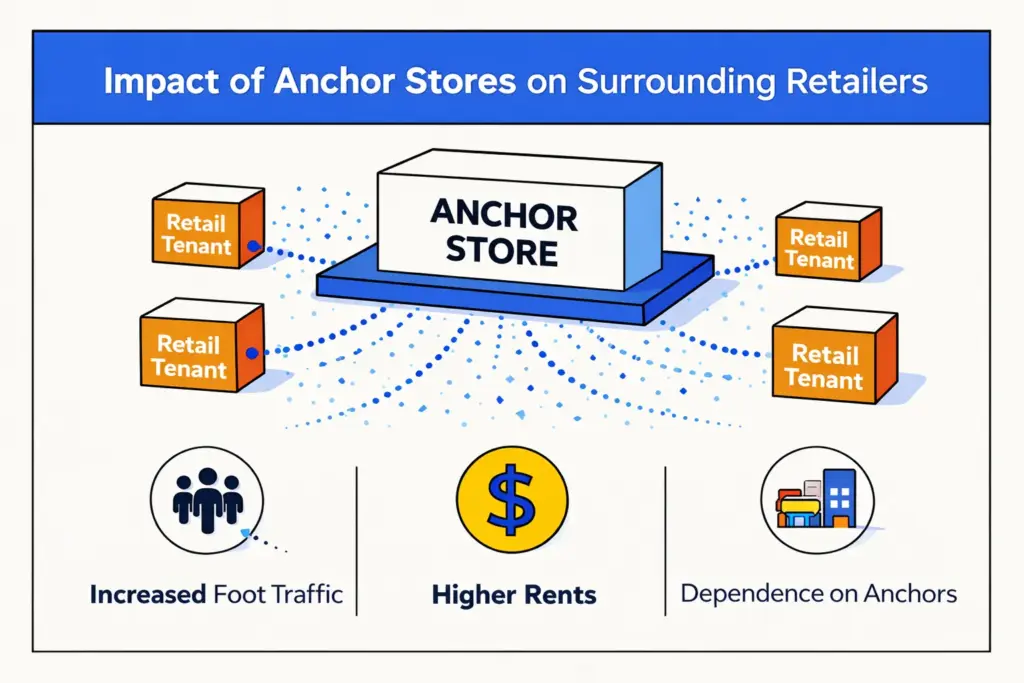
The influence of an anchor store extends well beyond its own walls.
1. Foot Traffic Spillover
The most direct benefit for neighboring retailers is increased foot traffic. When a Macy’s or a Target draws hundreds of shoppers to a location, many of those shoppers browse nearby stores before or after their main visit. This passive exposure translates into sales, brand awareness, and customer growth for smaller tenants.
The benefit works best when retail demographics align. A sporting goods store next to a Target will likely see real spillover. A niche luxury boutique next to a discount big-box store may see very little crossover.
According to Placer.ai’s 2024 retail foot traffic report, superstores, the classic anchor format, grew foot traffic by 1.7% year-over-year in 2024, outperforming many other retail categories. That steady draw is exactly what neighboring smaller tenants depend on.
2. Rent Dynamics
Proximity to an anchor store raises property value, and the data bears this out. According to a CBRE press release on retail rent trends, prime retail rents in the Americas have risen more than 9% since 2021, compared to 4.8% globally.
Laura Barr, Americas Retail Leader for CBRE, put the challenge plainly:
“Retailers face numerous obstacles to finding the prime space they desire, including record-low availability and rising rents.”
Both the stat and the quote come from the same CBRE source.
This is the market anchor-adjacent locations operate in. Landlords charge higher rents to smaller tenants near anchors partly to compensate for the discounts anchor tenants receive, and partly because the demand for that space is genuinely higher.
3. The Dark Anchor Effect
When an anchor store closes, the consequences ripple quickly. Vacant anchor spaces are a reliable warning sign for the health of an entire shopping center. Smaller tenants see foot traffic drop, some invoke lease clauses to exit or reduce rent, and the decline often becomes self-reinforcing.
This is why many smaller retailers negotiate protective lease clauses before signing. A go-dark clause lets a retailer vacate while still paying rent if an anchor closes. A co-tenancy clause allows a tenant to reduce or eliminate rent when anchor occupancy drops below a set threshold. Co-tenancy clauses typically activate when two or more anchors exit, according to Morningstar DBRS analysis, which noted that inline tenants may be eligible for rent reductions until space is backfilled in those scenarios.
The financial stakes are significant. Among the roughly 150 stores Macy’s has been closing as part of its turnaround plan, around 80 anchor malls that serve as collateral for $24 billion in commercial mortgage-backed securities, according to data from CoStar and Morningstar DBRS cited by ICSC. The closures illustrate just how deeply tied retail property finance is to anchor store health.
4. Shadow Anchors
A shadow anchor is a major retailer located near but not inside a shopping center. A Home Depot positioned next to a strip mall is a classic example. It draws traffic to the surrounding area without being a formal tenant. Property developers and leasing teams often reference nearby shadow anchors to attract smaller tenants, since the traffic effect is already present even without a formal lease.
Advantages and Disadvantages of Being Near an Anchor Store
Being located next to an anchor store is not automatically a win.
Advantages:
- Higher foot traffic past your storefront without additional marketing spend on your part
- Brand exposure to a wider audience, especially valuable for newer or independent businesses
- Ability to piggyback on the anchor’s advertising and promotional draws
Disadvantages:
- Research by Ebster and Garaus suggests that within roughly 50 feet of an anchor store, shoppers often become so focused on reaching the anchor that they overlook nearby storefronts entirely
- Higher rent for prime proximity positions, as reflected in those rising market rents
- Mismatched customer demographics can make the foot traffic largely irrelevant to your specific business
The right answer depends on how well your product or service aligns with the anchor’s customer base and whether your margins can support the rent premium. For retailers managing both physical and digital channels, understanding the spillover value of anchor proximity is part of a broader eCommerce management and location strategy.
Anchor Stores and the eCommerce Era
The rise of online shopping has changed the anchor store landscape significantly, though it has not eliminated it.
Enclosed malls have struggled as consumers shift purchasing online and prefer open-air or lifestyle centers. Ethan Chernofsky, VP of Marketing at Placer.ai, described the industry’s reckoning directly:
“Sears, Macy’s and JCPenney were closing stores. All of a sudden, you have to get more creative. The old playbook is being thrown out the window.”
- reported by Modern Retail.
Open-air shopping centers are filling the gap. LightBox research, citing CBRE data, forecasted that more than $10 billion in U.S. open-air retail portfolios will be change hands in 2025. These properties are attracting institutional capital precisely because grocery-anchored centers and open-air formats generate consistent, eCommerce-resistant foot traffic.
The concept of the anchor has also evolved beyond traditional retail. Cinemas, food halls, fitness chains, and entertainment venues are now considered anchor sites in modern shopping developments, since they generate repeat visits and extend how long customers stay in a location. This shift is a direct response to what consumers want: not just products, but experiences.
Anchor stores themselves have adapted too. Most major players now offer omnichannel experiences including buy online, pick up in store (BOPIS), curbside pickup, and integrated mobile apps. For smaller retailers who want to compete in that same environment, investing in a strong eCommerce product page design and effortless checkout experience is now table stakes, not optional.
Wrapping Up
Anchor stores are not a relic of the past. They are evolving. The department stores that defined American malls for half a century are being joined or replaced by big-box retailers, luxury flagships, experiential concepts, and even popular restaurants. Their core function remains the same: pull people in, keep the shopping center alive, and let foot traffic do the work for everyone around them.
For any retailer choosing a physical location, understanding how anchor stores work is essential. Who is the anchor? Does their customer base match yours? Are they likely to stay? Can your operation convert their foot traffic into loyal customers? And are you building the digital infrastructure to capture and retain those customers beyond the mall visit itself?
Those answers will shape more than just your lease decision. They will shape your growth.
Once In a Lifetime Offer
FAQs
What is the difference between an anchor store and a regular tenant?
An anchor store is a large, high-traffic retailer that drives shoppers to the shopping center as a whole. Regular tenants are smaller retailers who benefit from that traffic. Anchors typically pay lower rent in exchange for the foot traffic they generate, while smaller tenants pay premium rates for proximity to that draw.
What happens when an anchor store closes?
When an anchor goes dark, surrounding retailers often see significant drops in foot traffic. Smaller tenants may invoke co-tenancy lease clauses to reduce or eliminate rent, and in severe cases the closure triggers a chain reaction that empties the shopping center.
Can a non-retail business be an anchor tenant?
Yes. Cinemas, gyms, food halls, and entertainment venues increasingly serve as anchor tenants in modern shopping developments, particularly as traditional department stores have closed locations across many markets.
What is a shadow anchor store?
A shadow anchor is a major retailer located near but not inside a shopping center that still draws traffic to the surrounding area. A standalone Home Depot near a strip mall is the most commonly cited example.
What is the difference between anchored and unanchored retail?
Anchored retail centers have one or more major tenants whose brand recognition draws consistent foot traffic. Unanchored centers rely on a mix of smaller tenants and tend to struggle more with baseline traffic generation, though they are not subject to the volatility that comes when a single dominant anchor exits.

Deputy Marketing Lead, published literary author, and musician. I thrive on marketing for tech companies while composing music, collecting books of lasting depth, exploring cinema with a discerning eye, and studying the arts and history.

Subscribe now
Related Articles and Topics
-

WordPress Coupons: How to Create and Manage Discounts
Set up a WordPress coupons plugin and manage discount codes in minutes.
-
Buy One Get One Free: A FluentCart Guide for WordPress Store Owners
A complete buy one get one free setup guide in FluentCart, using three methods, so you can pick…
-

What Is a Business Proposal? Things to Know in 2026
A business proposal is a formal document that pitches your product or service to a client. Learn its…




Leave a Reply