
Is Dropshipping Worth It in 2026? Profitability, Trends & Real Challenges
You’ve seen the YouTube ads, heard the success stories, and probably also heard that dropshipping is dead. The truth sits somewhere between the hype and the doom.
“The global dropshipping market was valued at $290.7 billion in 2025” [1]. “It’s expected to hit $343 billion in 2026” [1]. Those numbers don’t suggest a dying model. They do suggest a change.
TL;DR
- Dropshipping is still worth it if you treat it like a real business, not a shortcut to easy money.
- The model has matured: generic stores and quick-win tactics no longer work, while brand-led and niche-focused approaches do.
- Profitability depends less on the product and more on marketing, positioning, and customer experience.
- Competition is higher, making differentiation and trust essential to survive.
- Rising costs and fulfillment expectations mean thin margins punish mistakes quickly.
- Dropshipping now favors builders who are patient, adaptable, and willing to learn continuously.
Bottom line: Dropshipping isn’t dead, it’s disciplined. If you want fast or passive income, it’s not worth it. If you want to build a real eCommerce business, it still can be.
If you’re willing to learn marketing, build a brand, and commit for 6-12 months before seeing real returns, dropshipping can work. Want quick money with minimal effort? Look elsewhere.
What Is Dropshipping in 2026? (And How It’s Changed)
Dropshipping is a retail model where you sell products without holding inventory. You list items in your online store. When someone buys, you forward the order to a supplier. The supplier ships directly to your customer. You keep the difference between your selling price and the supplier’s cost.
That basic definition hasn’t changed. Everything else has.
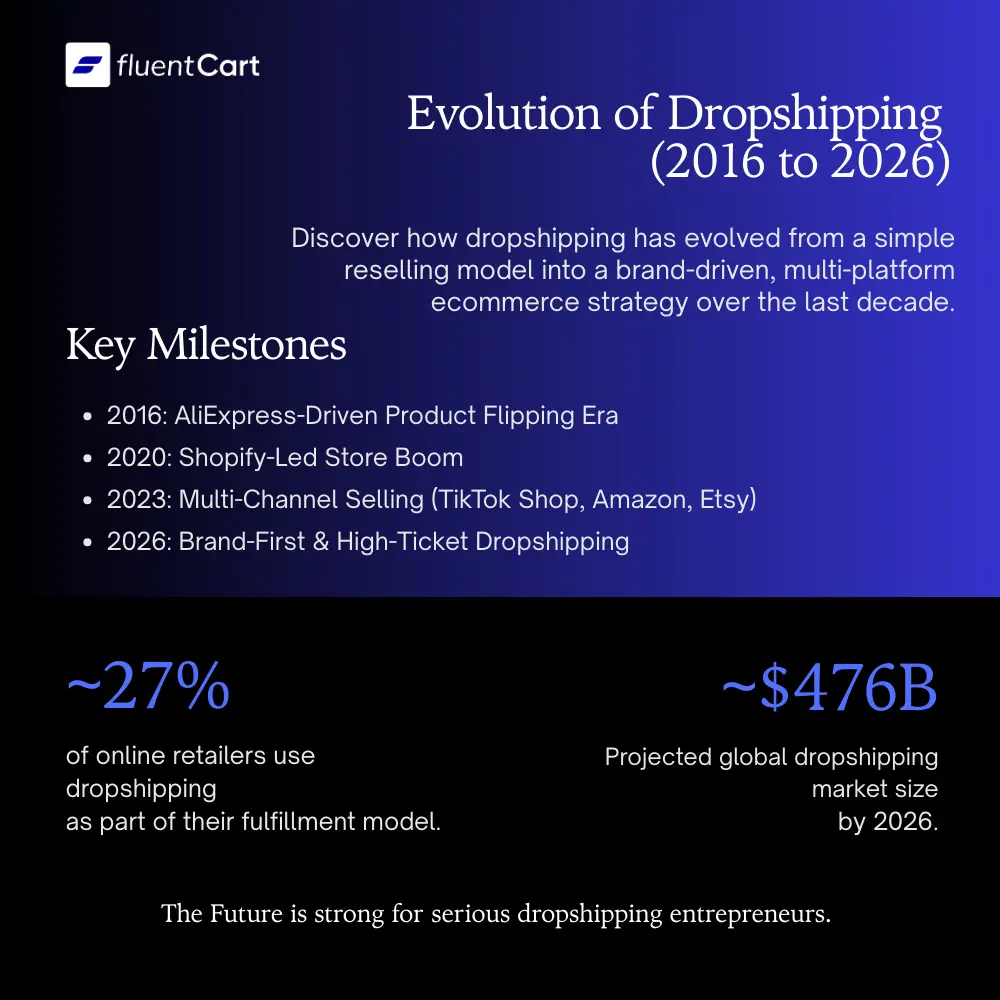
What’s Different Now vs 2018-2022
- Brand-first replaced one-product stores: The days of slapping together a generic Shopify store around a single viral product are over. Customers want cohesive brands with clear identities. They research. They read reviews. They compare.
- Faster shipping became non-negotiable: “In a 2025 survey of 3,161 store owners, 64% cited shipping delays as their biggest pain point” [3]. Customers won’t wait 4-6 weeks for products from overseas. Successful stores use regional warehouses and domestic suppliers.
- AI tools changed the game: Automation platforms now handle customer service, ad optimization, and inventory tracking. The barrier to entry dropped. Competition increased.
- Ad costs skyrocketed: Facebook CPM averages around $8.77 in 2026 [4], up from $4-5 just a few years ago. TikTok’s CPM ranges from $5 to $12 [5]. Getting attention costs more. Making a profit requires higher margins.
Why People Still Search This Question
People see the market size growing. They hear about others making money. They want to know if the opportunity still exists.
It does. But it’s not the same opportunity it was five years ago. The market matured. The playbook changed. The winners adapted.
Is Dropshipping Worth It in 2026?
Let’s cut through the noise. Dropshipping in 2026 is a viable business model. It’s not easy money.
The Quick Verdict
Worth it if:
- You can create content or run paid ads
- You’re willing to learn continuously
- You have 6-12 months to build before expecting full-time income
- You can invest $1,000-3,000 to start properly
- You enjoy problem-solving and iteration
Not worth it if:
- You want passive income
- You expect results in 30 days
- You refuse to spend money on ads or tools
- You’re looking for guaranteed returns
- You can’t handle customer complaints professionally
Who It’s Good For
Dropshipping rewards specific skills. If you have experience in digital marketing, content creation, or sales, you start ahead. The business is fundamentally about acquiring customers profitably and delivering value.
People who succeed typically share these traits:
- Comfort with testing and failure
- Data-driven decision making
- Customer service orientation
- Patience with slow starts
- Marketing creativity
Who It’s Not Good For
Anyone chasing quick money will lose money. The barrier to entry is low. That attracts competition. Winning requires differentiation. Differentiation requires effort.
If you can’t write product descriptions, create ads, or respond to customer emails professionally, you’ll struggle. These aren’t optional skills. They’re the job.
Dropshipping Trends in 2026
The model evolved. These six trends define what works now.
Trend 1: Shift From Low-Ticket to High-Ticket Dropshipping
Selling $10 products with $2 margins made sense when ads were cheap. Now, with acquisition costs rising, the math breaks down.
“Net profit margins average near 10%, with only the best brands breaking above 20%” [6]. Selling a $200 product with a $60 margin is more sustainable than selling a $15 product with a $3 margin.
High-ticket dropshipping focuses on furniture, electronics, fitness equipment, and home improvement items. The sales cycle is longer. The profit per sale makes it worthwhile.
Trend 2: Brand-Building Over Generic Reselling
Generic stores die fast. Branded stores build equity. Your store needs a clear identity. What problem do you solve? Who are you for? Why should someone trust you over Amazon?
The successful 2026 dropshipper curates products around a theme. They create original content, build email lists, and generate repeat customers.
Trend 3: Local & Private Suppliers Replacing AliExpress-Only Stores
“84% of ecommerce entrepreneurs say finding reliable suppliers is their biggest challenge” [2].
Relying solely on AliExpress creates problems. Long shipping times. Inconsistent quality. Poor communication.
Winners diversify. They use Spocket for US/EU suppliers, work with private suppliers on Alibaba, and negotiate better terms as they scale.
Trend 4: AI-Powered Tools for Ads, Support, and Product Research
Automation is no longer optional. It’s how you compete.
AI tools now write ad copy, respond to common customer questions, and analyze which products to test. They track profit in real-time. They identify unprofitable products before you waste thousands.
The technology levels the playing field. A solo operator with good tools can compete with teams.
Trend 5: Multi-Channel Selling
Relying on one traffic source is risky. Platform policies change. Ad accounts get banned. Algorithms shift.
Smart operators build presence across channels. They sell on TikTok Shop for viral reach, list on Amazon for search traffic, and maintain their Shopify store for brand control. They use Etsy for niche products.
Each channel requires different skills. The diversification reduces risk.
Trend 6: Faster Fulfillment & Regional Warehouses
Customer expectations changed. “27% of ecommerce businesses use dropshipping as their primary fulfillment model” [3], but those who succeed prioritize fast shipping.
Services now offer warehousing in the US, UK, and EU. Your supplier ships products in bulk to these warehouses. Orders ship domestically. Delivery takes 2-5 days instead of 2-5 weeks.
The model is still dropshipping. The customer experience is better. That matters.
Dropshipping Profitability
Let’s talk money. Real numbers. Not YouTube hype.
Average Margin Ranges
Your profit margins depend on your niche and strategy.
Low-ticket products (under $30): 5-15% net margins
- Example: $20 product, $17 cost, $3 gross profit before ads and fees
- After $8 in ad spend, you’re negative or breakeven
Branded niche products ($30-100): 15-35% net margins
- Example: $60 product, $30 cost, $30 gross profit
- After $15 in ads, $15 profit per sale
High-ticket products ($200+): 20-45% net margins
- Example: $300 product, $150 cost, $150 gross profit
- After $50 in ads, $100 profit per sale
Most dropshippers operate with a net profit margin of 15% to 20%, after accounting for product costs, shipping, advertising, and platform fees [3].
Cost Breakdown: What Actually Eats Your Profit
Understanding where money goes is critical. Here’s the reality:
Product cost: 30-50% of selling price (for decent margins)
Advertising: 20-40% of revenue when scaling
Platform fees: 2-3% (Shopify, payment processors)
Apps and tools: $50-200/month
Refunds and chargebacks: 2-5% of revenue
Miscellaneous: 3-5% (domain, email service, design work)
Do the math. On a $50 sale:
- Product cost: $25
- Ad spend: $15
- Fees: $2.50
- Tools (allocated): $1
- Refund reserve: $1.50
- Net profit: $5 (10% margin)
You need 200 sales at that margin to make $1,000. That requires spending $3,000 on ads. The business is simple math. Small margins require volume.
Beginner vs Experienced Seller Earning Scenarios
Months 1-3 (Testing Phase):
- Revenue: $500-2,000
- Ad spend: $1,000-2,500
- Net result: -$500 to -$1,500 (losing money while learning)
- This is normal. You’re buying data.
Months 6-12 (Optimization Phase):
- Revenue: $5,000-15,000
- Ad spend: $2,000-6,000
- Net profit: $500-2,500/month
- You’ve found products that work. You’re refining.
12+ months (Scaling Phase):
- Revenue: $20,000-100,000+
- Ad spend: $8,000-40,000+
- Net profit: $3,000-20,000+/month
- You have systems. You’re hiring help. You’re growing.
Beginners earn between $0 and $5,000 per month on average, while seasoned dropshippers make between $10,000 and $50,000 a month [7].
Why Most Beginners Fail Financially
80%-90% of new dropshippers fail in the first year [8]. The reasons are predictable:
- Undercapitalization: Starting with $200 and expecting profit
- Impatience: Quitting after two weeks of testing
- Poor product selection: Selling what everyone else sells
- No marketing skills: Expecting organic sales
- Ignoring numbers: Not tracking profit per product
The business requires investment. Time and money. People who fail usually quit too soon or never learn the fundamentals.
The Advantages of Dropshipping
Let’s be clear about what makes this model attractive.
Low Barrier to Entry
You can start with $500-1,000. Compare that to traditional retail requiring $50,000+ for inventory.
You need:
- Domain: $15/year
- Shopify: $39/month
- Apps: $50/month
- Product samples: $100
- Initial ad testing: $500
That’s roughly $700 to launch. You won’t scale on that budget. You can start testing.
The low barrier means more competition. It also means you can test business ideas cheaply. Want to see if people buy eco-friendly phone cases? Test it for $500. Find out in two weeks.
No Inventory Risk
You never buy products before selling them. Your supplier handles storage. When a product stops selling, you remove it from your store. No dead stock. No warehouse costs.
Traditional retail lives in fear of unsold inventory. Dropshipping eliminates that risk. The tradeoff is lower margins and less control.
Flexibility and Location Independence
Run your business from anywhere with internet. Manage it part-time while employed. Scale it to full-time income.
The model suits digital nomads, parents, students, and anyone wanting location freedom. Your supplier ships. You manage marketing and customer service remotely.
Fast Product Testing
Test 20 products in a month. See what sells. Double down on winners. Cut losers immediately.
Traditional retail requires buying inventory before testing. Dropshipping lets you validate demand first. E-commerce retailers using dropshipping earn 50% more compared to retailers utilizing their online inventory [2], partly due to this testing advantage.
Launch a product Monday. Run ads Tuesday. Know by Friday if it has potential. That speed creates opportunity.
Biggest Challenges of Dropshipping in 2026
The model has real problems. Understand them before starting.
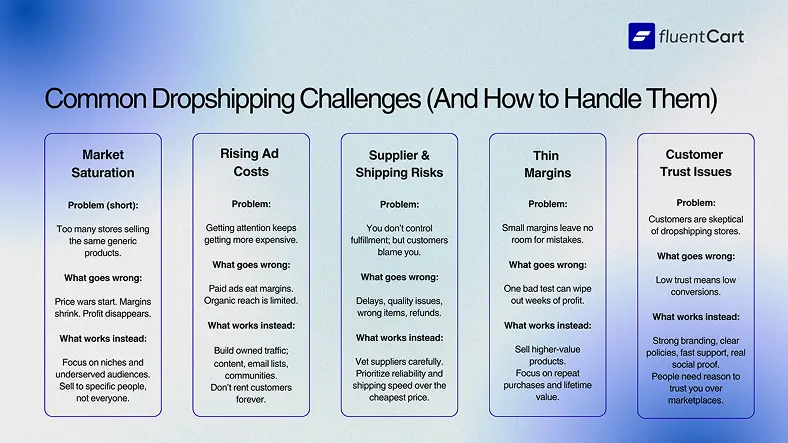
Market Saturation
27% of businesses have adopted dropshipping as their primary business model [2]. That’s millions of stores competing for attention.
Generic products face brutal price wars. Someone will always undercut you by $1. Race to the bottom kills profit.
Why niche selection matters: Find underserved audiences. Sell matcha whisks to tea enthusiasts, not phone cases to everyone. Smaller markets have less competition and higher customer value.
Rising Ad Costs
Facebook CPM averages $8.77 [9] across industries. TikTok’s ad rates are growing at 12.28% year-over-year [10].
Getting attention costs more every month. Organic reach on social platforms is near zero. You must pay to play.
Why organic traffic matters now: Building a TikTok following, YouTube channel, or email list creates free traffic. It takes time. It’s worth it. Relying only on paid ads means you’re renting customers, not building an asset.
Supplier and Shipping Risks
You don’t control the product. The supplier does. When they mess up, your customer blames you.
Common problems:
- Products out of stock after you made the sale
- Quality inconsistent between batches
- Shipping takes longer than promised
- Wrong items shipped
- Damaged products in transit
Each problem becomes a refund, angry review, or chargeback. 84% of dropshippers say finding good suppliers is their biggest challenge [2]. They’re not exaggerating.
Thin Margins
Low margins mean mistakes are expensive. One failed product test can wipe out profit from 10 successful sales.
Why “cheap product flipping” is dying: When your margin is $3 per sale and ads cost $8 per conversion, you lose $5 per sale. You can’t make it up with volume.
The importance of upsells and LTV: Successful stores sell multiple products. They get repeat purchases. They calculate customer lifetime value, not just first purchase profit. This changes the math.
Customer Trust Issues
Dropshipping has a reputation problem. Customers know the model exists. They’ve been burned by slow shipping or poor quality.
Building trust requires:
- Professional branding
- Clear shipping expectations
- Responsive support
- Generous return policies
- Social proof (reviews, testimonials)
Many customers prefer buying from Amazon. Your job is showing why your store is better. Usually, that means specialization or curation they can’t find elsewhere.
6 Things to Know Before Starting a Dropshipping Business in 2026
Reality check time. Here’s what nobody tells you in the sales pitch.
1. Low Costs Don’t Mean Easy Profits
Yes, you can start for under $1,000. No, that doesn’t mean you’ll make money quickly.
The YouTube gurus show revenue screenshots. They don’t show ad spend. A store doing $50,000 in monthly revenue might profit $3,000 after all costs. That’s 6% margins. It’s real money. It’s not the $50,000 the headline suggests.
Shopify puts a realistic lean startup budget at around $200-600 per month [6] for platform costs. Add product testing, and you need $1,000-2,000 monthly to make progress.
Hidden costs beginners miss:
- Testing products that don’t sell ($500-1,000/month)
- Refunds and chargebacks (2-5% of revenue)
- App subscriptions that add up ($100-300/month)
- Product samples to verify quality ($50-200)
- Professional photography or content creation ($200-500)
Budget for learning, for mistakes, for time before profit.
2. Competition Is Brutal (But Beat-able)
Thousands of stores launch monthly. Most fail. The ones that succeed differentiate.
Choosing a Less Crowded Niche
Avoid phones, watches, jewelry, and anything promoted heavily on Facebook. These niches are saturated.
Look for:
- Hobbyist communities (birdwatching, aquariums, woodworking)
- Emerging trends (new fitness movements, diet changes)
- Underserved demographics (products for seniors, left-handed people)
- Replacement parts and accessories (not the main product)
Building a Real Brand
Generic stores die. Brands survive.
Your brand needs:
- Clear value proposition (Why you? Why now?)
- Consistent visual identity (colors, fonts, style)
- Original content (blog posts, videos, guides)
- Customer community (email list, social following)
Think of yourself as a publisher who happens to sell products, not a product seller who happens to have a website.
Prioritizing Customer Service
Fast responses win. 52% of dropshippers report low margins as a major hurdle [3]. When margins are thin, customer service becomes your competitive edge.
Answer emails within 2 hours during business hours. Solve problems without arguing. Offer refunds generously. Happy customers leave reviews. Reviews build trust. Trust lowers acquisition costs.
3. Dropshipping Takes Time
The timeline for success is longer than advertised.
Realistic expectations:
- Weeks 1-4: Store setup, product research, first tests (probably no profit)
- Months 2-3: Testing products and ads (likely still losing money overall)
- Months 4-6: Finding winning products, optimizing (breakeven to small profit)
- Months 7-12: Scaling winners, building systems (real profit starts)
- 12+ months: Established business with multiple products (sustainable income)
Some people get lucky fast. Most take 6-12 months to reach $3,000-5,000 monthly profit. Plan accordingly.
4. Finding a Reliable Supplier Is Everything
Your business lives or dies on supplier quality. Spend serious time here.
What to Check: Shipping Estimates
Ask for exact shipping times to major markets. Test them yourself. Order samples. Track delivery. If a supplier promises 7-10 days and delivers in 14-18, that’s your customer experience.
64% of store owners cite shipping delays as their biggest pain point [3]. This matters more than product cost.
Reviews and Ratings
Check supplier reviews on their platform. Look for:
- Consistent 4.5+ star ratings
- Recent positive reviews (not just old ones)
- Responses to negative feedback
- Similar product types to yours
Avoid suppliers with complaints about shipping delays or quality issues. Those problems become your problems.
7+ Legit Dropshipping Suppliers You Can Trust
Customer Support
Email potential suppliers before committing. See how fast they respond. Ask detailed questions. Poor communication before you’re a customer means worse communication after.
Good suppliers provide:
- Order tracking numbers within 24 hours
- Clear communication about stock levels
- Photos of products before shipping (for high-ticket items)
- Resolution of problems without argument
Recommended Supplier Platforms
- Spocket: US/EU suppliers, faster shipping, higher costs
- CJ Dropshipping: Good balance of quality and price, warehouses worldwide
- Zendrop: Automated fulfillment, US warehouses available
- AliExpress: Cheap, slow, inconsistent (use with caution)
- Alibaba: Private suppliers, requires vetting, better for scaling
Start with established platforms. Migrate to private suppliers as you scale.
5. You’re 100% Responsible for Customer Support
The supplier ships the product. You handle everything customer-facing.
Expect to spend 1-3 hours daily on:
- Responding to pre-purchase questions
- Handling tracking inquiries
- Processing refund requests
- Dealing with complaints
- Managing chargebacks
Your supplier won’t talk to your customers. You’re the brand. Every interaction matters.
Common scenarios:
- “Where’s my order?” (50% of all messages)
- “This doesn’t fit/work/match the photo” (20%)
- “I want a refund” (15%)
- “Is this the right product for…?” (10%)
- Everything else (5%)
Have templates ready. Respond fast. Solve problems quickly. Your 5-star rating depends on it.
6. Dropshipping Is Legal (But Regulated)
You’re running a business. That means legal requirements.
Business Structure
Register your business. Most start as sole proprietorships or LLCs. The LLC protects personal assets if someone sues.
Costs: $50-500 depending on your state.
Taxes
You owe taxes on profit. Track everything. Use accounting software like QuickBooks or Wave. You might need to collect sales tax in states where you have economic nexus. Shopify can automate this, but you’re responsible for remitting it.
Contracts and Supplier Agreements
Have written agreements with suppliers covering:
- Pricing and payment terms
- Shipping commitments
- Return and refund policies
- Product quality standards
Verbal agreements fail when problems arise.
Ecommerce Policies
Your store needs:
- Privacy policy
- Terms of service
- Refund policy
- Shipping policy
Shopify has templates. Don’t skip this. Chargebacks get decided based on your policies.
Business Insurance
Consider general liability insurance. Costs $300-500 annually. Protects you if a product injures someone. Most dropshippers skip this. That’s risky. One lawsuit can destroy your business.
Is Dropshipping Worth It for Beginners in 2026?
The honest answer depends on your definition of “worth it.”
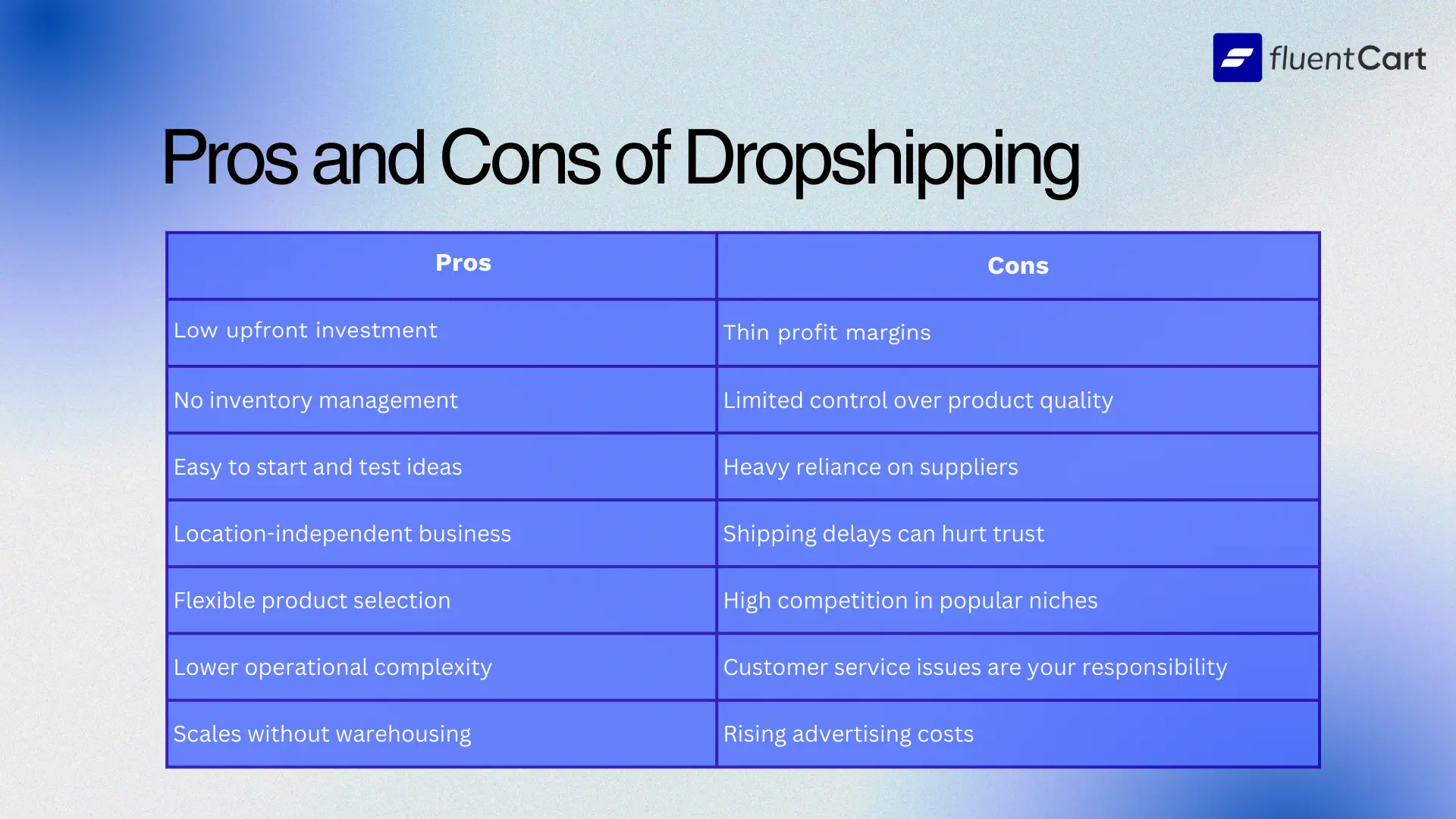
Pros for Beginners
- Learn ecommerce without a massive investment
- Test business ideas quickly
- Develop valuable marketing skills
- Build something part-time while employed
- No technical skills required to start
Cons for Beginners
- Only 10% of dropshipping businesses turn a profit in year one [2]
- Steep learning curve for paid advertising
- Easy to lose money on bad products or ads
- Customer service can be overwhelming
- Requires patience most beginners lack
Skills Beginners Must Learn
- Marketing: Running Facebook/TikTok ads, understanding metrics (CTR, CPM, ROAS), testing creatives
- Copywriting: Product descriptions, ad copy, email sequences that convert browsers into buyers
- Customer support: Handling complaints, processing refunds, and de-escalating angry customers professionally
These aren’t optional. You’ll learn them by doing or by failing.
Minimum Budget Recommendation
Start with $1,500-2,500 total:
- $500 for store setup, apps, and samples
- $1,000-2,000 for initial ad testing
More is better. Less is possible but slower.
Time Commitment Reality Check
Plan for 10-20 hours weekly if running this part-time. More if you want faster results.
Tasks include:
- Product research (2-3 hours/week)
- Creating/testing ads (3-5 hours/week)
- Customer service (2-4 hours/week)
- Analyzing data and optimizing (2-3 hours/week)
- Learning and staying current (1-2 hours/week)
This isn’t passive income. It’s a part-time to full-time business.
Is Amazon Dropshipping Still Worth It in 2026?
Amazon dropshipping exists in a gray area. The platform allows it under specific conditions.
What Still Works
Dropshipping on Amazon works when:
- You’re the seller of record with supplier invoices
- Your packaging doesn’t identify the supplier
- You handle all customer service
- You comply with Amazon’s strict policies
Many successful sellers use hybrid models. They test products on Shopify, then stock winners via Amazon FBA for better margins and Prime eligibility.
What’s Risky
Amazon’s policies change frequently. Accounts get suspended for:
- Extended shipping times
- Too many customer complaints
- Policy violations (even unintentional ones)
- High refund rates
37% of dropshippers struggle with customer service exposure [3]. Amazon penalizes poor service harshly.
Who Should Try It
Sellers with experience managing Amazon accounts and understanding their policies. Not beginners.
The platform offers traffic. You trade control and margins for that traffic. If you can maintain high ratings and fast shipping, it can work.
Who Shouldn’t Try It
Anyone new to ecommerce. Amazon is unforgiving. One mistake can ban your account. Start with Shopify or TikTok Shop where you control more variables.
Skepticism vs Success Stories
Reddit is skeptical by nature. Claims of “$50K in month 1” get downvoted hard. People want proof.
The success stories that gain traction are measured:
- “Made $3,000 profit in month 8 after losing $2,000 in testing”
- “Took 14 months to replace my job income”
- “Finally profitable after learning paid ads the hard way”
These realistic timelines resonate more than hype.
Importance of Mentorship and Persistence
People who succeed credit consistency and learning from others. They mention:
- Following successful stores and studying their approach
- Joining paid communities for feedback and support
- Testing continuously instead of giving up after failures
The pattern is clear: success comes from treating dropshipping as a skill to develop, not a lottery ticket to buy.
Reality vs Hype Summary
Reddit’s message: dropshipping works, but not the way it’s sold.
The YouTube course promising passive income is nonsense. The business requiring 6-12 months of learning, testing, and optimizing is real. Most people quit too soon. Those who persist intelligently can build sustainable income.
The Future of Dropshipping
The model isn’t dying. It’s maturing. Here’s where smart money is heading.
What Will Likely Grow
- Premium and specialized products: Generic commodity dropshipping shrinks. Curated, specialized product lines for specific audiences expand.
- Hybrid models: More sellers combine dropshipping with private label or held inventory. Test products via dropshipping. Stock winners for better margins and control.
- Multi-platform presence: Single-channel dependence decreases. Successful businesses sell across their own store, Amazon, TikTok Shop, and emerging platforms.
- Automation and AI: Tools continue improving. AI writes better ad copy. Automation handles more customer service. Technology lowers operational burden.
- Subscription and repeat purchase products: One-time sales become harder to profit from. Consumables, refills, and subscription models create predictable revenue.
What Will Die
- Generic one-product stores: The simple formula is finished. No one wants another random Shopify store selling wireless earbuds.
- Long shipping times: Customer tolerance for 3-4 week delivery is gone. Suppliers who can’t ship in under 10 days lose to those who can.
- Pure paid advertising plays: Relying only on paid ads without organic traffic or brand equity becomes unsustainable as costs rise.
- Low-quality products: Customers have more options and information. Poor quality gets exposed quickly in reviews.
Where Smart Money Is Going
Experienced sellers are moving toward:
- Building email lists and SMS subscribers (owned traffic)
- Creating content that ranks in search or goes viral organically
- Developing unique product bundles competitors can’t easily copy
- Negotiating exclusive supplier arrangements
- Investing in brand building and customer retention
The focus shifts from quick wins to sustainable businesses.
Skills That Will Matter Most
- Content creation: Video, images, writing. You need to create attention-grabbing content or hire people who can.
- Data analysis: Understanding metrics, identifying trends, making data-driven decisions separates winners from losers.
- Community building: Engaging audiences, creating followers, building trust at scale.
- Customer experience design: Every touchpoint matters. Speed, quality, communication all contribute to whether customers buy again and refer others.
- Platform adaptation: Learning new platforms early (like TikTok Shop) before they get saturated creates first-mover advantages.
The future belongs to dropshippers who think like real brand owners, not arbitrage players.
Final Verdict: Is Dropshipping Worth It in 2026?
Dropshipping is worth it in 2026 if you approach it as a real business requiring skill development, financial investment, and patience. It’s not worth it if you’re chasing passive income or expecting quick returns without effort.
The data supports cautious optimism. The market is growing. Profit margins exist. Success stories are real. But so is the 80-90% failure rate.
Sources:
[1]Global Market Insights – Dropshipping Market Size
[2]Zik Analytics – Dropshipping Statistics 2026
[3]Sellers Commerce – Dropshipping Statistics
[4] Neal Schaffer – Facebook Ads Cost 2026
[5]Quimby Digital – TikTok Ad Costs 2025
[6]Barchart – TrueProfit Dropshipping Profitability Outlook
[7]AutoDS – Dropshipping Statistics
[8]Market.us News – Dropshipping Statistics
Once In a Lifetime Offer

Deputy Marketing Lead, published literary author, and musician. I thrive on marketing for tech companies while composing music, collecting books of lasting depth, exploring cinema with a discerning eye, and studying the arts and history.

Subscribe now
Related Articles and Topics
-

Pure Play eCommerce: What It Is and How It Works in 2026
Pure play ecommerce means selling online only. Learn how it works, the real pros and cons, and whether…
-
Custom CSS For Online Product Card Design in FluentCart
We have built styles with Custom CSS for your online product card design in FluentCart to give your…
-
What’s New in WordPress 6.9: Walkthrough
The year is almost coming to a close, and we have brand-new WordPress release news. WordPress 6.9 is…




Leave a Reply