
What Is Petty Cash? Examples, Uses, and Smarter Alternatives
Running a business means handling hundreds of financial decisions every week. Some of those are big calls, like payroll or vendor contracts. But some are just small, unavoidable, everyday costs that nobody budgets a formal process for. That is exactly where petty cash comes in. Understanding it properly, especially if you run an eCommerce or physical retail business, can save you time, reduce friction, and keep your books clean.
In this blog, we will cover what petty cash is, how it works in real business settings, the accounting behind it, how it differs from cash on hand, what risks come with it, and what modern alternatives look like for online businesses today.
TL;DR
- Petty cash is a small physical fund businesses keep for minor, immediate expenses
- It is managed by a designated custodian and recorded as a current asset on the balance sheet
- The imprest system keeps the fund at a fixed balance through documented replenishment
- Every transaction requires a receipt or voucher for audit compliance
- Retail and eCommerce businesses use it for change-making, courier fees, and quick supply runs
- Digital alternatives like prepaid cards and expense apps are growing, but petty cash still has a valid place
What Is Petty Cash?
Petty cash is a small, fixed amount of physical money a business keeps on hand to pay for minor day-to-day expenses that do not warrant a formal payment process. Think: a last-minute pack of printer paper, a tip for a delivery, stamps for an urgent package, or coffee for an unexpected client visit.
The word “petty” comes from the French word petit, meaning small or little. So petty cash, at its core, is just a small sum set aside for small needs. One of the earliest recorded uses of the phrase dates back to 1678 in Benjamin Billingsley’s educational work on housekeeping.
Most businesses keep their petty cash fund somewhere between $100 and $500, stored in a locked box or drawer. A designated custodian manages every dollar in and out, with receipts and vouchers attached to every transaction.
On the balance sheet, petty cash is classified as a current asset under the “Cash and cash equivalents” section. It is not an expense itself. The purchases made from it become expenses when they are recorded during fund replenishment.
How Does Petty Cash Work? The Imprest System Explained
The most common way to manage petty cash is through the imprest system. Here is how it works in plain terms.
You start by setting a fixed amount for the fund, say $200. That $200 gets deposited into a dedicated cash box. Every time money is taken out, a receipt or voucher goes in to replace it. So at any given moment, the combination of remaining cash plus the collected receipts must always equal $200.
When the cash runs low, your custodian brings all the vouchers to the bookkeeper. A check or transfer is issued to bring the balance back to $200. Those vouchers are then recorded in the general ledger as debits to the relevant expense accounts and a credit to the main cash account.
Journal Entries for Petty Cash
Setting up the fund: Debit Petty Cash, Credit Bank Account.
Replenishing the fund: Debit Office Expenses (or relevant categories), Credit Cash.
If there is a shortage: Record a debit to the over/short account. If there is an overage: Record a credit.
This system works because it forces accountability at every step. The fund does not grow or shrink randomly. Every gap has to be explained with documentation.
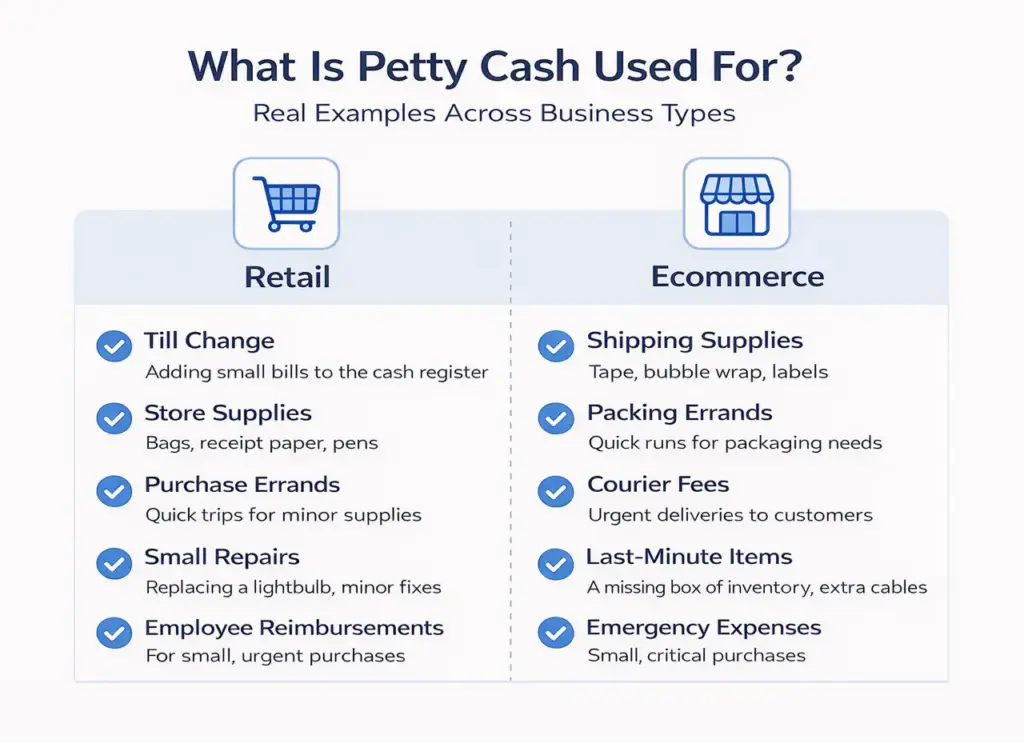
What Is Petty Cash Used For? Real Examples Across Business Types
Petty cash is most useful when the purchase is too small, too sudden, or too cash-only for formal payment channels.
Common petty cash expenses include:
- Office supplies: Emergency printer ink, a box of pens, sticky notes, batteries
- Postage and courier fees: Urgent mailings, last-minute shipping labels
- Refreshments: Coffee, snacks, or a team lunch for a small group
- Parking and tolls: Driver fees during a delivery or errand run
- Small repairs: A replacement screw, a minor hardware fix
- Employee reimbursements: When a staff member buys something small on the go
For eCommerce and Retail Businesses
If you run an online store or a physical retail location, petty cash shows up in slightly different ways. A retail cashier may use it to top up the till when small bills run short. A small eCommerce team might use it for a quick trip to grab packaging tape or bubble wrap before a large shipment goes out.
If your business involves physical goods, you likely have more operational micro-expenses than a purely digital service company. Managing those efficiently, even through something as simple as a well-kept petty cash log, contributes directly to cleaner books and smoother day-to-day operations. This connects to a broader system of eCommerce accounting, which you can read about in FluentCart’s guide on eCommerce accounting.
Petty Cash vs. Cash on Hand: What Is the Difference?
These two terms sound similar and do overlap, but they mean different things.
Petty cash is a specific, intentional fund set aside for small internal business expenses:
- Lives in a locked box.
- Has a designated custodian.
- Follows a structured replenishment cycle.
Cash on hand is a broader accounting term. It refers to any accessible funds your business has, including petty cash, register float, undeposited customer payments, and highly liquid assets like money market accounts.
In short, all petty cash counts as cash on hand, but not all cash on hand is petty cash. Petty cash is the specifically designated subset meant for minor operational expenses, while cash on hand describes overall liquidity.
This distinction matters when you are building a proper chart of accounts or reconciling your balance sheet. Mixing them up leads to messy records.
How to Set Up a Petty Cash Fund: Step by Step
Getting a petty cash system right from the start prevents most of the problems people run into later.
1. Decide on the fund size
Look at your typical monthly small expenses. For most small businesses, $100 to $200 is a reasonable starting point. If you replenish it more than twice a month, increase the amount.
2. Appoint a custodian
This is the single most important structural decision. One person should manage all disbursements, receipts, and replenishment requests. Avoid multiple people having open access simultaneously. A backup custodian is fine for coverage, but keep the primary role clearly assigned.
3. Create a written petty cash policy
Define what the fund can and cannot be used for. Set a per-transaction maximum (usually between $25 and $50). Make it clear that personal purchases are never acceptable.
4. Build your petty cash log
Every transaction needs to be recorded before money changes hands. Date, amount, purpose, recipient, and running balance at minimum. A spreadsheet works fine. Physical ledgers work too. Pick a format and keep it consistent.
5. Establish your replenishment process
Decide when replenishment happens: monthly, when the balance drops below a set amount, or both. The custodian submits vouchers to the bookkeeper, who issues a check and records the journal entry.
Once In a Lifetime Offer
Petty Cash Accounting: Recording and Reconciling
Petty cash accounting is less about complexity and more about consistency. Recording and reconciling it properly ensures that even the smallest expenses stay accurate and traceable.
Recording Transactions
A common point of confusion: petty cash transactions are not recorded one by one in real time in your general ledger. You record them in the log, and you record them in the ledger when the fund is replenished. The journal entry goes in at the replenishment stage, not each time $5 leaves the box.
Each disbursement does need a voucher or receipt filed immediately, even if the ledger entry waits until replenishment.
Reconciling the Petty Cash Fund
Reconciliation is how you verify that your records match reality. Here is the process:
- Count the remaining physical cash in the box
- Add up all receipts and vouchers collected since the last replenishment
- Confirm that cash remaining plus receipts equals the original fund amount
- Investigate any discrepancy before requesting replenishment
- Prepare a summary by expense category for your accountant or bookkeeper
- File all documentation and request a replenishment check
Small overages or shortages under $10 are usually written off to an “over/short” account. Recurring discrepancies are a red flag that requires investigation or a policy change.
The IRS recommends keeping petty cash slips and attaching them to receipts for documentation. Store these records for at least three years.
Internal Controls for Petty Cash: Preventing Misuse
Petty cash is low-tech and tangible, which makes it unusually vulnerable. No system eliminates all risk, but these controls reduce it significantly.
- Segregation of duties: The person disbursing petty cash should not be the same person recording it in the ledger or approving replenishments
- Surprise audits: Periodic unannounced counts by someone outside the custodian role catch problems early
- Secure storage: A locked box inside a locked drawer or safe is the minimum standard
- Transaction caps: A per-transaction maximum keeps the fund from being used for anything substantial
- Receipts without exception: No receipt, no disbursement. This is the one rule that should never have exceptions
- Custodian handover documentation: Any time the custodian changes, do a witnessed count and get a signed transfer document
“Cash management requires structured controls and oversight to reduce risk.” — Based on principles discussed by Steven Bragg
Petty Cash Pros and Cons
Petty cash has earned its place in business operations for a reason, but it also comes with real limitations.
Advantages
- Immediate access with no processing delay or fees
- Works with cash-only vendors and situations
- Eliminates the need for employees to pay out of pocket for small work expenses
- Simple enough for anyone on the team to understand
Disadvantages
- Vulnerable to theft, misuse, and undocumented withdrawals
- Requires manual tracking and regular reconciliation
- Lost receipts create reconciliation headaches
- Physical cash cannot be traced the way digital transactions can
- Adds administrative overhead, especially for small teams
According to Bluevine’s 2025 SMB survey, “nearly 4 in 10 small businesses (39%) cannot cover more than a month of operating expenses in a financial disruption.” That context matters here. Petty cash is a convenience fund, not a cash reserve strategy. Keeping it in proportion to your overall financial setup is important.
Is Petty Cash Still Relevant for eCommerce Businesses?
This is a fair question. If most of your transactions happen online and your team processes payments digitally, does a physical cash box still make sense? For many eCommerce businesses, the answer is yes, but in a more limited way.
Physical locations still need it. If you operate a warehouse, fulfillment space, or hybrid retail setup, petty cash covers on-the-spot purchases that cannot wait for a purchase order. If your business handles physical inventory, packaging, or local courier runs, the same applies.
Remote-first or fully digital teams, on the other hand, may have very little use for traditional petty cash. For them, prepaid business cards or expense apps tend to work better. They serve the same convenience purpose while creating a digital paper trail automatically.
The decision is not petty cash versus digital tools. It is about understanding which expenses need instant access, and then choosing the system that makes that access accountable.
Understanding your cost of starting a business and your ongoing operational costs clearly helps you decide how much working capital to keep liquid, including whether a petty cash fund is worth maintaining.
Modern Alternatives to Petty Cash
Several tools now replicate the convenience of petty cash while adding the accountability that physical cash lacks.
- Prepaid business debit cards: Load a fixed amount, distribute to authorized employees, set per-category spending limits, and monitor in real time through an online portal. Every transaction is logged automatically. You can freeze it instantly if a card is lost or misused.
- Expense management apps: Tools that let employees photograph receipts at the moment of purchase, submit categorized expenses for approval, and sync directly with your accounting software. These significantly reduce reconciliation time and virtually eliminate the lost-receipt problem.
- Virtual cards: Some expense platforms generate single-use or department-specific virtual card numbers for online purchases, giving maximum control over who spends what.
None of these are mandatory replacement. Some businesses run both a small petty cash fund for truly cash-only situations and a prepaid card for everything else. The goal is clean records and fast access, through whatever combination fits your operation.
Wrapping Up
Petty cash is one of those foundational concepts that sounds simple but touches several real aspects of how a business manages its day-to-day finances. It is a current asset, not an expense. It runs on a system of receipts, vouchers, and periodic reconciliation. When managed properly, it saves time and keeps minor operational costs accounted for without bureaucratic overhead. When managed poorly, it becomes a slow drain that is hard to trace.
For
- eCommerce businesses, the relevance of petty cash depends heavily on whether your team handles physical operations.
- Hybrid or fully physical businesses, it remains a practical tool.
- Purely digital operations, a prepaid card approach may serve you better.
Either way, the underlying principle is the same: small expenses still need to be tracked. How you track them is just a matter of matching the tool to the situation.
Once In a Lifetime Offer
FAQs
Is petty cash taxable?
Petty cash itself is not taxable income. However, the expenses paid with it may be tax-deductible, and the IRS expects proper documentation (receipts and vouchers) for every transaction if you intend to claim deductions.
What happens if petty cash cannot be reconciled?
Document the discrepancy. Small shortfalls can be recorded as a loss in an over/short account. Recurring discrepancies warrant a policy review and possibly a conversation with the custodian about accountability procedures.
Can a sole proprietor or freelancer use petty cash?
Yes. Even a one-person business can benefit from a small designated cash fund for minor work expenses, especially to keep personal and business spending clearly separated.

Deputy Marketing Lead, published literary author, and musician. I thrive on marketing for tech companies while composing music, collecting books of lasting depth, exploring cinema with a discerning eye, and studying the arts and history.

Subscribe now
Related Articles and Topics
-

eCommerce Laws in 2026: The 8 Rules Regulators Are Fining Stores Over
The 8 ecommerce laws regulators fined stores over in 2025 and 2026.
-

What Is a Payment Gateway? A Guide for WordPress Store Owners
Confused about payment gateways? Here’s what they actually do, which ones fit WordPress, and how to pick the…
-

GiveWP Alternatives: What Actually Replaces It
GiveWP’s future is shaky. Here’s what real GiveWP alternatives do better in donation-taking operations, and where they still…




Add your first comment to this post