
Is eCommerce Profitable in 2026? Things You Need to Know
Starting an online store has never been easier. Payment gateways are plug-and-play, hosting is affordable, and global shipping is more accessible than ever. But “easy to start” and “easy to profit from” are two very different things, and a lot of new sellers learn that gap the hard way.
The question people are genuinely searching for today is not just whether eCommerce works, but whether is eCommerce profitable still? It is really worthy and accessible in 2026? Or whether the window has closed for newcomers.
In this blog, we will walk through the actual profit benchmarks, the business models that work right now, the niches worth targeting, and what separates stores that grow from stores that quietly bleed money.
TL;DR
- Global eCommerce sales are forecast to reach $6.88 trillion in 2026, representing 21.1% of all retail
- Healthy net profit margins range from 15% to 30% depending on your business model and niche
- Dropshipping offers lower margins (10–15%), while inventory-based stores can hit 25–40%
- The biggest profitability killers are ad spend, high returns, and platform fees
- Retention, niche focus, and owning your store are the three pillars of eCommerce profitability today
What Is eCommerce Profitability?
eCommerce profitability refers to the ability of an online store to generate consistent net income after accounting for all operating costs. These costs include product sourcing, platform fees, shipping, customer acquisition, returns, and marketing. A store can generate high revenue and still lose money if the cost structure is poorly managed.
Gross profit margin and net profit margin are the two core metrics. Gross margin measures how much you keep after the cost of goods sold. Net margin reflects what remains after every expense.
According to TrueProfit’s analysis of over 5,000 eCommerce stores, “a healthy net profit margin for most eCommerce businesses in 2026 falls between 15% and 30%”, while digital product sellers regularly outperform that range because there are no shipping costs and minimal fulfillment overhead. eCommerce business profitable operations in 2026 are built on precision, not volume alone.
The Market Opportunity Is Real and Still Growing
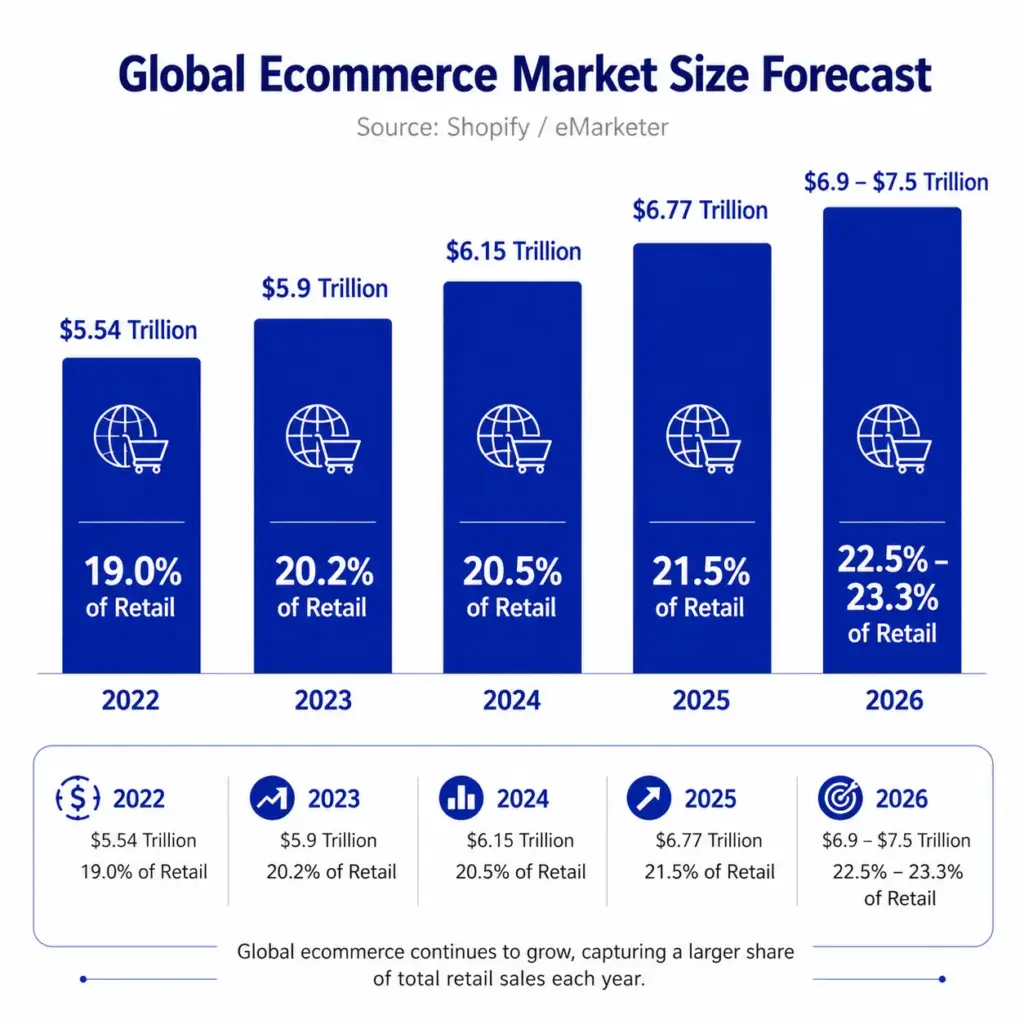
Global eCommerce is not slowing down. According to Shopify’s global eCommerce sales report, “total online retail sales are forecast to reach $6.88 trillion in 2026, representing 21.1% of all retail worldwide.”
That growth represents genuine opportunity for new sellers, not just legacy brands. What has changed is the competitive environment. The market has matured.
Consumers are smarter, ad costs are higher, and generic products with no brand identity struggle to convert. The brands pulling strong margins today are the ones that chose a specific audience, built a recognizable identity, and reduced their reliance on expensive paid acquisition. eCommerce growth does not guarantee individual store growth.
The opportunity is real, but capturing it requires strategy, not just a store account and a supplier.
eCommerce Business Models and Their Profit Margins
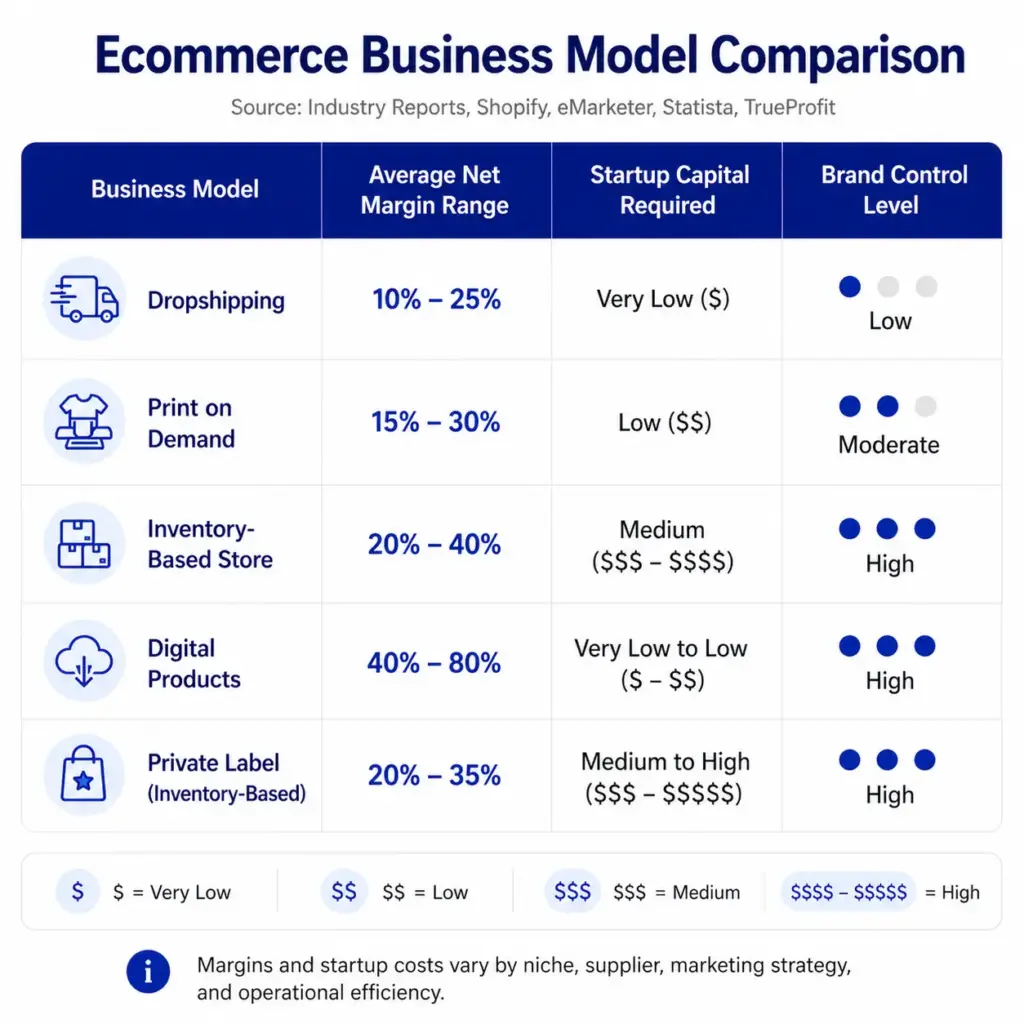
Not all eCommerce business models deliver the same returns. Understanding which model fits your goals, capital, and risk tolerance is the first decision that shapes everything else.
Dropshipping
Dropshipping remains the most popular entry point for new sellers. You list products, a supplier fulfills orders, and you pocket the difference. The appeal is obvious: no inventory risk, low startup cost, and easy-to-test products. The challenge is that rising ad costs have compressed margins significantly in recent years.
What works in 2026 is branded dropshipping, where sellers control the packaging and customer experience rather than acting purely as a middleman. If you are exploring this model further, what dropshipping covers the fundamentals and what to watch for before committing.
Private Label and Inventory-Based Stores
Owning your product line gives you pricing control, brand equity, and significantly higher margins. Inventory-based stores with third-party logistics support typically see stronger net margins than dropshipping because pricing power and operational control go hand in hand. The tradeoff is upfront capital.
A first batch of goods might require $5,000 to $20,000 depending on the category. But the long-term return on that investment, especially if you are building toward a sellable business, is substantially higher than pure dropshipping.
Brand aggregators in 2026 are paying three to five times annual profit for independent stores with strong brand identity and clean financials. Marketplace-only accounts rarely qualify.
Digital Products
Selling digital goods, whether templates, courses, plugins, or downloadable assets, is the highest-margin eCommerce model available. Gross margins often reach 80% to 95% because there is no physical inventory, no shipping cost, and fulfillment is instant. The barrier is building an audience and establishing authority.
But once that foundation exists, a single digital product can generate revenue indefinitely with minimal ongoing cost. FluentCart is purpose-built for this use case, with a digital products infrastructure that handles licensing, delivery, and customer management cleanly.
Print on Demand
Print on demand sits between dropshipping and private label in terms of margin and complexity. It works well for creators who already have an audience and want to monetize without managing inventory. For cold-start sellers relying on paid ads, margins can be too thin to sustain growth at scale.
What Actually Drives eCommerce Profitability in 2026
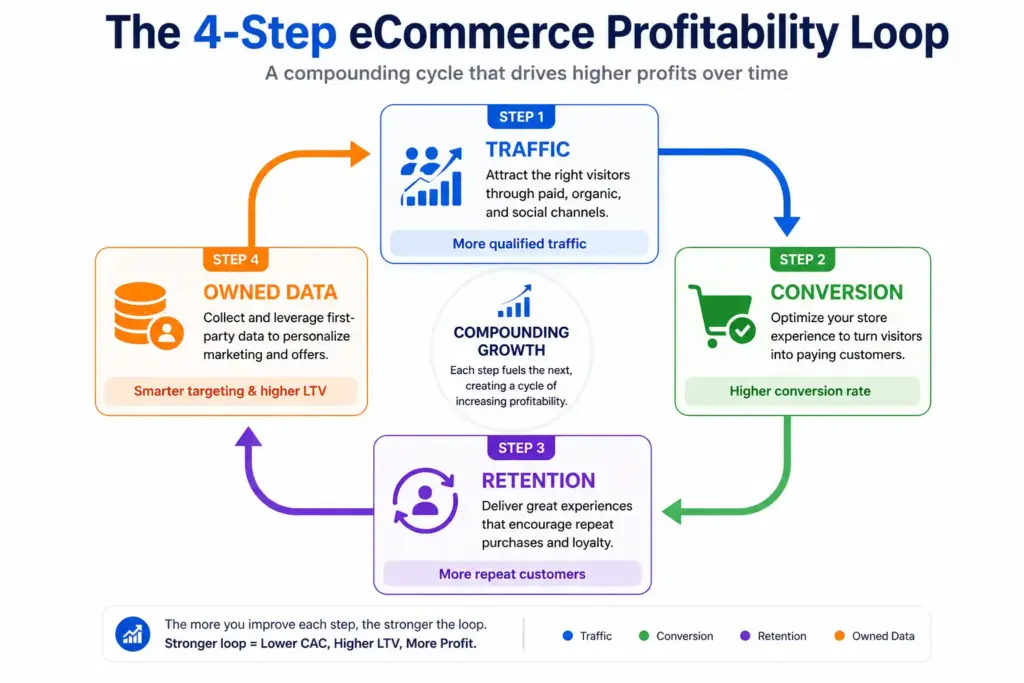
1. Repeat Purchases Over New Acquisitions
The single most reliable path to eCommerce profitability is reducing your dependence on first-sale revenue. When your profit depends entirely on converting cold traffic, ad cost increases immediately threaten your margins.
Brands that build repeat purchase cycles through subscriptions, refill models, and strong post-purchase email sequences are the ones with stable cash flow.
Customer lifetime value is the metric that separates growing stores from stagnant ones. A customer who buys once at a $50 acquisition cost and never returns is a liability. A customer who buys four times a year is an asset. Building for retention from day one changes your entire unit economics picture.
2. Niche Specificity Over Broad Appeal
Trying to sell to everyone means you end up converting no one efficiently. The highest-performing eCommerce stores in 2026 serve a specific audience with a specific problem. That focus allows for more targeted marketing, stronger product-market fit, and lower customer acquisition cost.
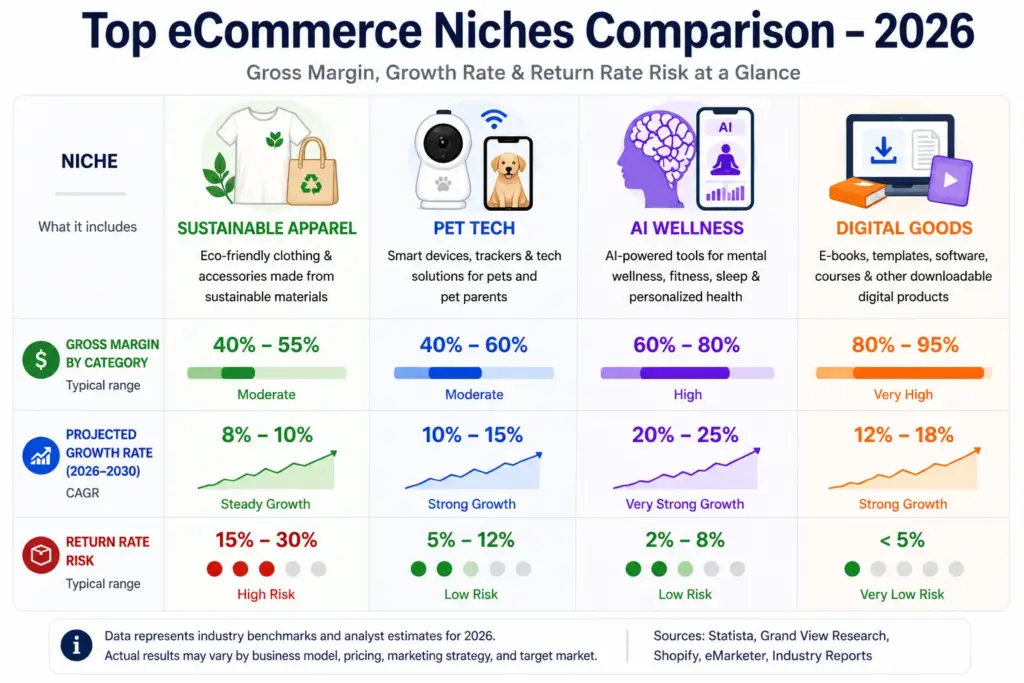
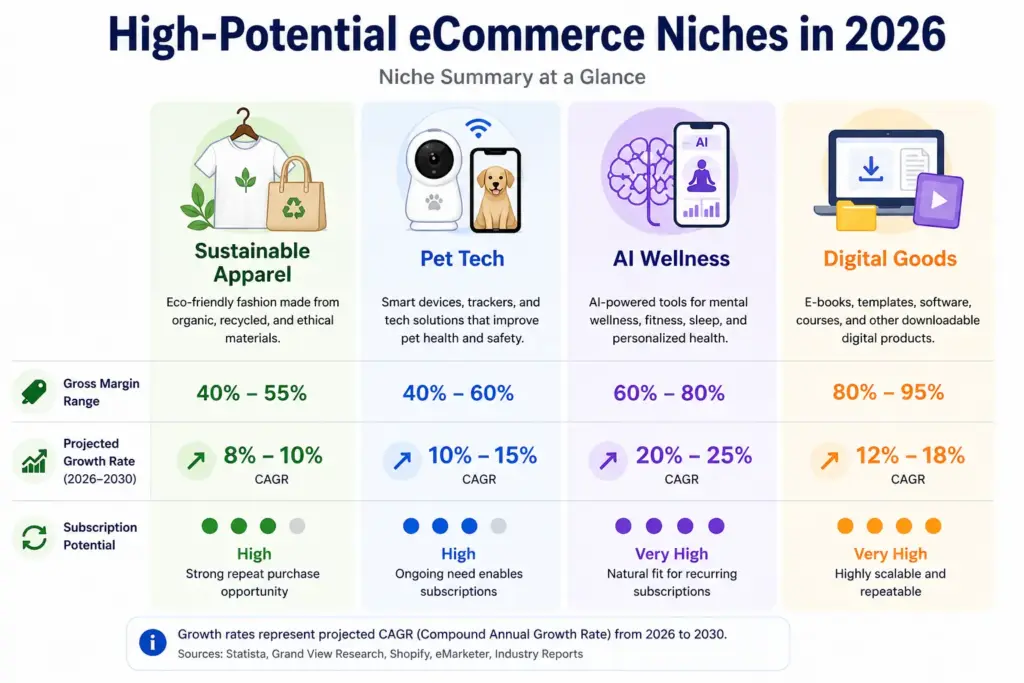
Profitable niches right now include
- sustainable apparel,
- premium pet care and pet tech,
- AI-enhanced wellness products,
- and digital tools for specific professional audiences.
These are not saturated categories and they carry real margin potential.
3. Owning Your Store and Your Customer Data
Selling exclusively on Amazon or Etsy is renting an audience. Those platforms charge referral fees of 15% to 20% on every transaction. A store owner who migrates even a portion of their marketplace sales to their own domain effectively recovers that fee margin without any increase in ad spend.
More importantly, marketplace sellers do not own their customer list. When the algorithm changes or a competitor undercuts pricing, there is no retention lever to pull. Owning a store means owning the email list, the data, and the relationship. That is what makes a business worth building, and worth selling.
4. Managing the Cost Structure Ruthlessly
Platform fees, transaction fees, return handling, and shipping costs are silent margin killers. A $100 sale can net very little after all costs if the cost structure is not actively managed. When choosing an eCommerce system, the total cost of ownership matters as much as the feature list.
Transaction fees on high-volume stores add up faster than most new sellers expect. FluentCart operates on a model that keeps those costs predictable and does not penalize growth with escalating per-sale charges.
The Profitability Killers Sellers Underestimate
1. Ad Inflation
Digital advertising costs have risen consistently year over year. In competitive categories, a single click can cost $3 to $8 before a single conversion happens. Brands that built their entire growth model on paid acquisition without a retention system are feeling this acutely.
The solution is not to abandon paid ads but to treat them as a top-of-funnel driver rather than the entire engine. Organic SEO, content, and email marketing reduce the cost per acquired customer over time. Paid channels should accelerate what organic already validates.
2. Returns and Logistics Complexity
In apparel, return rates in the US and UK consistently sit between 25% and 30%. Every return generates costs in shipping, inspection, and restocking that come directly out of your margin if they are not factored into your pricing from the start.
Sellers who study their eCommerce KPIs and understand their return rate by product category make smarter inventory decisions. eCommerce KPIs worth tracking include return rate, average order value, and CLV alongside the more obvious revenue metrics.
3. Underpricing Out of Fear
New sellers often underprice to compete on cost. When your price point is too low, you cannot afford the marketing required to reach enough customers, and you cannot invest in the customer experience that builds loyalty.
Understanding how to price a product is not just about covering cost of goods sold. It is about building a margin structure that funds growth. A strong value proposition justifies a higher price point. Build the value case before cutting the price.
Profit Benchmarks by Store Type (2026)
Understanding what realistic eCommerce earnings look like by stage helps set expectations and goals. Based on TrueProfit’s benchmark data across 5,000+ eCommerce stores, “most eCommerce businesses today maintain a net profit margin between 15% and 30%, with the range varying significantly by model and niche. “
- A solo freelance seller or small creator typically generates $1,000 to $5,000 per month in revenue with net margins between 20% and 40% when selling niche or digital products.
- Small direct-to-consumer brand generating $5,000 to $30,000 per month using social commerce and email retention can sustain 15% to 25% net margins.
- A scaled omnichannel store at $30,000 to $100,000 per month often operates at 10% to 20% net margin due to higher operational overhead, though the absolute profit figure is significantly larger.
Digital goods consistently outperform physical products at every revenue tier because of zero fulfillments cost and high repeatability. Sellers who combine physical and digital products often see the strongest overall unit economics.
Profitable Niches Worth Building In
1. Sustainable and Resale Apparel
Eco-conscious fashion is one of the fastest-growing categories in retail today. According to ThredUp’s 14th Annual Resale Report, “the global secondhand apparel market has grown into a $393 billion industry projected to expand at roughly 9% annually through 2030, growing twice as fast as the overall apparel market.
In the US, resale is growing four times faster than retail overall, with US online resale expected to nearly double by 2030. Sellers who build brand identity around sustainability attract loyal buyers who value the mission over the lowest price. Hosting your store on your own domain rather than a marketplace lets you reinvest the 15% to 20% commission savings into marketing and product development.”
2. Pet Tech and Premium Care
US household spending on pets continues to climb, and high-ticket pet tech products like smart feeders, GPS trackers, and health monitors carry strong margins alongside emotionally driven purchase behavior.
Pet owners are among the most brand-loyal consumers in any category, which makes this niche particularly well-suited to retention-based growth models.
3. AI Wellness and Personalized Health
Personalized supplement stacks, AI-driven fitness programs, and mental wellness tools are growing at double-digit annual rates.
According to Grand View Research, “the global AI in mental health market is projected to grow at a CAGR of 23.29% from 2026 to 2033, reaching $9.12 billion. Subscription models work exceptionally well in this category, transforming one-time buyers into recurring revenue and keeping monthly cash flow predictable regardless of new traffic levels.”
4. Digital Tools and Templates
Selling digital assets, whether Notion templates, Figma files, WordPress plugins, or productivity systems, requires no inventory, no shipping, and no returns. Margins are near 100% of revenue after platform costs.
For sellers with domain expertise, this is the most scalable model available. FluentCart’s sell digital products infrastructure is built specifically for this use case, with licensing controls, instant delivery, and customer management tools that support a professional buyer experience from the first transaction.
Building for Profitability
1. Choose a System That Does Not Punish Growth
Your platform choice affects your margin from day one. Transaction fees, app dependency costs, and escalating tier pricing all reduce what you keep as you scale. Before committing to any platform, calculate the full cost of ownership at your expected revenue level, not just the entry plan price.
For WordPress-based sellers, FluentCart offers a lean, performance-focused alternative to bloated eCommerce plugins. If you are considering a migration, try FluentCart migrator. It simplifies moving from existing plugins (e.g. EDD) without losing order history or customer data.
Once In a Lifetime Offer
2. Optimise Your Checkout Experience
Cart abandonment is one of the largest sources of invisible revenue loss. A streamlined, distraction-free checkout with clear pricing, multiple payment options, and minimal form fields directly improves conversion without additional ad spend.
Reducing cart abandonment is one of the highest-leverage optimisations available to any store, particularly once traffic volume reaches a point where even a 5% improvement in checkout conversion produces meaningful revenue.
3. Invest in Product Presentation Early
High-quality product pages with detailed descriptions, professional photography, and social proof elements build the trust that converts browsers into buyers. eCommerce product photography and strong product descriptions are not optional polish. They are conversion infrastructure that pays for itself in improved close rates across every traffic source you run.
4. Build Email Revenue Before You Need It
Email marketing consistently delivers the highest return on investment of any digital channel. Stores that invest in list building from launch, rather than waiting until they need a retention lever, are the ones with resilience when ad costs spike or algorithms shift. Your email list is the one customer asset that no platform can take away from you.
Wrapping Up
eCommerce profitability in 2026 is real, but it belongs to sellers who treat their store as a business rather than a side experiment. The market is large enough to support new entrants across dozens of niches.
The margins are there for sellers who manage costs, build for retention, and own their customer relationships. The era of easy wins on cheap traffic has passed. What has replaced it is an era of smart operators who understand their unit economics, choose the right model for their resources, and build brands that customers return to.
Whether you are launching your first store or restructuring an existing one, the fundamentals have not changed. Sell something people want, price it to fund growth, and build the infrastructure to keep customers coming back.
That is eCommerce profitability in 2026, and it is more achievable than the noise suggests.
Once In a Lifetime Offer

Deputy Marketing Lead, published literary author, and musician. I thrive on marketing for tech companies while composing music, collecting books of lasting depth, exploring cinema with a discerning eye, and studying the arts and history.

Subscribe now
Related Articles and Topics
-
FluentCart vs PrestaShop: Honest Comparison for Store Owners
FluentCart vs PrestaShop compared on features, pricing, and what comes built in. See which ecommerce platform fits your…
-
Credit Card Payment Plugins Compared: Which Should You Choose?
Compare 10 credit card payment plugins for 2026. See the hidden 1.9% to 3% fees on free plans,…
-
Best Membership Website Hosting in 2026
Membership website hosting isn’t a separate kind of hosting. It’s regular managed cloud or VPS hosting that happens…



Add your first comment to this post