
What Is a Business License? (And Do You Actually Need One)
Starting a business comes with a long checklist, and the licensing question trips up a surprising number of new owners. Some assume any registered company is automatically covered.
Others put it off entirely, not realizing the fines or forced shutdowns that can follow. The truth sits somewhere in between, and it depends heavily on where you operate, what you sell, and how your business is structured.
In this blog, we will cover what a business license actually is, the five main types you might encounter, how to figure out which ones apply to you, what it costs, and the most common questions people search about this topic.
TL;DR
- A business license is a government-issued authorization that lets you legally operate a business in a specific location.
- Requirements differ widely by city, county, state, and industry.
- General, sales tax, professional, federal, and health or special permits.
- Not every business needs a federal license, but most need at least a local or state-level one.
- A business license and an LLC are two entirely separate things.
- Fees typically run from $15 to $500 or more depending on jurisdiction and business type.
- Online businesses are not exempt from licensing requirements.
What Is a Business License?
A business license is a legal document issued by a government agency, whether local, state, or federal, that grants a person or company permission to operate within a specific jurisdiction. Think of it as the government’s formal acknowledgment that your business exists and is allowed to run where it does.
According to Wikipedia, “business licenses are permits issued by government agencies that allow individuals or companies to conduct business within the government’s geographical jurisdiction,” and a single jurisdiction can require multiple licenses issued by multiple departments.
The U.S. Small Business Administration confirms that “most small businesses need a combination of licenses and permits from both federal and state agencies.”
What makes this topic genuinely confusing is that there is no single universal license. The term “business license” can refer to a general operating license, a seller’s permit, a professional certification, a tax registration, or all of the above, depending on your state and industry.
5 Main Types of Business Licenses
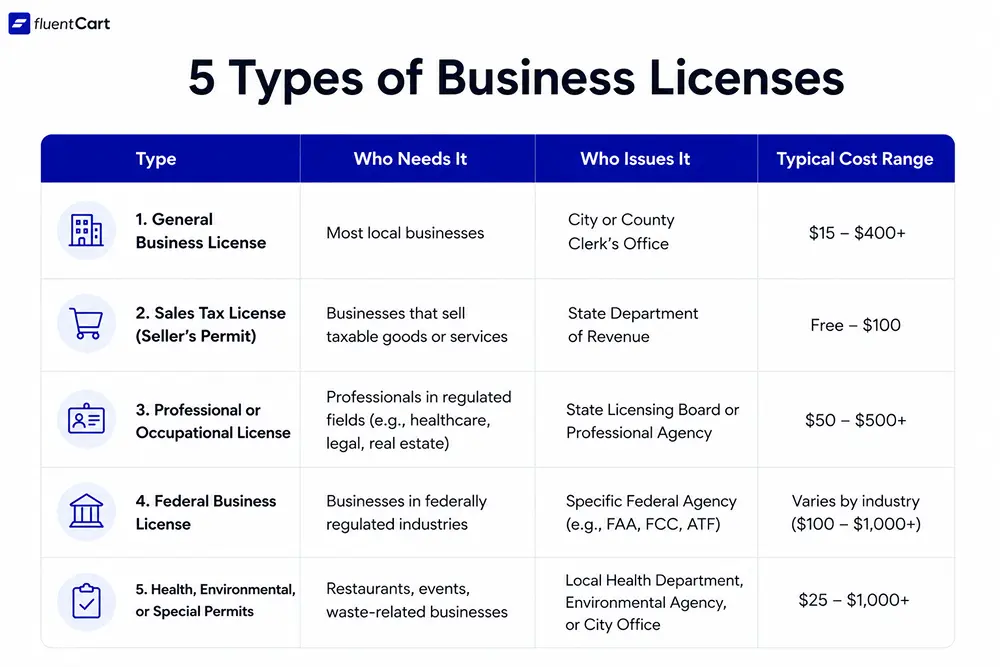
Understanding which category your situation falls into makes the whole process far less overwhelming. There are five main types of business licenses and permits that apply across most industries and locations in the United States.
1. General Business License
Sometimes called an operating license or business privilege license, this is the baseline authorization to run a business in a city or county. Around 29 states require some form of it. Alabama calls theirs a “business privilege license.”
Nevada requires one from every business, including sole proprietors. In states that do not issue a statewide version, the local county or city clerk’s office typically handles it.
2. Sales Tax License (Seller’s Permit)
If your business sells taxable goods or services, most states require you to register for a sales tax permit before collecting from customers. This applies to both physical and online stores. States use this to track who is collecting sales tax and to ensure it gets remitted properly on a monthly or quarterly basis.
3. Professional or Occupational License
Certain fields require proof that the practitioner meets specific educational or safety standards before they can operate. According to the Bureau of Labor Statistics, “the prevalence of occupational licenses, common in fields such as healthcare, law, and education, has risen substantially over the past 50 years.” The list varies by state but generally covers doctors, nurses, accountants, real estate agents, cosmetologists, contractors, and similar skilled professions.
4. Federal Business License
Most businesses will never need one. Federal licenses apply only to industries regulated at the national level, such as broadcasting, commercial fishing, alcohol manufacturing, firearms, aviation, and nuclear energy production.
The SBA’s licensing and permits page lists the relevant federal agency alongside each regulated activity, so if your business falls into one of those categories, that is the right starting point.
5. Health, Environmental, and Special Permits
These cover businesses whose operations could directly affect public health or the local environment. Restaurants need health permits from the county health department. Companies with significant waste outputs may need environmental clearance.
Temporary businesses like traveling markets, conventions, or outdoor events sometimes need special event permits specific to the city where they operate.
Do You Have to Have a Business License?
For most businesses, yes. The exact rules vary by state, structure, and what you sell.
A sole proprietor doing business under their own legal name may not need to register with the state, but they will very likely still need a local operating license and a sales tax permit if they sell taxable products. Corporations, LLCs, and partnerships almost always require state registration plus applicable licenses on top of that.
One widely misunderstood scenario involves online sellers. Operating entirely online does not exempt a business from licensing. According to the U.S. Chamber of Commerce, “if you run an online or home-based business, you should assume that you’re operating under the same regulatory requirements as a brick-and-mortar business.”
If you are building revenue and running ads, the IRS already classifies you as a business regardless of whether you have formally licensed one.
Some states do have revenue thresholds. Tennessee operates on a tiered system: businesses earning under $3,000 per year need no license, those earning between $3,000 and $10,000 can apply for a minimal activity license, and businesses with gross receipts of $10,000 or more require a full business tax license.
Washington state requires a general license if your business earns over $12,000 annually, sells taxable products, or has employees. Worth checking your specific state’s rules rather than assuming you fall below the threshold.
Business License Requirements by State: A Quick Overview
Because requirements differ so much, here is a simplified breakdown of the general landscape across the U.S.
- Statewide license required: Alabama, Alaska, Delaware, Nevada, and Washington, among others. These require virtually all businesses to hold a state-issued license regardless of industry.
- Local or industry-specific only: California, Texas, Illinois, New York, and most others. There is no universal state license in these states, but counties and cities set their own rules, and professional or industry licenses still apply at the state level.
- Hybrid approach: Some states require both a state-level registration and a local license depending on what you sell and where your business is physically located. Washington is one example where both state and local licenses can be required simultaneously.
The practical first step is always to contact your county clerk’s office or visit your state’s Secretary of State website.
Most states now have online portals that walk business owners through applicable requirements based on industry and location. If your state does not have one, the county clerk’s office is the right starting point.
How Much Does a Business License Cost?
Fees vary considerably depending on jurisdiction and business type. A basic local business license can cost as little as $15 in a small municipality.
- California’s range spans roughly $30 to $500 depending on business type and gross receipts.
- New York licenses can run from $200 to $4,500.
- Pennsylvania charges a flat $75 for most business types,
- while Delaware charges $75 per year for the first location and $25 for each additional one.
Processing time also varies. Some jurisdictions approve applications within days. Others, especially for regulated industries, can take up to 90 days. Starting before you launch avoids any gap in your legal right to operate.
Business License vs. LLC
This confusion comes up constantly in small business discussions. An LLC (Limited Liability Company) is a business structure, a legal entity type that determines how your business is taxed and how liability is handled.
The IRS defines an LLC as “a business structure allowed by state statute” that protects its members from personal liability in most circumstances.
A business license is an operating permission issued by a government agency. Forming an LLC does not automatically grant you permission to do business in your city or state.
Most LLC owners still need to obtain the appropriate licenses and permits in addition to their state registration.
In Connecticut, for instance, all LLCs must register with the Secretary of State and separately obtain a business license before starting operations.
Is a Business License the Same as an EIN?
No. An EIN (Employer Identification Number) is a federal tax identification number issued by the IRS to identify a business entity for tax purposes. Most businesses will need one, especially if they have employees or operate as an LLC or corporation.
A business license and an EIN serve entirely different functions and come from different agencies. You apply for an EIN through the IRS directly, while your business license comes from your local or state government.
When Do You Need to Get a Business License?
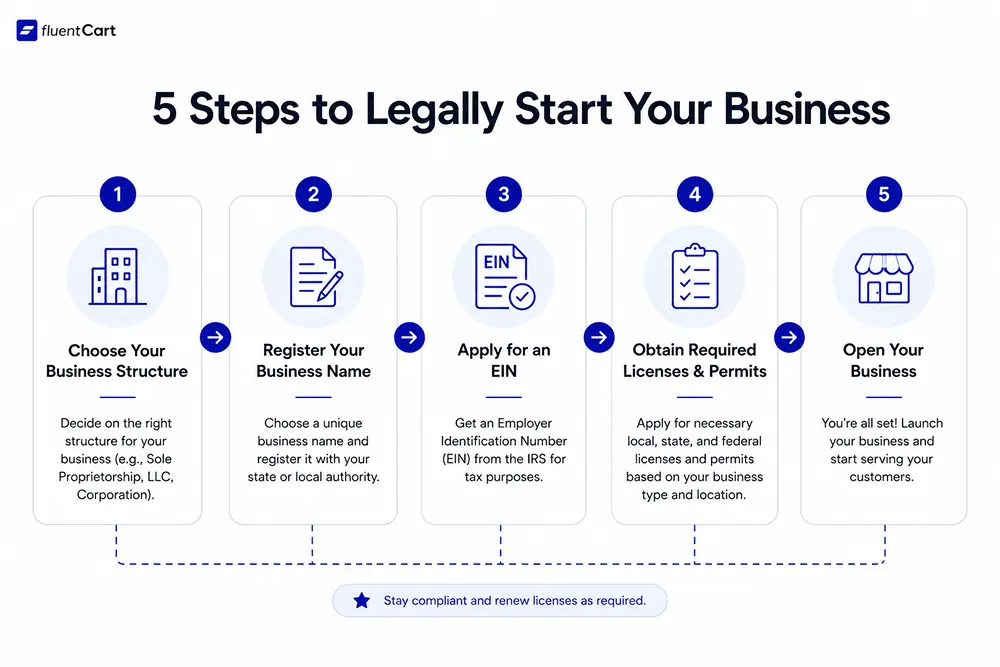
Before you start operating. Licensing should happen after you have chosen your business structure and registered your business name, but before you open for business or begin making sales. Some jurisdictions issue fines retroactively for unlicensed operations, so the timing genuinely matters.
For businesses that are growing, a few triggers can require new or additional licenses: hiring employees, crossing certain revenue thresholds, selling in new states (which may create a tax “nexus”), or adding regulated products or services to your lineup.
Understanding the full costs involved in starting a business early helps you plan for all of these steps before they catch you off guard.
Wrapping Up
A business license is not just a bureaucratic formality. Operating without the right ones puts your business at risk of fines, forced closure, and difficulty opening a business bank account, since most banks require an active license before proceeding.
For most businesses, a local operating license and a sales tax permit are all it takes to get started. The complexity scales with your industry, your state, and how regulated your specific activity is.
When in doubt, start with your county clerk’s office, your state’s Secretary of State website, or a business attorney before your launch date. Getting licensed early is far less costly than correcting it later.
FAQ
What is a business license called in different states?
The name varies by state. You may encounter a “business privilege license” in Alabama, a “business tax receipt” in Florida, a “basic business license” in Washington D.C., or simply an “operating license” depending on the jurisdiction. The function is essentially the same across all of them.
Does California require a business license?
California does not issue a statewide general business license, but all businesses must obtain a seller’s permit for tax purposes and a local tax certificate from the city or county where they operate. The state’s CalGold portal helps identify specific requirements by location and business type.
Is a business license the same as an EIN?
No. An EIN is a federal tax identification number from the IRS used to identify your business for tax filing purposes. A business license is an operating permission from a local or state government. They are different documents from entirely different agencies, and most businesses need both.
Do you need a business license to sell online?
Yes, in most cases. Online businesses are subject to the same local, state, and sometimes federal licensing requirements as physical stores. If you are selling taxable products and generating consistent revenue, you almost certainly need at least a local business license and a sales tax permit in your home state.

Deputy Marketing Lead, published literary author, and musician. I thrive on marketing for tech companies while composing music, collecting books of lasting depth, exploring cinema with a discerning eye, and studying the arts and history.

Subscribe now
Related Articles and Topics
-

Bundle Marketing: An eCommerce Guide for Store Owners
Bundle marketing guide: types, pricing math, examples, and a FluentCart setup.
-
Wholesale Pricing: A FluentCart Guide for WordPress Store Owners
Learn how to set up wholesale pricing. Using FluentCart for this, you get five practical methods, from simple…
-

eCommerce Laws in 2026: The 8 Rules Regulators Are Fining Stores Over
The 8 ecommerce laws regulators fined stores over in 2025 and 2026.




Add your first comment to this post