
What Is Fulfillment? Definition, Meaning & Guide for 2026
Most online stores do not fail at marketing. They do not fail at product selection. They fail at the moment the customer has already paid and is waiting. That moment, everything after the checkout button, is called fulfillment. And for most growing stores, it is the most neglected part of the entire business.
In this blog, we will explain what fulfillment actually is, walk through how it works from the inside, show you where it breaks down, and help you figure out which model fits where your store is right now.
TL;DR
- Fulfillment is every step between a customer placing an order and receiving it, including returns
- Most stores treat it as a logistics task, but customers experience it as a direct measure of your brand’s reliability
- The three main models are in-house, third-party logistics (3PL), and dropshipping, each with real tradeoffs
- Choosing the wrong model at the wrong stage of growth is one of the most common reasons stores stall
- Speed, accuracy, and transparency are what customers actually measure you on, not your product page
What Is Fulfillment?
Fulfillment is the complete process of getting a customer’s order from your inventory into their hands. It begins the moment an order is placed and ends when the item is delivered, or in cases of returns, when the reversal is resolved.
That definition sounds simple. The execution is not.
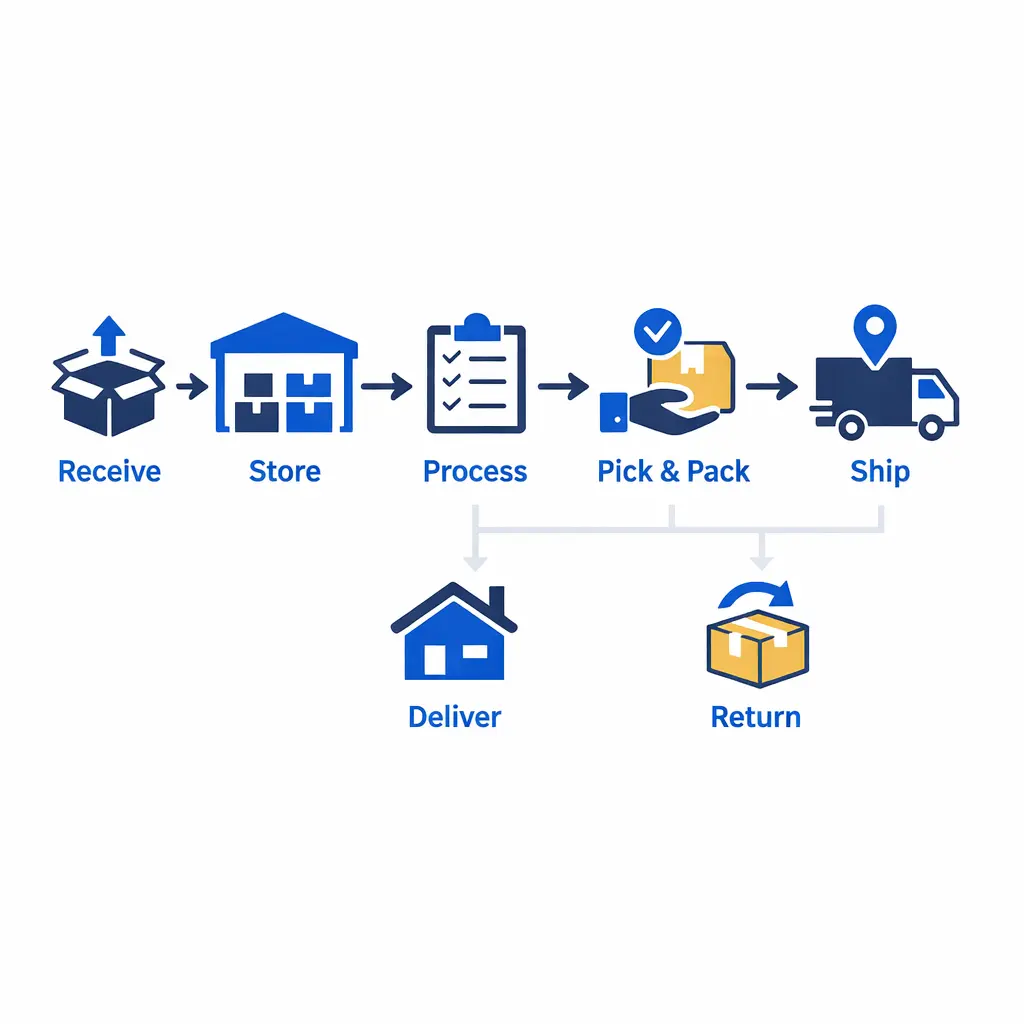
It includes receiving stock from suppliers, storing it, processing each order as it comes in, picking the right items, packing them properly, handing off to a carrier, tracking the shipment, and handling anything that comes back. Every single step in that chain is an opportunity for something to go wrong, and when it does, the customer does not blame the carrier or the warehouse. They blame your store.
The Real Problem Most Stores Are Ignoring
Here is what the data says: as of 2024, “55% of consumers across all markets expected delivery within 48 hours, a 5% increase from the year before”, according to the eCommerce Delivery Benchmark Report 2024 by Retail Economics and Auctane. Meanwhile, “nearly half of consumers stop buying from a brand after a single poor delivery or packaging experience”.
That gap, between what customers expect and what most stores can actually deliver, is where revenue disappears. Not during the sale. After it.
Most store owners feel this as a customer service problem. They get complaints, they respond, they issue refunds, and they move on. But the complaints are a symptom. The actual problem is that fulfillment has no real system behind it. Orders are going out late. Items are getting mixed up. Tracking is unreliable. And no one in the business has a clear picture of how bad it actually is because nobody measured it.
This is the fulfillment problem. And it does not get better by itself.
How eCommerce Fulfillment Actually Works
Understanding what order fulfillment in eCommerce means in practice requires walking through it step by step, not as a list of definitions, but as a chain where every link depends on the one before it.
- It starts before the customer orders anything: Inventory has to arrive from your supplier, get checked for accuracy, and be stored in a way that makes it easy to find and pull quickly. If your stock is disorganized or your counts are wrong from the start, every order that follows inherits that error.
- Then the order comes in: When a customer checks out, that order needs to move immediately into your fulfillment workflow. The right items need to be located, pulled from storage, and packed. This is the picking and packing stage, and it is where most accuracy problems originate. A wrong item pulled, a quantity misread, a box packed without the correct label, and you have a customer about to receive the wrong thing.
- Then it ships: The packed order goes to a carrier, a label gets generated, and tracking activates. From here, the carrier owns the transit, but your store still owns the customer’s experience of it. If tracking is not communicating, or if the estimated delivery window was wrong, the customer is emailing you, not the carrier.
- Then it arrives, or it does not: Delivery confirmation closes the loop, but only if it goes smoothly. Returns, damaged items, and missing packages reopen it, and how you handle reverse logistics says as much about your store as anything on your product page.
This is what fulfillment in logistics actually means. Not a single action, but a connected sequence where the quality of each stage determines the outcome of the next.
Three Stages Stores Get Wrong
Most fulfillment failures are not random. They cluster in predictable places.
1. Inventory visibility
Stores oversell items they do not have, or hold too much of something that is not moving. Without an accurate, real-time view of what is in stock and where it is sitting, your fulfillment operation is guessing. Understanding what is inventory at a deeper level is the starting point for fixing this, because everything downstream depends on your stock data being correct.
2. Order management
When orders come in and there is no clear system routing them through the fulfillment workflow, things fall through the gaps. Orders get delayed sitting in a queue. Prioritization is arbitrary. Staff are unclear on what to pack next. A proper understanding of what is order management and building that layer correctly is what separates stores that scale from stores that break under volume.
3. Returns handling (the most ignored)
According to theNational Retail Federation’s 2025 Retail Returns Landscape report, “19.3% of online sales will be returned in 2025.” That is a fifth of your revenue cycling back through your operation. Stores that treat returns as an afterthought are paying twice for every bad outcome: once when the item ships, and again when the return process is slow, unclear, or just broken.
Three Fulfillment Model
Understanding what fulfillment is gives you the foundation. But the practical question is: who should be running it? There are 3 models, and the right one depends entirely on where your store is, not where you want it to be.
1. In-House Fulfillment
You own the full process. Your team picks, packs, and ships every order. This works well when order volume is manageable, when your products need specific handling, or when your margins are tight enough that outsourcing fees would hurt. The tradeoff is time and headspace. As volume grows, in-house fulfillment consumes both faster than most founders expect.
2. Third-Party Logistics (3PL)
A 3PL provider takes your inventory into their warehouse and handles everything from there. They have the infrastructure, the carrier relationships, and the staff. You pay per order processed and per unit stored. According to Grand View Research, “the U.S. eCommerce fulfillment services market generated USD 22.4 billion in 2024 and is projected to grow at a 14.1% CAGR through 2030”, which reflects how many brands are making exactly this shift as they scale.
What is third-party fulfillment good at? Speed and scale without building your own infrastructure. What is it bad at? Giving you close control over packaging quality and the unboxing experience. The 3PL handles your orders, but they are not invested in your brand the way you are.
3. Dropshipping
With dropshipping, you never hold inventory at all. Your supplier ships directly to the customer when an order comes in. The overhead is minimal and the risk is low, which is why it appeals to stores just starting out. The serious downside is that you hand over the entire post-purchase experience to a supplier who has no stake in your customer relationship. Shipping times, packaging, and accuracy are all outside your control.
| Model | Control | Cost | Scalability | Setup Complexity | Best Fit |
| In-House Fulfillment | High | Medium (fixed + operational costs) | Low to Medium | Medium | Small to mid-size stores that want full control and brand experience |
| 3PL (Third-Party Logistics) | Medium | Medium to High (per order + storage fees) | High | High (integration, onboarding) | Growing stores that need scale without managing logistics |
| Dropshipping | Low | Low upfront (pay per order) | High | Low | New or testing-phase stores with minimal risk and no inventory |
Fulfillment in Supply Chain
Zoom out for a moment. Fulfillment sits at the end of a larger supply chain, the final execution layer that connects everything upstream to the actual customer. Supply chain covers sourcing, manufacturing, and distribution. Fulfillment is specifically the piece that turns a stored product into a delivered order.
This distinction matters when something goes wrong. Fulfillment problems and supply chain problems look similar from the outside but have entirely different root causes and solutions. A stockout caused by poor forecasting is a supply chain problem. A stockout caused by miscounted inventory is a fulfillment problem. Treating them the same way wastes time and money.
Similarly, fulfillment and shipping are not the same thing. Fulfillment happens inside your operation, receiving, organizing, picking, packing. Shipping is what the carrier does after that. Logistics connects the full network end to end. Knowing where one starts and another ends is what lets you actually diagnose your problems rather than just feel them.
In Fulfillment vs Awaiting Fulfillment
These two order statuses cause more customer service confusion than almost anything else.
| Aspect | Awaiting Fulfillment | In Fulfillment |
| Definition | Payment is confirmed, but processing has not started | Order is actively being picked and packed |
| Stage | Pre-processing | Active processing |
| Who is handling it | Not yet assigned to warehouse/picking team | Warehouse team is working on it |
| Activity level | Idle / queued | Active / in progress |
| Normal duration | Short delay (hours to a day, depending on volume) | Usually a few hours |
| Common cause | Order queue, off-hours, backlog | Ongoing picking and packing |
| When to worry | If it exceeds the stated processing time | If it stays longer than 24–48 hours |
| Customer perception | “Nothing is happening yet” | “My order is being prepared” |
A Note on Amazon FBA and FBM
People often search for what is Amazon FBA alongside general eCommerce fulfillment questions. FBA is Amazon’s own 3PL service: you send inventory to their centers, and they handle storage, picking, packing, shipping, and Prime eligibility. FBM means you fulfill Amazon orders yourself.
Both are marketplace-specific. If you run an independent store, the in-house versus 3PL decision is the one that actually applies to you. FBA is a useful reference point for understanding 3PL logic, but it is not a model you would directly adopt for your own storefront.
Wrapping Up
Fulfillment is not the glamorous part of eCommerce. But it is the part your customers experience most directly after buying from you. Every late delivery, wrong item, or confusing return is a piece of trust you spent marketing budget earning and then gave back for free.
Getting fulfillment right does not require a warehouse or a logistics team. It requires understanding the process, knowing where your current setup is breaking down, and choosing the model that matches your actual stage of growth. Start there, build the system, and your customer experience problems will start solving themselves.
Once In a Lifetime Offer
FAQs
Is a fulfillment center the same as a warehouse?
Not quite. A warehouse stores goods; a fulfillment center is purpose-built to receive, pick, pack, and ship orders fast. The operational design and staffing are different even when the building looks the same.
At what point should a small store consider moving to a 3PL?
When packing orders is consistently eating into time that should go toward growing the business, or when you cannot reliably ship within your promised window, that is the signal.
Does fulfillment apply to digital products?
The concept of delivery still applies, but digital fulfillment means instant file access or license delivery rather than physical picking and shipping. No warehouse involved.
What is the difference between fulfillment rate and order accuracy rate?
Fulfillment rate measures how many orders shipped out of all orders placed. Order accuracy rate measures how many of those shipped orders contained the correct items. You want both as close to 100% as possible, for different reasons.

Deputy Marketing Lead, published literary author, and musician. I thrive on marketing for tech companies while composing music, collecting books of lasting depth, exploring cinema with a discerning eye, and studying the arts and history.

Subscribe now
Related Articles and Topics
-
Best Membership WordPress Plugin: 8 Options Compared for 2026
Compare the best membership WordPress plugin options for 2026 by use case.
-
WordPress Coupons: How to Create and Manage Discounts
Set up a WordPress coupons plugin and manage discount codes in minutes.
-
eCommerce Scalability and Performance: FluentCart vs Woo
eCommerce scalabilty and performance is a question that people ask arbitrarily. And what they measure rarely answers the…



Add your first comment to this post