
What Is Market Research? Why Smart Businesses Rely on It

Most businesses that fail do not fail because they had a bad product. They fail because they built something without understanding who needed it, why, and at what price. Market research is what separates businesses that guess from businesses that know.
In this blog, we will cover what market research means, the main types, why it matters at every stage of a business, and how to think about it practically whether you are starting out or scaling up.
TL;DR
- Market research is the process of gathering and interpreting information about your customers, competitors, and overall market
- It helps you reduce risk, validate ideas, and make smarter business decisions
- There are two main categories: primary research (data you collect yourself) and secondary research (data that already exists)
- Qualitative and quantitative methods each serve different purposes
- Good market research directly informs pricing, product, messaging, and positioning
- It is not a one-time event but an ongoing business practice
What Is Market Research?
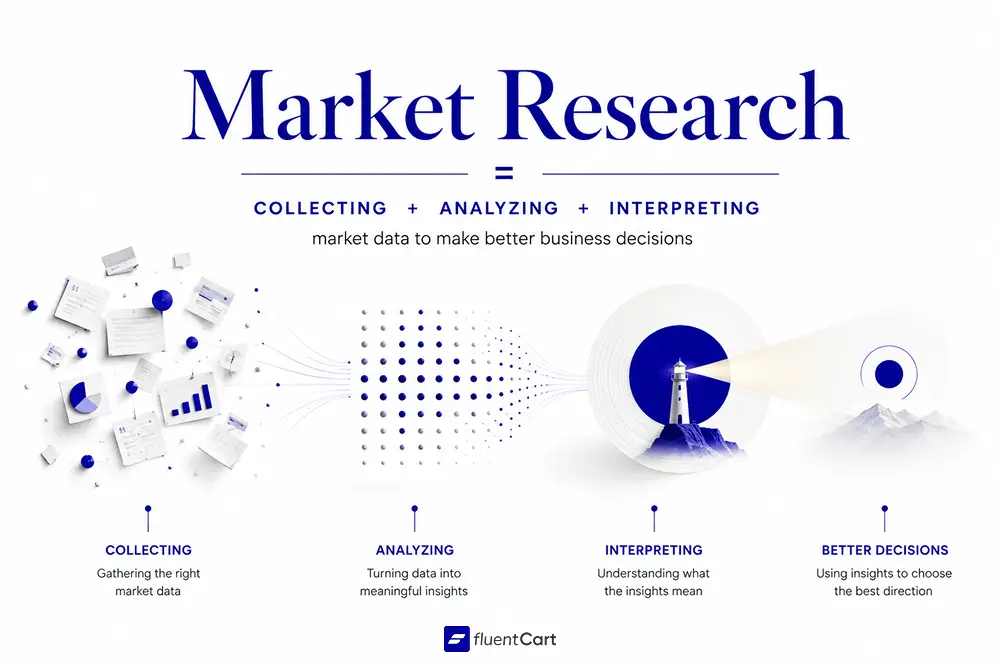
Market research is the systematic process of collecting, analyzing, and interpreting information about a market. This includes data about your target customers, your competition, and the broader industry environment.
The goal is simple: reduce guesswork. Instead of making decisions based on assumptions, businesses use market research to build a factual picture of what their customers actually want, what problems exist in the market, and where opportunities are being missed.
It applies equally to a founder validating a new idea before spending a single dollar, and to an established brand deciding whether to expand into a new product category.
Market Research vs. Marketing Research: Is There a Difference?
People often use these terms interchangeably, and for most practical purposes, that is fine. However, there is a subtle distinction worth knowing.
Market research focuses specifically on a particular market, including its size, competitors, customer behavior, and trends. Marketing research is broader. It covers the full marketing process, including campaign effectiveness, brand perception, pricing strategy, and distribution analysis.
Think of market research as a subset of marketing research. When people say “do your market research,” they typically mean: understand your audience and your competitive landscape before making decisions. Both terms point toward the same core habit of gathering evidence before acting.
The Two Main Types of Market Research
1. Primary Research
Primary research is data you collect yourself, directly from your target audience. You design the study, choose the participants, and gather fresh information specific to your business question.
Common primary research methods include surveys, interviews, focus groups, and direct observation. Because you control the process, you get answers tailored to your exact situation. The trade-off is time and cost.
2. Secondary Research
Secondary research uses information that already exists, collected by someone else for their own purposes. This includes industry reports, government census data, trade publications, competitor websites, and academic studies.
Secondary research is faster and cheaper, which makes it the natural starting point for most businesses. The limitation is that it may not address your specific question precisely. Most strong research efforts combine both types.
A quick note: we have a dedicated guide covering all market research methods in depth, so this article focuses on the foundation rather than each individual technique.
Qualitative vs. Quantitative Research
Within both primary and secondary research, you will encounter two modes of data.
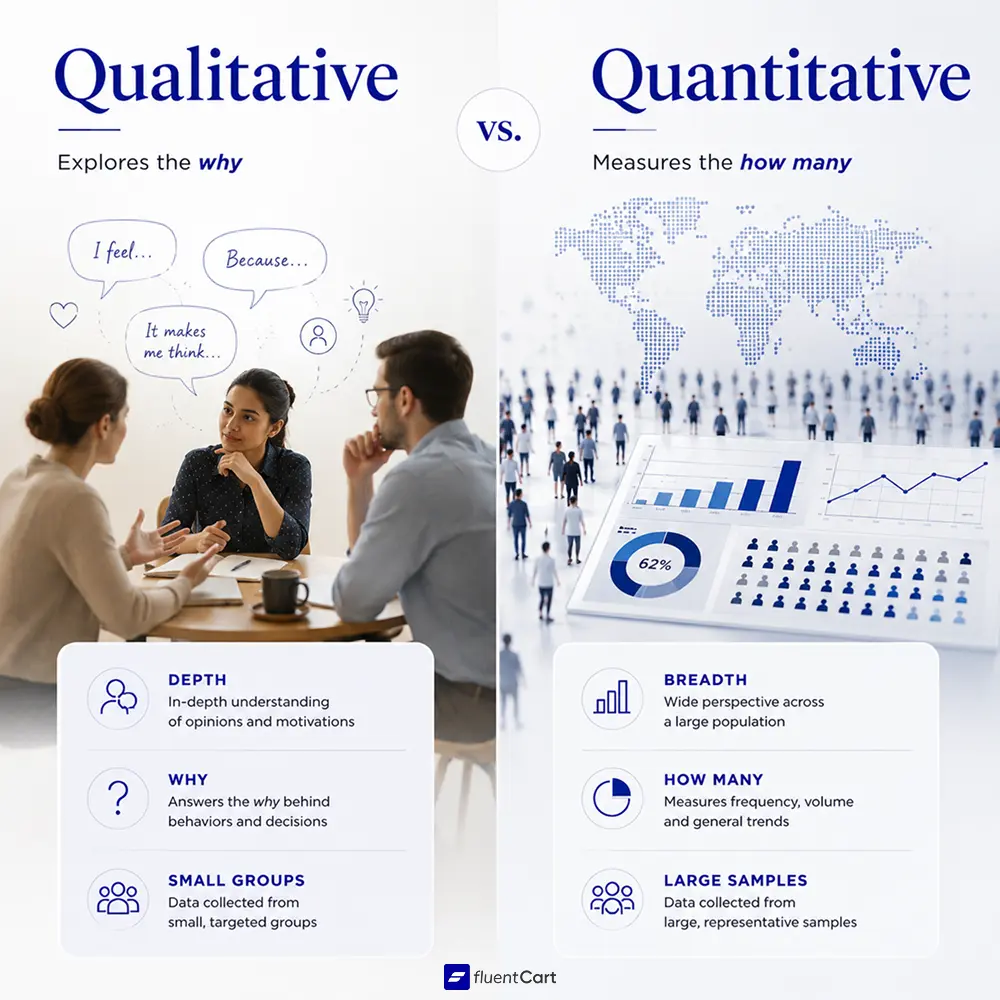
- Qualitative research focuses on understanding the “why” behind behavior: It is exploratory. It reveals motivations, emotions, and the language your customers use when they describe their problems. A conversation with ten customers can surface insights that no spreadsheet would show.
- Quantitative research deals with numbers: It tells you how many, how often, and at what rate. Survey results, sales data, website analytics, and A/B test outcomes are all quantitative. It gives you statistical confidence and makes patterns visible across large groups.
Neither is superior. The most useful market research combines both: qualitative to understand, quantitative to validate.
Why Market Research Matters
The global insights industry surpassed $150 billion in 2024 and is projected to exceed $160 billion by end of 2025, according to ESOMAR’s Global Market Research 2025 report.
Within that, the market research sector alone grew 4.8% in 2024. Businesses are not spending that kind of money out of habit.
They are spending it because the cost of skipping research is almost always higher than the cost of doing it.
What Good Market Research Actually Helps You Do
Here is what market research specifically does for a business:
- It reduces risk before you commit: Testing an idea with real people before you invest in building it is one of the highest-leverage things you can do. You learn whether demand actually exists and what form it needs to take.
- It sharpens your product: Customer feedback during and after development helps you refine what you are building. Products that map closely to real pain points sell better and retain users longer.
- It improves your messaging: When you understand how your audience thinks and the exact words they use to describe their problems, your marketing becomes dramatically more effective. You are not inventing language. You are reflecting theirs back at them.
- It reveals where competitors are falling short: Competitive gaps are market opportunities. Research that identifies what customers complain about in existing solutions tells you exactly where you have room to differentiate.
- It informs pricing: Willingness-to-pay is rarely obvious. Research helps you understand what customers value and how they anchor their price expectations so you can price with confidence rather than guessing.
What Good Market Research Actually Looks Like
Market research does not need to be expensive or elaborate. It needs to be intentional.
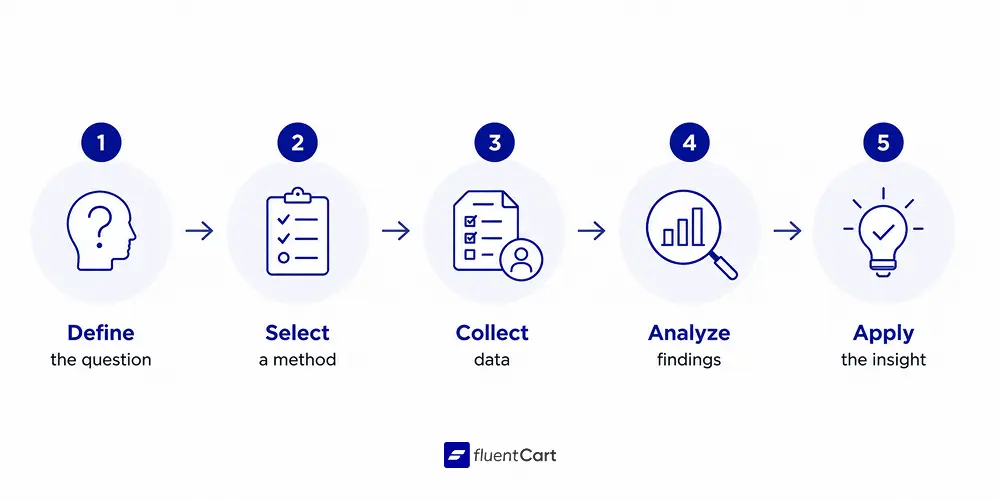
The process generally follows a logical path: first define the decision you are trying to make, then identify what information would change that decision, then go collect that specific information. Collecting data without a clear question in mind produces noise, not insight.
A practical starting point for almost any business is to talk directly to customers. Not to pitch to them but to listen. Ask about their workflows, their frustrations, the alternatives they have tried, and what they wish existed. Even ten conversations can fundamentally shift your understanding of a problem.
From there, layer in secondary research. Look at industry reports, competitor reviews on platforms like G2 or Trustpilot, and community discussions on Reddit or industry forums. These sources reveal what your audience says when no one is trying to sell to them.
Market Research in the Context of eCommerce
For online businesses, market research does not stop at product validation. It feeds into every layer of the operation.
Understanding which products are gaining traction, what customers expect from checkout experiences, how competitors are structuring their offers, and where customer drop-off is happening are all research questions with direct revenue implications.
Platforms built for selling digital products or physical goods benefit most when the owner has done the groundwork to understand their audience before they build. Research informs which products to list, how to price them, and what the store experience should feel like.
If you are still figuring out your product direction, product research is a natural complement to market research. Where market research tells you about your audience and competitive landscape, product research narrows your focus to specific opportunities worth pursuing.
Common Mistakes to Avoid
Asking too broad a question is one of the most common traps. “What do customers want?” is not a research question. “What do customers find most frustrating about managing their subscription purchases?” is.
Relying too heavily on stated preferences rather than observed behavior is another. What people say they will do and what they actually do are often different. Where possible, supplement surveys and interviews with behavioral data.
Treating research as a one-time event is a costly mistake. Markets shift. Customer expectations evolve. Competitors move. Regular research, even if lightweight, keeps you calibrated to reality rather than the version of reality you had when you started.
Wrapping Up
Market research is not a formality or a checkbox. It is the practice of making sure you understand your market before you bet money and time on it.
At its core, it is about getting out of your own head and into the perspective of the people you are trying to serve. Whether you are launching your first product, revisiting your pricing strategy, or trying to understand why conversions are dropping, the right research will almost always point you toward the right answer faster than any shortcut.
Once In a Lifetime Offer
Frequently Asked Questions
What is the difference between market research and a market survey?
A survey is one specific method of collecting data. Market research is the broader process, which can include surveys, interviews, competitive analysis, and secondary research. Surveys are a tool within market research, not a substitute for it.
When should a business do market research?
Before launching a product, entering a new market, changing pricing, or making a significant strategic decision. It is also valuable as a regular practice to stay current with shifting customer expectations and competitive dynamics.
Is market research only for large companies?
Not at all. Small businesses and solo founders often benefit most from it because they have fewer resources to recover from a wrong decision. Even basic customer interviews and competitive analysis count as meaningful research.
What is a market research analyst?
A market research analyst is a professional who designs research studies, collects and interprets data, and translates findings into business recommendations. They work across industries and are in high demand as businesses increasingly rely on data to guide strategy.

Deputy Marketing Lead, published literary author, and musician. I thrive on marketing for tech companies while composing music, collecting books of lasting depth, exploring cinema with a discerning eye, and studying the arts and history.

Subscribe now
Related Articles and Topics
-

Bundle Marketing: An eCommerce Guide for Store Owners
Bundle marketing guide: types, pricing math, examples, and a FluentCart setup.
-

Wholesale Pricing: A FluentCart Guide for WordPress Store Owners
Learn how to set up wholesale pricing. Using FluentCart for this, you get five practical methods, from simple…
-

eCommerce Laws in 2026: The 8 Rules Regulators Are Fining Stores Over
The 8 ecommerce laws regulators fined stores over in 2025 and 2026.




Add your first comment to this post