
Market Research Methods: Find What Your Market Actually Wants [Complete Guide]

Every product that flopped had one thing in common: someone assumed instead of asking. A $140 billion global industry exists precisely because assumptions are expensive, and the businesses that win in competitive markets are the ones that replace guesswork with evidence.
Whether you are a solopreneur validating a product idea, a B2B marketing manager building a go-to-market strategy, a UX designer testing usability assumptions, or a developer figuring out which feature your users actually need, knowing the right market research methods separates smart decisions from costly ones.
In this blog, we will cover what market research methods are, how they are categorized, which methods work for which goals, how qualitative and quantitative approaches complement each other, and how B2B contexts shift the rules.
TL;DR
- Primary research (firsthand data you collect) and secondary research (existing published data)
- Surveys, in-depth interviews, focus groups, and observational research
- Qualitative answers “why,” quantitative answers “how many”
- Interviews and competitor intelligence matter more than broad surveys
- Combine at least two methods from different categories for reliable insight
- Treating research as a one-time pre-launch activity rather than an ongoing habit
What Are Market Research Methods?
Market research methods are the structured approaches businesses use to collect, analyze, and interpret data about their target audience, competitors, and broader market conditions. The goal is to turn raw information into actionable insight that drives smarter decisions across product development, pricing, messaging, and positioning.
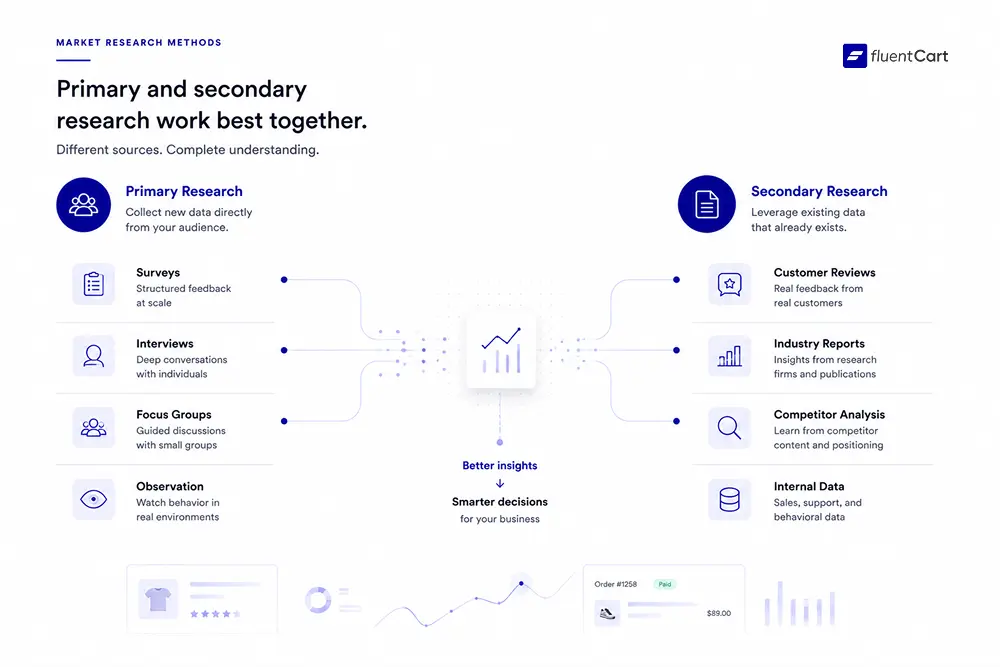
These methods fall into two overarching categories. Primary research means collecting data directly from your source, through surveys, interviews, focus groups, or observation. Secondary research means working with data that already exists, from government databases, industry reports, competitor analysis, and published studies.
Within each category, specific methods serve different purposes. Some are built for scale, capturing patterns across thousands of respondents. Others are built for depth, revealing the reasoning behind individual behavior. Knowing which to use, and when, is the foundation of effective market research. To understand the broader context of why this matters, see our guide on what is market research and how it fits into business strategy.
Primary vs. Secondary Research
Most research strategies open with secondary research before moving into primary. Secondary data gives you market context quickly and cheaply, which helps you design sharper primary research later.
The U.S. Small Business Administration outlines several free resources businesses can use for secondary research, including census data, consumer behavior reports, and economic indicators. These are excellent starting points before spending time or budget on direct outreach.
Primary research takes over when you need answers that are specific to your audience, situation, or product. You own the data. You control the questions. The tradeoff is time and cost.
Secondary Research Sources Worth Pulling From
These four sources cover most secondary research needs without a budget:
- Public data: Government census bureaus, labor statistics, trade reports from agencies like the SBA
- Industry reports: Published findings from research firms such as Gartner, Nielsen, and ESOMAR
- Competitor review mining: Customer reviews, public pricing pages, and marketing copy from competitors reveal real market gaps
- Internal records: Your own sales history, support ticket themes, and customer churn patterns are secondary data most businesses already have
The limitation of secondary research is specificity. It tells you what the market looks like broadly. It rarely tells you exactly why your specific customers behave the way they do. That is the opening primary research fills.
The 4 Methods of Primary Market Research
Primary research is direct and deliberate. You design the questions, select the participants, and own every data point. There are four core methods, each suited to different goals and stages of research.
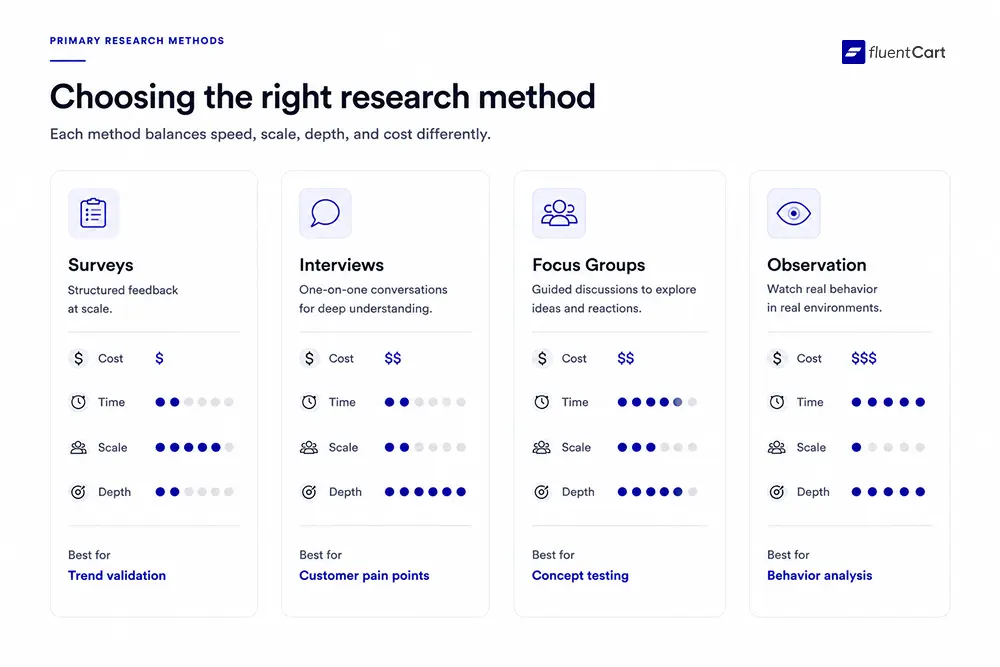
1. Surveys
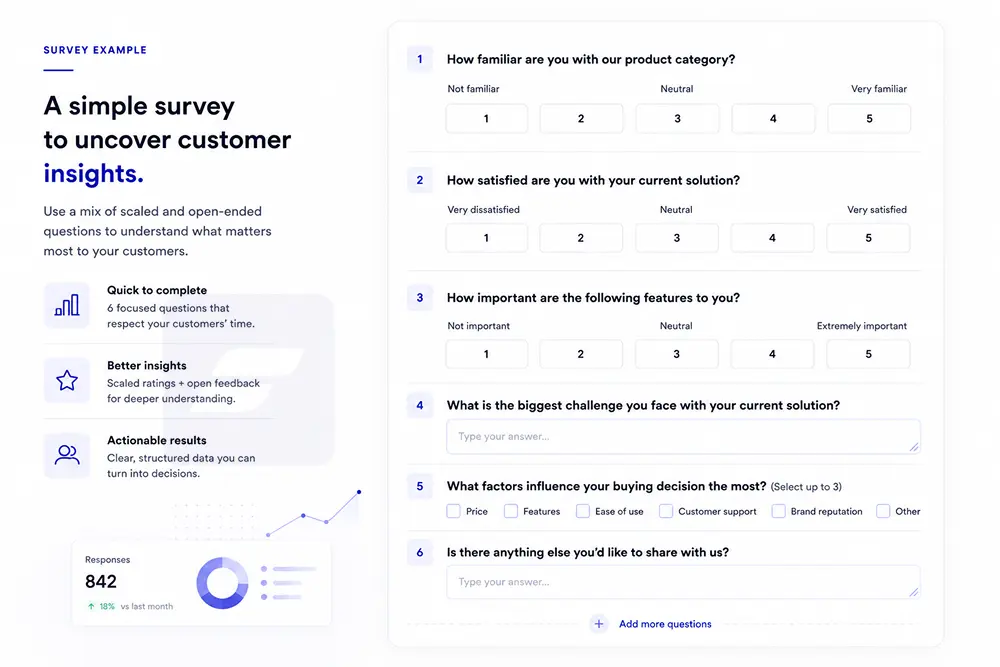
Surveys are the most widely used quantitative primary research method. According to ESOMAR’s Global Market Research Report, online surveys are used regularly by 85% of market research professionals worldwide, making them the dominant data collection tool in the industry.
They work best at scale: capturing measurable patterns around preferences, price sensitivity, satisfaction levels, and feature demand across large groups. The strength of a well-designed survey is volume and speed. The weakness is that surveys tell you what people report, not always what they actually do.
- Best for: Validating a hypothesis, measuring satisfaction, gauging pre-launch demand, running NPS tracking
- Watch out for: Survey fatigue, leading questions that bias responses, and shallow answers that lack context
2. In-Depth Interviews
One-on-one interviews, by phone, video, or in person, are the most effective method for understanding the reasoning behind behavior. They are qualitative, open-ended, and allow you to follow unexpected threads when a participant says something revealing.
A common mistake is running interviews like a verbal survey, moving through a fixed list of closed questions. Effective interviews use open-ended prompts that let participants speak in their own words. The interviewer’s job is to listen, then probe.
Practitioners on r/smallbusiness consistently make the same point: start with interviews before building your survey. Conversations surface the language, concerns, and priorities that shape far better survey questions than any desk assumption.
- Best for: Exploring pain points before building a product, uncovering objections before writing sales copy, understanding the full decision-making process
- Watch out for: Acquiescence bias (where people agree to seem helpful), small sample size, and researcher framing that nudges answers in a particular direction
3. Focus Groups
A focus group gathers six to ten people who represent your target demographic in a structured discussion, guided by a trained moderator. The method works well for testing early concepts, exploring brand perception, and observing how shared context shapes opinion.
Focus groups shine in early-stage product development when you are still exploring rather than validating. As Qualtrics notes in their overview of market research types, dominance bias is a real risk in this format: forceful participants can pull the group toward their view and suppress quieter respondents who think differently.
- Best for: Concept testing, brand perception research, initial reactions to messaging or product ideas
- Watch out for: Group dynamics distorting individual opinion, high coordination cost, and participants saying what sounds reasonable rather than what they believe
4. Observational Research
Observational research removes self-reporting entirely. Instead of asking people what they do, you watch what they actually do. This can mean in-store behavioral observation, heatmaps and session recordings on a website, or structured usability testing on a product interface.
The key advantage is accuracy. People frequently say they would use a feature or buy a product, then behave differently when the moment arrives. Observation captures what actually happens. For UI/UX designers and product teams, this method is often more reliable than any survey.
- Best for: UX research, retail behavior analysis, ecommerce conversion optimization, understanding how users interact with interfaces in real conditions
- Watch out for: Interpretation bias (you still have to make sense of what you see), limited scale, and the observer effect where people behave differently when they know they are being watched
Qualitative vs. Quantitative Market Research Methods
These are not competing approaches. They are complementary lenses that belong in the same research strategy.
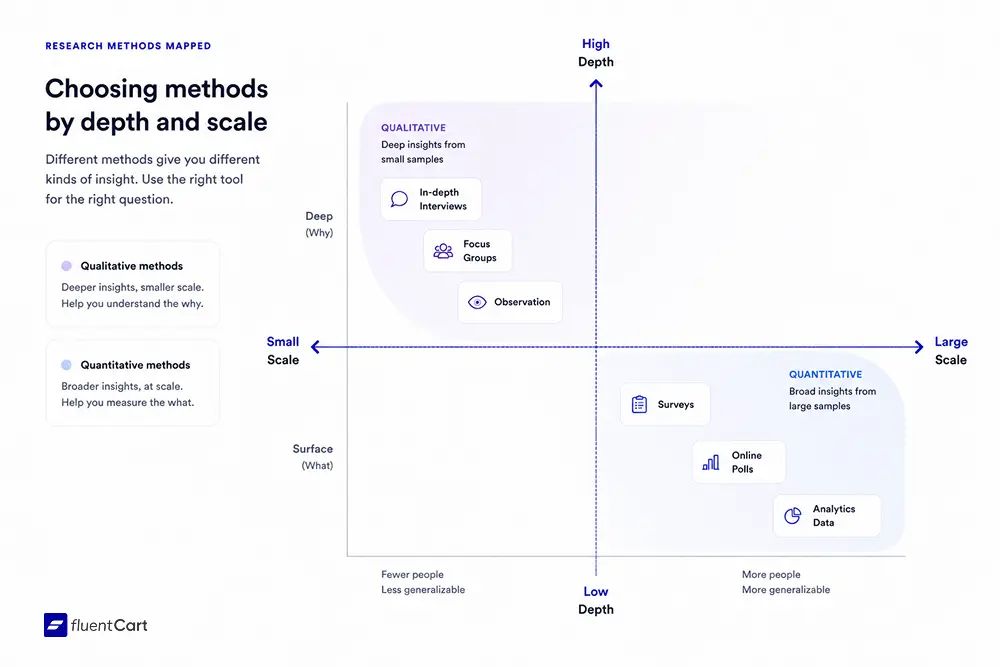
- Qualitative market research methods: include interviews, focus groups, open-ended survey responses, and social media listening. They answer “why” and “how.” They generate rich, contextual understanding of motivation and behavior but are harder to measure at scale.
- Quantitative market research methods: This include structured surveys, web analytics, A/B testing, and behavioral data. They answer “how many,” “how often,” and “what percentage.” They produce statistically reliable numbers that let you validate patterns and forecast demand.
The strongest research cycles use both. Start with qualitative to discover what questions are worth asking. Then use quantitative to measure how broadly those findings hold across your audience.
B2B Market Research Methods: Where the Same Rules Apply Differently
B2B market research follows the same fundamental framework but operates in a different environment. Purchasing decisions involve multiple stakeholders, longer evaluation cycles, and considerably higher stakes per transaction than typical consumer purchases.
This shifts the method mix significantly.
- In-depth interviews: Become the highest-value primary method. Decision-makers are harder to reach but a single honest conversation with a qualified buyer reveals more than hundreds of survey responses from unqualified leads.
- Competitor intelligence: Takes on greater strategic weight. Analyzing how competitors position, price, and message their offerings helps B2B teams identify differentiation gaps they can actually own.
- LinkedIn and industry forums: Serve as accessible secondary research channels. The language buyers use to describe their problems in public forums is directly usable in your positioning and content.
- Internal CRM and sales data: Win/loss records, objection logs, and deal velocity data reveal market dynamics without requiring a single external survey. Most B2B teams underuse this.
As of 2025, 85% of B2B professionals rely on online surveys as a primary research tool, while qualitative methods like interviews and focus groups continue to play a vital role in uncovering the motivations that drive complex buying decisions.
In B2B, the balance tips qualitative because the audience is smaller and their decisions are more layered.
Social Media Listening
Social media listening means systematically tracking what your target audience says on platforms like Reddit, LinkedIn, X, and niche industry forums. No survey. No recruitment. Just real, unprompted opinion already being shared in public.
The advantage is authenticity. Someone on Reddit venting about a product frustration is not performing for a researcher. The exact words they use to describe a pain point, the comparisons they make, the alternatives they consider, this is marketing intelligence in its most unfiltered form.
Effective listening tracks mentions of your product, your competitors, and the core problem your product solves. Free tools like Google Alerts combined with native platform search cover a lot of ground without budget.
For ecommerce businesses and digital product sellers, social listening connects directly to how you describe your products. Pulling real customer language into your product descriptions is one of the most practical ways to apply research to copy without a formal research budget.
How to Choose the Right Mix of Methods
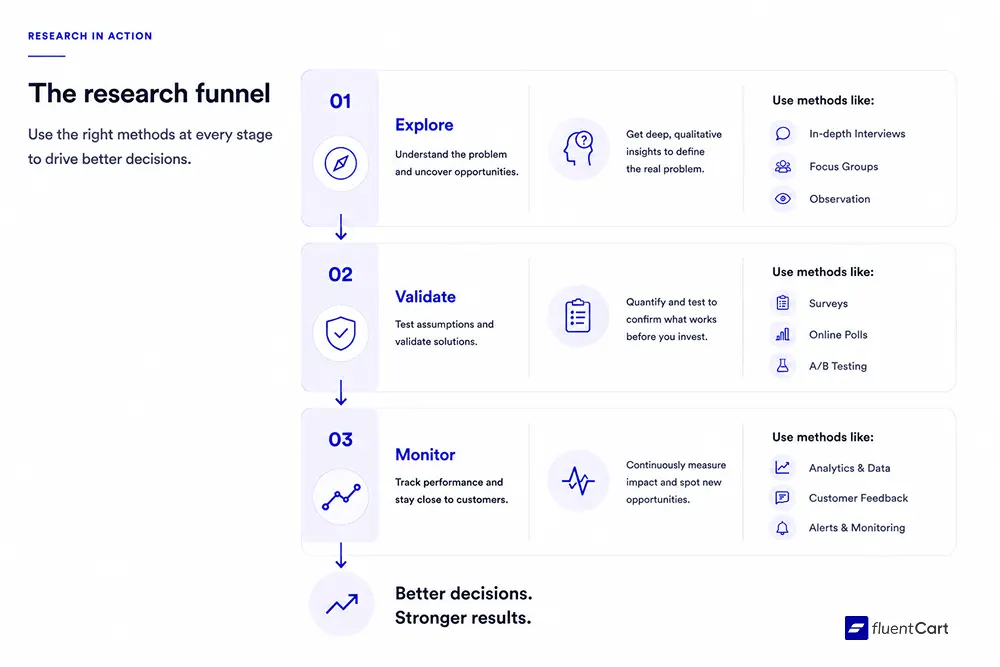
No single method gives you the full picture. The right combination depends on your stage, objective, and constraints. A practical three-stage framework:
- Stage 1, Explore: Use qualitative methods (interviews, social listening, focus groups) when you do not yet know which questions are worth asking
- Stage 2, Validate: Use quantitative methods (surveys, analytics, A/B tests) once a clear hypothesis has emerged from your exploratory phase
- Stage 3, Monitor: Use secondary research and ongoing observational tools to track market shifts after launch
Budget matters here. In-depth interviews cost time, not money, if you conduct them yourself. Government and public secondary research is free. Modern survey tools make quantitative research affordable at scale. You do not need an enterprise research budget to run a rigorous research cycle.
From Research to Action
Market research only creates value when it changes a decision. The gap between gathering data and acting on it is where most businesses lose their research investment.
A few practical ways to close that gap:
- One-page brief: Synthesize findings into a single document before every major product or marketing decision
- Team-wide sharing: Distribute research summaries across your whole team, not just leadership
- Ongoing cadence: Treat research as a repeating cycle rather than a one-time pre-launch activity
- Language transfer: Let exact phrases from interviews and social listening shape your actual copy and messaging
For businesses building or scaling an online store, research connects directly to decisions about product selection, positioning, and customer experience design.
Tools like FluentCart make it easier to act on those decisions quickly, whether that means updating product pages, adjusting pricing, or restructuring how you present an offer. Before any of that, the research has to come first.
For teams working at the SKU or category level, doing thorough product research by combining internal sales data with social listening and competitor analysis gives you a demand signal grounded in evidence before you commit budget.
Download the free Market Research Planning Template and turn ideas into actionable insights.
Wrapping Up
Market research methods are not about picking the most sophisticated tool. They are about asking the right questions of the right people through the right channel at the right stage of your process.
A structured approach, starting with secondary context, moving into qualitative exploration, and validating with quantitative data, gives you a complete picture that any single method alone cannot.
Whether you are launching a product, entering a new segment, refining your messaging, or benchmarking against competitors, the framework is the same: define your objective clearly, choose methods that match where you are in the process, and let what you learn drive decisions rather than confirm what you already believed.
Once In a Lifetime Offer
Frequently Asked Questions
What are the 4 methods of primary market research?
The four primary market research methods are surveys, in-depth interviews, focus groups, and observational research.
Each collects firsthand data directly from participants and varies in scale, depth, cost, and the type of insight it produces.
What are the 7 types of marketing research?
The seven commonly referenced types are primary research, secondary research, qualitative research, quantitative research, branding research, customer research, and product research.
Each addresses a different layer of market understanding, from broad category insight down to specific product or messaging decisions.
What is the best market research method for a startup?
In-depth interviews tend to deliver the highest value per hour at the early stage. They surface real pain points without requiring a large sample size.
Social media listening is a strong complement because it is free, fast, and captures unprompted opinion from people not trying to impress anyone.
How is B2B market research different from B2C?
B2B research deals with longer buying cycles, multiple stakeholders per account, and smaller but higher-value audiences.
This makes qualitative methods like interviews and competitor intelligence more central. Broad-scale surveys still play a role in B2B, mainly for tracking satisfaction and validating messaging across a larger customer base.
Do I need a budget to do market research?
Not for most early-stage research. In-depth interviews, secondary research from public sources, social media listening, and competitor review mining all cost time rather than money.
Paid survey panels and professional focus group facilities cost more, but the highest-value methods for early validation are largely free.

Deputy Marketing Lead, published literary author, and musician. I thrive on marketing for tech companies while composing music, collecting books of lasting depth, exploring cinema with a discerning eye, and studying the arts and history.

Subscribe now
Related Articles and Topics
-

Bundle Marketing: An eCommerce Guide for Store Owners
Bundle marketing guide: types, pricing math, examples, and a FluentCart setup.
-
Wholesale Pricing: A FluentCart Guide for WordPress Store Owners
Learn how to set up wholesale pricing. Using FluentCart for this, you get five practical methods, from simple…
-

eCommerce Laws in 2026: The 8 Rules Regulators Are Fining Stores Over
The 8 ecommerce laws regulators fined stores over in 2025 and 2026.




Add your first comment to this post