
What is a Patent? Definition, Business Use Cases, and how to apply
Every original idea carries risk. The moment you launch a product, publish a method, or introduce a new design to the market, someone could copy it. A patent is one of the few legal tools that can stop that from happening. Yet many entrepreneurs, especially in the digital and ecommerce space, overlook it entirely or assume it only matters for large corporations.
In this blog, we will cover what a patent is, the different types that exist, real-world examples, how patents differ from other IP protections, and how inventors anywhere in the world can file for one.
TL;DR
- A patent gives an inventor the exclusive legal right to exclude others from making, using, or selling their invention for a limited period
- Three main types exist: utility patents, design patents, and plant patents
- Patents typically last 20 years from the application filing date
- To file internationally, inventors use the Patent Cooperation Treaty (PCT) system administered by WIPO
- A patent is not the same as a copyright or trademark; each protects something different
- Coca-Cola famously chose not to patent its formula, opting instead for a trade secret
What Is a Patent?
A patent is a legal right granted by a government that gives an inventor exclusive control over an invention for a limited period, typically 20 years. It allows the patent owner to prevent others from making, using, selling, or importing the invention without permission in exchange for publicly disclosing how the invention works.
In exchange for that protection, the inventor must publicly disclose exactly how the invention works. That trade-off sits at the heart of the patent system: temporary monopoly in exchange for public knowledge.
According to Parola Analytics‘ analysis of USPTO grant data, the agency issued approximately 326,921 utility patents in fiscal year 2024, spanning semiconductors, AI, cybersecurity, and healthcare.
Patents fall under intellectual property (IP) law, alongside trademarks and copyrights. Each serves a distinct purpose. A trademark protects brand identifiers like names and logos. A copyright protects creative expression like books, art, or music. A patent protects the invention itself, covering the process, product, machine, or novel design behind it.
Patent vs Trademark vs Copyright
| Patent | Trademark | Copyright | |
| What it protects | Inventions, new processes, machines, designs, or compositions of matter | Brand identifiers such as names, logos, slogans, and symbols that distinguish a source | Original creative works such as books, music, art, software code, and films |
| How long it lasts | 20 years from filing date (utility and plant patents); 15 years for design patents | Indefinitely, as long as it is actively used and renewed every 10 years | Life of the author plus 70 years; 95 years from publication for corporate works |
| Who grants it | National patent office (e.g., USPTO in the U.S., EPO in Europe, WIPO for international PCT filings) | National trademark office (e.g., USPTO in the U.S.); registration is optional but strengthens rights | Copyright exists automatically upon creation; registration with a copyright office is optional but recommended |
| Requires registration? | Yes, application and approval are required | Optional, common law rights can exist without registration | No, protection is automatic upon creation |
| Disclosure required? | Yes, full public disclosure of the invention is required | No | No |
Types of Patents
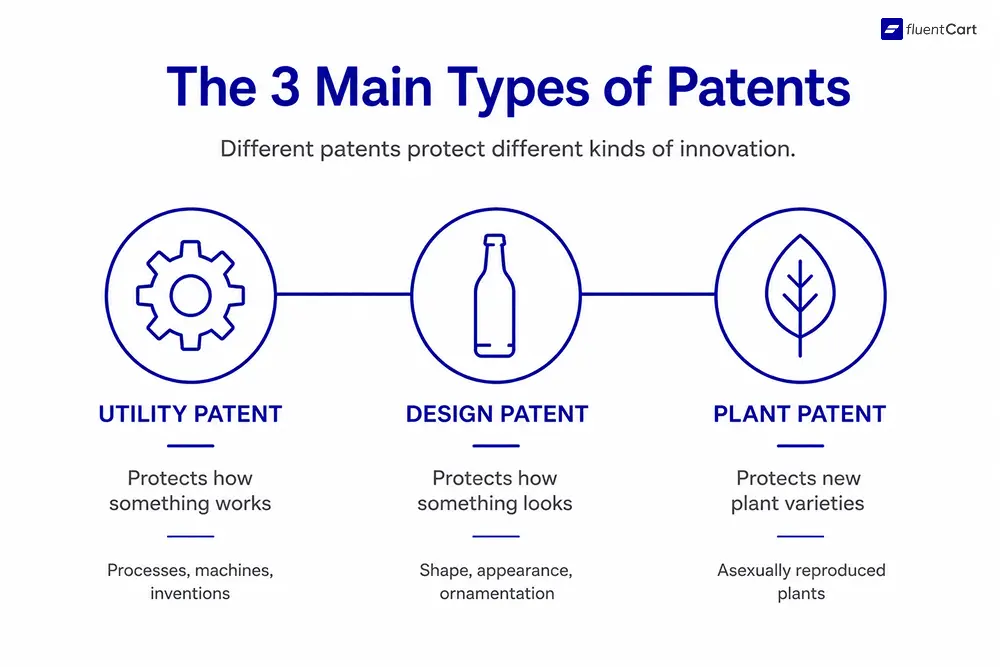
Patents come in three main categories, each designed for a different type of invention.
Utility Patents
The most common category, utility patents protect any new and useful process, machine, article of manufacture, or composition of matter. Utility patents represent more than 90% of all USPTO patents (USPTO data). If you invent a new kind of software mechanism, a machine component, or a chemical compound, this is the type that applies.
Design Patents
Design patents protect the ornamental appearance of a functional product, not how it works. A well-known example is the recognizable contour shape of the Coca-Cola bottle, which was first patented in 1915. The shape itself became protectable property even though the contents inside were not.
Plant Patents
These apply to anyone who invents or discovers and asexually reproduces a distinct new variety of plant. The Honeycrisp apple, developed at the University of Minnesota and filed for patent in 1988, is one well-known example. The university earned $16.5 million in royalties before the patent expired in 2008 (MNopedia source).
Patent Meaning in Business: Why It Matters
In a business context, a patent does more than protect an invention. It creates a barrier competitors cannot cross without permission. That competitive exclusivity can attract investors, support licensing deals, and command premium pricing.
It also shapes how businesses approach innovation. Companies that know their R&D output is protectable are more willing to invest in it. Without that protection, the incentive to develop and disclose new methods shrinks significantly.
One nuance many business owners miss: a patent does not guarantee the right to use or sell an invention. If your invention builds on someone else’s still-active patent, you may need a license from them before commercializing it. Patents are layered, and earlier foundational ones can affect newer improvements.
If you are building a product business, knowing business license basics is equally important. Patents protect the innovation itself; a business license covers your legal right to operate.
The Coca-Cola Question: Why Some Inventions Go Unpatented
People frequently ask why Coca-Cola never patented its formula. The answer clarifies something important about the patent system itself.
A patent gives an inventor exclusive rights for a limited time, typically 20 years, but to get one, the inventor must fully disclose the details of the invention to the public. Trade secrets, by contrast, can last indefinitely as long as the information remains confidential, with no expiration date and no forced public disclosure.
Coca-Cola made a deliberate decision: disclose the formula and lose control of it after 20 years, or protect it as a trade secret forever. They chose the latter. To this day, the exact blend is kept in a vault. The secrecy itself has become part of the brand’s identity.
That choice worked for Coca-Cola’s specific situation. For most inventors, a patent is the stronger option, particularly when secrecy cannot be maintained or when a product could be reverse-engineered by a competitor.
Three Things That Make an Invention Patentable
Before filing anything, an inventor needs to confirm three things about their idea:
Novel. The invention must be new. Something already known, used, or published anywhere in the world typically cannot be patented.
Non-obvious. The invention must not be something a skilled person in that field would arrive at through routine thinking. It has to involve a genuine inventive step.
Useful. The invention must have a practical application. Abstract ideas, mathematical formulas, and natural phenomena on their own do not qualify.
Conducting a prior art search before filing is strongly recommended. WIPO’s free PATENTSCOPE database, the USPTO Patent Public Search tool, and the EPO’s Espacenet are all reliable starting points.
How to File a Patent for Your Product, From Anywhere in the World
Filing a patent is a process, not a single step. Here is how it typically works, whether you are based in the US or filing internationally.
Step 1: Document the Invention
Record the conception date of your invention in detail. An inventor’s notebook, signed and dated, serves as evidence if a dispute ever arises over who invented what and when.
Step 2: Run a Prior Art Search
Search existing patents and published applications to confirm your invention is truly novel. Use the three free databases listed above, or hire a patent attorney to run a more thorough analysis.
Step 3: Assess Commercial Viability
Filing a patent costs money, sometimes significant money. Before investing in the process, confirm whether there is a real market for the invention. A patent that protects something nobody wants to buy offers little return.
Step 4: File Your Patent Application
In the United States, applications go through the USPTO. Other countries have their own national patent offices. Your application must include a specification describing the invention, one or more claims defining the scope of protection, and any drawings needed to illustrate it.
Step 5: Respond to the Examiner
After filing, a patent examiner reviews the application. If objections are raised, called Office Actions, the applicant can respond with amendments or arguments. The process can take months or even years.
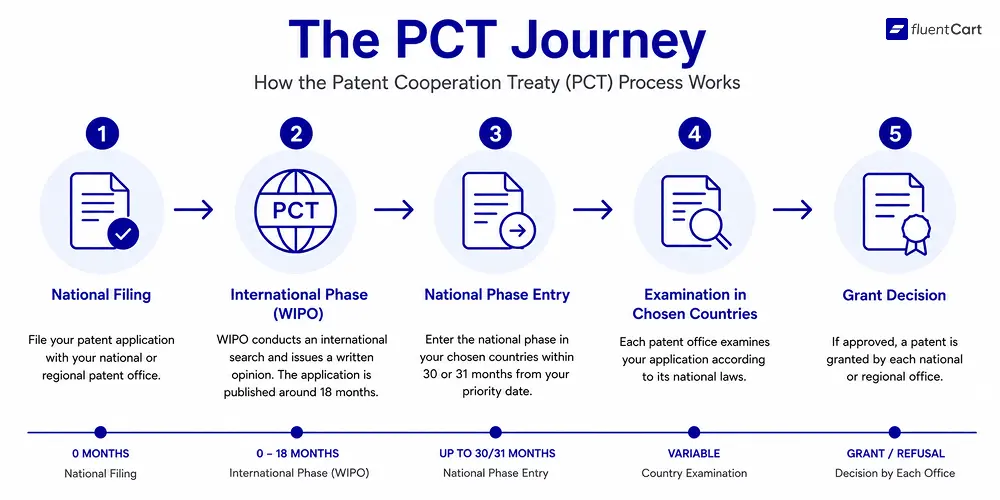
Filing Internationally Through the PCT System
There is no such thing as a worldwide patent. However, inventors can file an international patent application under the Patent Cooperation Treaty (PCT), administered by WIPO. A single A single PCT application currently has the same legal effect as filing in up to 158 contracting states (WIPO PCT), without having to file separately in each country from the start.
The process runs in two phases. 1. International Phase, and 2. The National Phase.
- International Phase: This involves a single filing, an international prior art search, and a written opinion on patentability.
- National Phase: Must be entered within 30 months of the priority date, which is where individual countries examine and ultimately decide whether to grant the patent under their own laws.
This system gives inventors time to assess the commercial potential of their invention across markets before committing to the cost of individual national filings in each territory. It is particularly valuable for businesses building products they intend to sell internationally.
Note: For businesses that sell software, plugins, or digital goods and want to protect the methods behind them, understanding how digital product selling works in practice is the natural next step alongside IP strategy.
What Owning a Patent Actually Does
A granted patent gives the holder the right to take legal action against infringers through civil courts. It does not mean any government agency enforces it on your behalf. Enforcement is entirely the patent owner’s responsibility.
Beyond defense, patents can generate revenue through licensing, allowing others to use the invention in exchange for royalties. They can also be sold, assigned, or used as collateral. In startup ecosystems, a strong patent portfolio signals defensibility and can be a meaningful asset during fundraising or acquisition discussions.
Once a patent expires, the invention enters the public domain, and anyone can use it freely. That is by design. The system rewards public disclosure with temporary protection, then returns that knowledge to society.
Wrapping Up
A patent is one of the most concrete ways to protect what you have built. It rewards genuine innovation, creates market exclusivity, and gives businesses a legally enforceable position in their space. Filing one takes time and resources, but for products or methods that are truly novel, the protection it offers is difficult to match through any other means.
Whether you are early in the ideation stage or ready to file, the most important step is starting with a clear understanding of what you have, whether it qualifies, and where you want to protect it.
FAQs
What is a patent in accounting?
In accounting, a patent is classified as an intangible asset on a company’s balance sheet. Its value is typically amortized over its useful life or legal life, whichever is shorter.
What is a patent in research?
In research contexts, a patent protects novel discoveries or methods developed through scientific work. Universities and research institutions frequently file patents for inventions produced by their faculty and labs.
What is a patent in simple terms?
A patent is a legal right granted by a government that stops others from making, using, or selling your invention for up to 20 years. In return, you publicly disclose how the invention works.

Deputy Marketing Lead, published literary author, and musician. I thrive on marketing for tech companies while composing music, collecting books of lasting depth, exploring cinema with a discerning eye, and studying the arts and history.

Subscribe now
Related Articles and Topics
-
eCommerce Laws in 2026: The 8 Rules Regulators Are Fining Stores Over
The 8 ecommerce laws regulators fined stores over in 2025 and 2026.
-
What Is a Payment Gateway? A Guide for WordPress Store Owners
Confused about payment gateways? Here’s what they actually do, which ones fit WordPress, and how to pick the…
-
GiveWP Alternatives: What Actually Replaces It
GiveWP’s future is shaky. Here’s what real GiveWP alternatives do better in donation-taking operations, and where they still…




Leave a Reply