
Wholesale Pricing: A FluentCart Guide for WordPress Store Owners
Wholesale pricing usually means a different price, a bigger pack size, and a buyer you actually trust, not the general public browsing your store.
You can build a real wholesale pricing workflow in FluentCart using private products, pack-based pricing, and restricted coupons, each suited to a different kind of setup.
This guide walks through five practical methods, from the simplest no-code option to when the answer is genuinely custom development, so you can pick the one that actually fits how your store sells wholesale.
Every method below puts something FluentCart already has to work for wholesale.
TL;DR
- Wholesale pricing typically means lower B2B prices, larger pack sizes, minimum order values, approved buyers, and sometimes separate catalogs, not every store needs all of it
- FluentCart’s free core supports wholesale pricing through private products, pack pricing, and restricted coupons.
- Private Wholesale Products. Lower-priced product, hidden from listings, sold via direct link only
- Wholesale Pack Products or Variations. Fixed pricing for fixed pack sizes, not automatic quantity discounts
- Restricted Wholesale Coupons. Discount codes gated by minimum spend, category, and email domain
- Combine Private Products and Coupons. The tightest no-code setup
- Custom Development. Required for automatic role-based pricing, quantity breaks, or account approval
- Use the comparison table to pick your method, and the calculator to set your actual price and margin
- Test everything before going live. Private product discoverability, coupon restrictions, taxes, refunds, and mobile checkout, not just the happy path
What Wholesale Pricing Normally Includes
Before picking a method, it helps to separate what your store actually needs from what “wholesale” tends to include everywhere else. Common pieces are:
Not every store needs all of this.
A small operation selling to five known buyers has a very different problem than a distributor-facing catalog with dozens of accounts, and the right method below depends entirely on which of these your store actually requires.
Native Building Blocks for Wholesale Pricing
FluentCart, in the free core, provides several building blocks for straightforward wholesale arrangements:
- Fixed pricing on products and variations
- A Private product status that hides the product from normal public listings while allowing purchase through its direct link
- Fixed and percentage-based coupons
- Coupon restrictions by product, category, minimum and maximum spend
- Email-restricted coupons, including wildcard-style domain matching
- Coupon scheduling, usage limits, and recurring subscription coupons
The five methods below combine these building blocks in different ways, roughly in order from simplest to most involved.
Pricing that changes automatically by WordPress user role, dynamic quantity-break pricing, and formal wholesale account approval are covered separately in Method 5, where custom development is the right tool for the job.
Build this on the free version
Download FluentCart for free and set up wholesale pricing using the methods below, no upgrade required.
Method 1: Private Wholesale Products
This is the most reliable approach, and usually the right place to start.
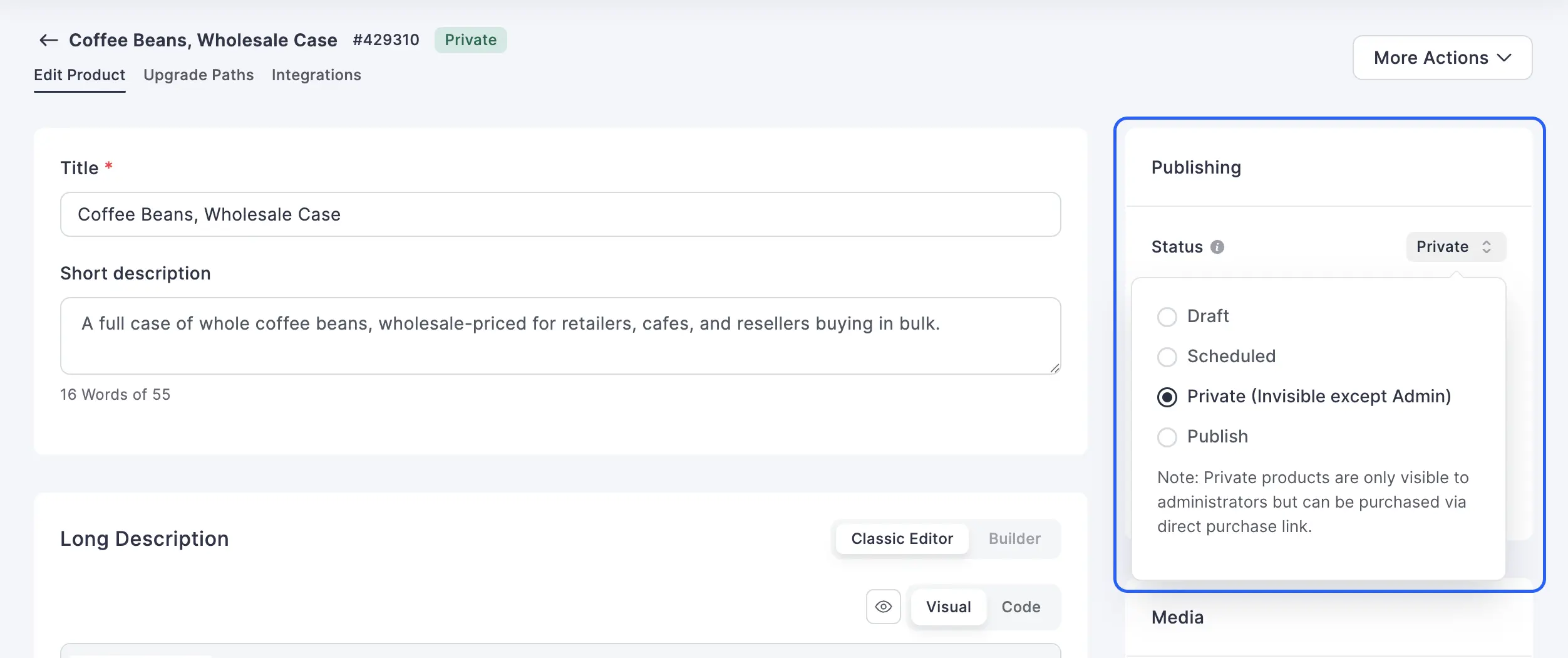
Create a second version of your product specifically for wholesale, priced lower, and set its status to Private.
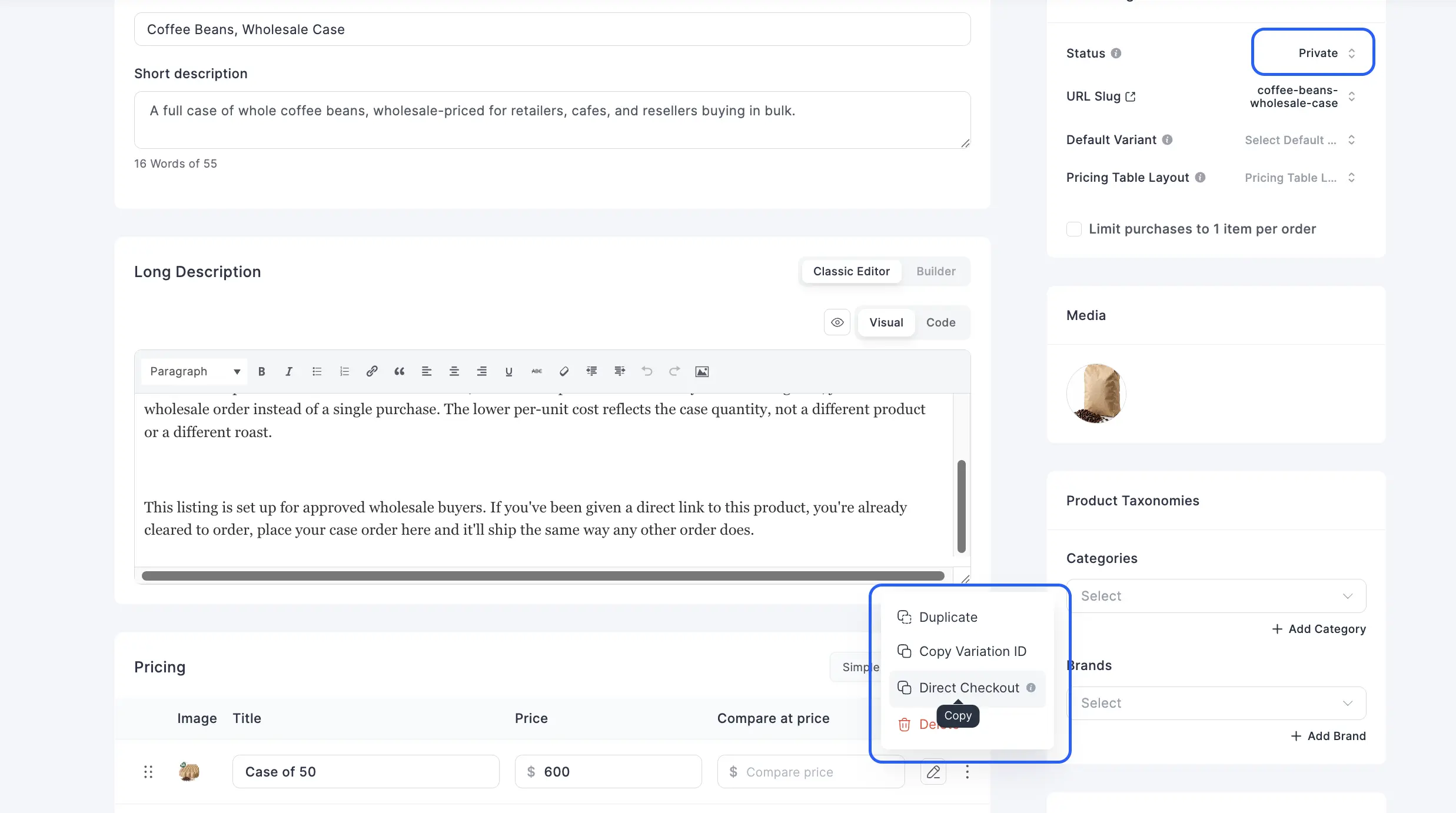
A private product doesn’t show up in your normal store listings, but it can still be purchased through its direct link, so you share that link only with the buyers you’ve approved.
Setup:
- Create your normal retail product as usual.
- Duplicate it, or create a new product, for the wholesale version.
- Set the wholesale price.
- Give it a clear internal title, something like “Coffee Beans, Wholesale Case” or “T-Shirts, Retailer Pack,” so it’s obvious at a glance which product is which.
- Set the product’s status to Private.
- Copy its direct purchase link.
- Share that link only with approved wholesale buyers.
- Place a test order yourself before sending the link out.
Example: a retail product sells one item for $25. The private wholesale version sells a case of 20 for $300, an effective unit price of $15.
What this gets you: a clean separation between retail and wholesale pricing, no coupon code required, and the wholesale product can carry its own description, images, and pack size.
What it doesn’t get you: a private link controls whether someone stumbles onto the product by browsing your store, not who’s actually allowed to buy it. Anyone who receives the link, forwards it, or finds it posted somewhere can use it. Treat this as a catalog-visibility tool, not account-based access control. You’re also maintaining two product records instead of one, so keep an eye on inventory syncing between the retail and wholesale versions if you track stock.
Method 2: Wholesale Pack Products or Variations
Instead of a price that changes automatically with quantity, this method sets fixed prices for fixed pack sizes.
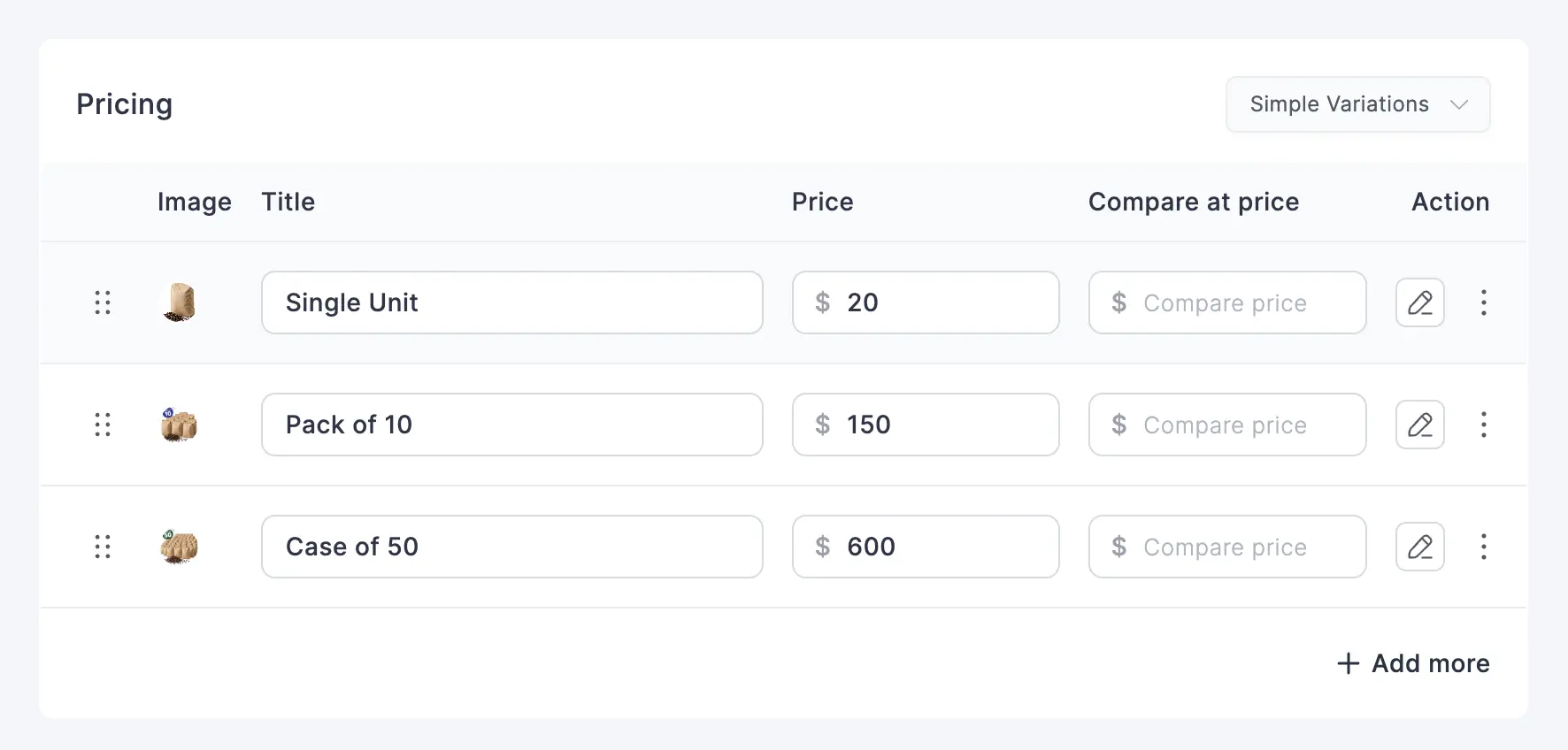
Example structure:
- Single unit: $20
- Pack of 10: $150
- Case of 50: $600
Each pack size is its own priced option, either a separate product or a variation on the same product. The wholesale discount is built into the pack price itself; it is not calculated dynamically when the customer changes the quantity.
This is worth being precise about: FluentCart doesn’t reduce the unit price automatically as someone orders more. What you’re actually doing is creating separately priced pack sizes that represent your wholesale quantities, and the customer picks the pack that fits what they need.
Good fit for: case-based ordering, product bundles, fixed carton sizes, distributor packages, and agency or team license packages, anywhere a handful of standard order sizes covers how your buyers actually order. If you’re using variations that also affect fulfillment, shipping weight, or access in some way, test each one individually before relying on it.
Method 3: Restricted Wholesale Coupons
Coupons in FluentCart can carry real restrictions beyond a simple discount code, and combined correctly, they get close to a wholesale-pricing rule without a second product catalog.
Example setup:
- Code: WHOLESALE20
- Discount type: Percentage
- Discount amount: 20%
- Minimum spend: $500
- Included category: Wholesale Products
- Allowed email pattern: an approved business domain
- Usage limit: set to match your agreement with the buyer
- Expiration: optional
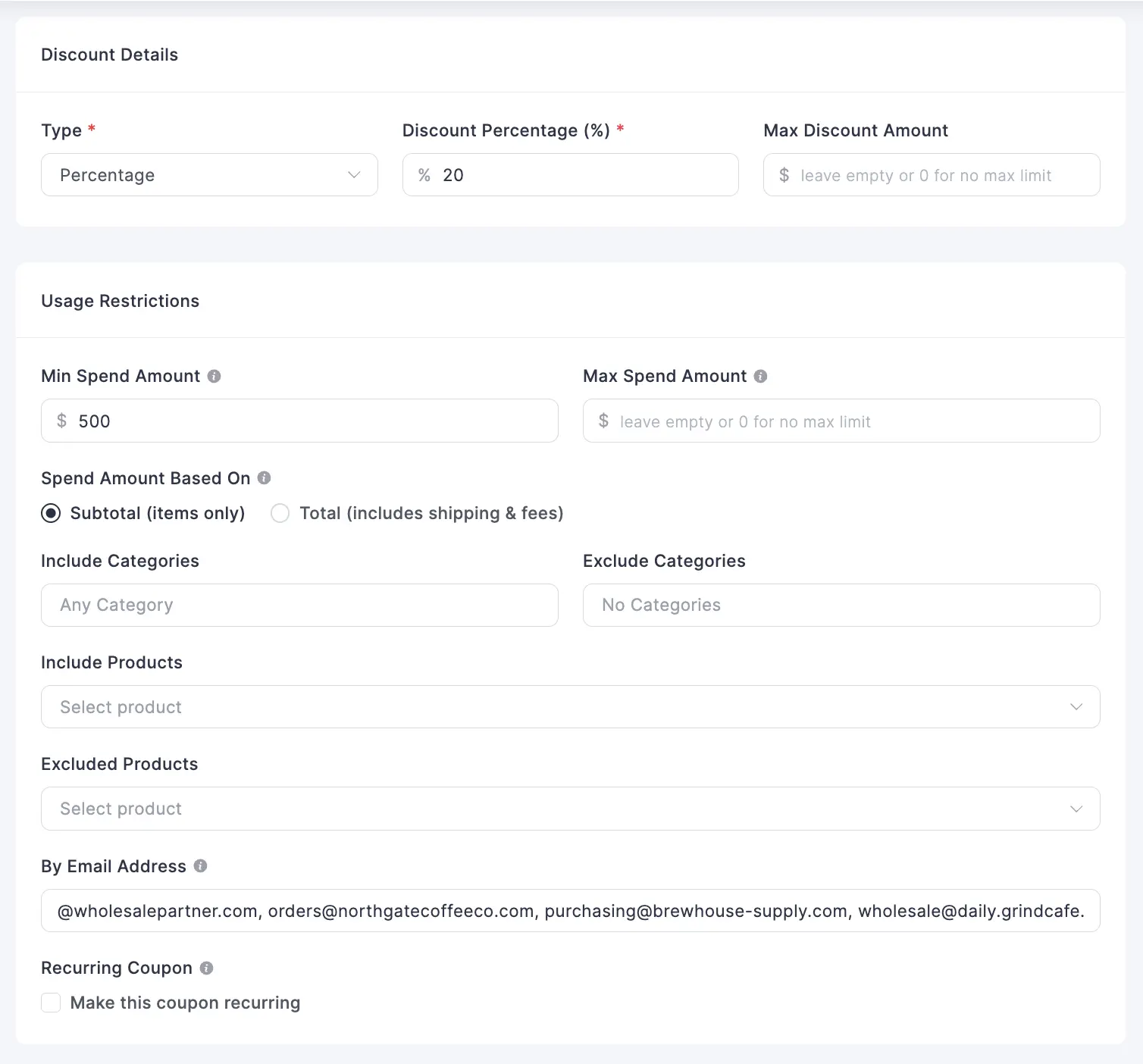
What this gets you: no second product catalog required, discounts that apply only to selected products or categories, a minimum wholesale order value enforced through the minimum spend field, and email restriction that’s tighter than a code anyone could use.
What it doesn’t get you: a coupon code can still be shared or leaked, even with restrictions on it. Email restriction narrows who can realistically apply it, but it isn’t a full dealer-approval workflow. And minimum spend enforces a minimum order value, in dollars, not a minimum item quantity. These are two different requirements. Customers will also see the retail price first and then watch the discount apply, rather than seeing a wholesale price from the start. A recurring coupon can apply to future subscription renewals, but FluentCart does not apply it when the discount would reduce the payable renewal amount to zero.
Method 4: Combine Private Products and Restricted Coupons
Used together, methods 1 and 3 cover more ground than either does alone.
A typical combined setup looks like:
- A private wholesale product with case-based pricing already built in
- A direct link shared only with approved buyers, limiting casual discovery
- An email-restricted coupon on top, for an additional distributor-specific discount
- A minimum spend rule that enforces the agreed order value
- A usage limit and expiration date matched to the buyer agreement
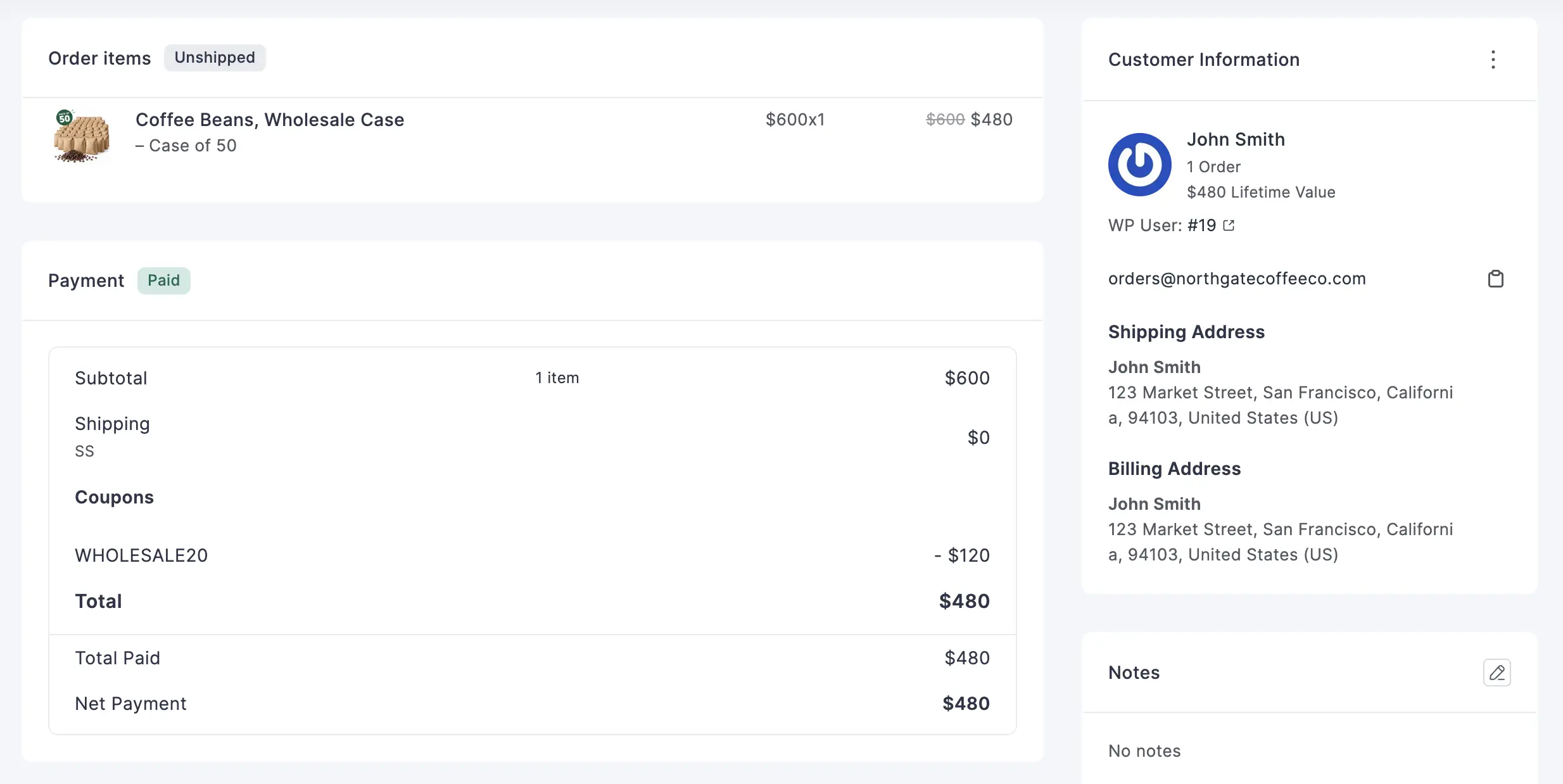
This still isn’t a full wholesale account-management system. Buyers are not applying for and receiving approval through a native wholesale registration workflow, but it’s noticeably tighter than relying on a public coupon by itself, and it’s still entirely no-code.
Setting up wholesale pricing brings up questions a guide can’t always answer. Join the FluentCart community and ask other store owners.
Ask the people who’ve already set this up. Join the FluentCart Community.
Method 5: When Custom Development Is the Right Answer
Some wholesale requirements aren’t things any combination of native FluentCart settings can deliver, and it’s worth saying so plainly rather than stretching a workaround to fit.
Custom development is the honest answer if your store needs:
- Pricing tied automatically to a WordPress user role
- Approved-customer pricing that applies without a coupon
- Quantity-based price breaks that adjust as order size changes
- Customer-specific or distributor-level price lists
- Enforced minimum order quantities or case multiples
- Wholesale-only products hidden from every non-approved account
- Tax-exempt handling for qualifying business customers
- Contract-specific pricing tied to an individual buyer
One thing matters more than any feature list here: price and authorization logic has to be enforced on the server, not just changed in what the browser displays. A frontend-only price adjustment can be manipulated by anyone who knows how, so any custom wholesale pricing work needs the actual calculation and buyer verification happening server-side, not just visually.
Whatever gets built should be tested against the full order lifecycle before it goes live: product and variation prices, cart recalculation, checkout totals, coupon stacking, taxes, shipping, refunds, subscription renewals, order editing, reports, emails and invoices, guest versus logged-in checkout, and cached pages. A wholesale pricing rule that works at checkout but breaks on a refund or a renewal isn’t finished yet.
Choosing the Right Approach
| Your situation | Best starting point |
|---|---|
| A small, known list of wholesale buyers | Restricted coupon |
| Fixed case or pack pricing | Pack products or variations |
| Separate retail and wholesale catalogs | Private wholesale products |
| Discounts based on order value | Coupon with minimum spend |
| More control, still no code | Private products plus restricted coupons |
| Automatic pricing by user role | Custom development |
| Automatic quantity-break pricing | Custom development |
| Customer-specific price lists | Custom development |
| Formal wholesale account approval | External workflow or custom development |
| Enforced minimum quantities or case multiples | Custom development, or carefully designed pack products |
The table above tells you which method fits your situation, but not what number to actually type into it. A 20% wholesale discount means something very different depending on your margins.
Use the calculator below to work out your own numbers before you set anything up in FluentCart.
Testing Checklist Before You Go Live
Whichever method you land on, confirm the following before sending pricing to real wholesale buyers:
Wrapping Up
FluentCart supports a straightforward wholesale pricing workflow through private products, fixed pack pricing, and restricted coupons. These handle simpler B2B arrangements well, and combining them covers many straightforward wholesale requirements.
If your store needs automatic role-based pricing, dynamic quantity breaks, formal account approval, or customer-specific price lists, that’s the point where custom development is the honest next step, not another workaround stacked on top of a coupon.
Every store finds its own way to run wholesale pricing. Join the FluentCart community and see how others are doing it.
Real store owners. Real problems. Real answers. Join the FluentCart Community.

Hi, this is Sajid, a Marketing Strategist who creates content and visuals designed for maximum audience engagement. I also love exploring different tech tools, always curious to see what’s out there.

Subscribe now
Related Articles and Topics
-
How to Build an Online Community With FluentCart
Learn how to build an online community with FluentCart and FluentCommunity, from planning access levels to testing the…
-
FluentCart Ecommerce Plugin: Smartest WordPress Store
Before you build your online store, see why FluentCart eCommerce plugin solves the problems that quietly kill new…
-
Buy One Get One Free: A FluentCart Guide for WordPress Store Owners
A complete buy one get one free setup guide in FluentCart, using three methods, so you can pick…




Leave a Reply