
Pure Play eCommerce: What It Is and How It Works in 2026
The internet removed one of commerce’s oldest assumptions that selling requires a physical place to sell from. A brand today can launch, grow, and generate real revenue without a single store, a lease, or a retail floor. That model is called Pure Play eCommerce.
But in 2026, the pressure on digital-only retailers is higher than it has ever been, and the tension between staying pure play and expanding into omnichannel is a decision most growing brands eventually face.
In this blog, we will break down exactly what pure play ecommerce is, how it operates, where it genuinely wins, where it runs into structural limits, and how to decide whether it is the right model for your business.
TL;DR
- Pure Play eCommerce means selling exclusively online with no physical stores, pop-ups, or brick-and-mortar presence of any kind.
- It runs on three functions: traffic acquisition, conversion, and fulfillment. All three must work or the economics break down.
- The core advantages are lower overhead, focused digital experience, global reach, and richer data.
- The core risks are expensive returns, slower brand visibility, and rising customer acquisition costs.
- Warby Parker, Zalando, and Adored Vintage all started pure play and built durable businesses by investing in digital infrastructure early.
- It fits best for early-stage brands, niche products, and organic acquisition models. It becomes limiting when return rates are high or paid CAC is unsustainable.
- The foundation that makes it work: strong product pages, honest pricing, clean checkout, and a clear returns policy.
What is Pure Play eCommerce?
Pure play eCommerce is a business model in which a retailer sells goods or services exclusively through digital channels, operating no physical stores, pop-up retail locations, or brick-and-mortar presence of any kind.
Every customer interaction, every transaction, and every part of the fulfillment process happens entirely online, whether through a brand’s own website, a mobile app, or third-party online marketplaces.
The term originally described companies focused on a single industry or product line. Over time it came specifically to identify online-only retailers. Today when someone says pure play retailer, they mean a business whose entire commercial surface exists on the internet.
What separates the eCommerce model from simply having an online store is the total absence of physical retail. The website is not a supplementary channel. It is the entire commercial operation. Product discovery happens through search and social.
Trust is built through reviews, returns policy, and brand design. The checkout experience carries the full weight of a closing moment that in physical retail a shop floor and a trained sales associate would share.
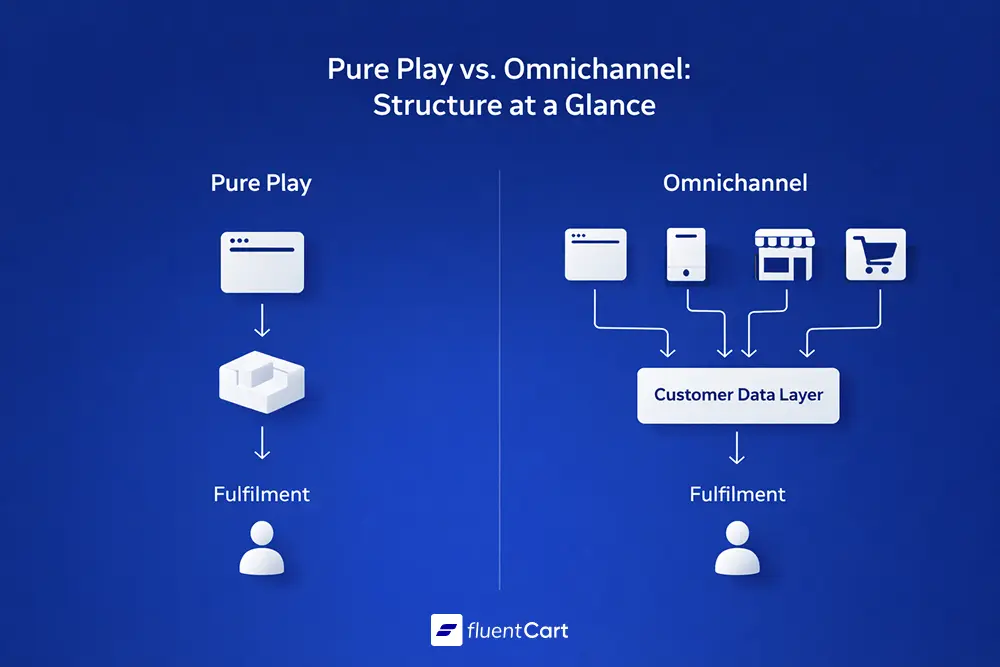
Pure Play vs. Omnichannel
Pure play and omnichannel are not just different channel strategies. They represent different cost structures, different customer relationships, and different growth ceilings.
Pure play
This model concentrates every commercial activity in digital channels. Every sale and every brand impression lives online. The advantage is focus and lower fixed cost. The constraint is that every impression must be earned or bought. Nothing happens passively.
Omnichannel
Omnichannel integrates multiple channels into one connected customer experience. A shopper can discover a product through Instagram, evaluate it on a website, and pick it up from a local store that afternoon.
Here is how the two models compare across what matters most:
| Pure Play | Omnichannel | |
| Channel presence | Online only | Digital and physical |
| Overhead cost | Low | Higher |
| Customer touchpoints | Digital only | Digital and in-person |
| Brand visibility | Earned only | Ambient and earned |
| Fulfillment complexity | Moderate | Higher |
| Data richness | High | High |
| Best suited for | Launch and niche brands | Scaling and established brands |
The honest question is never which model is better in the abstract. It is: pure play until when, and then what?
How Does Pure Play eCommerce Actually Work?
A pure play retailer’s entire operation runs on 3 core functions. Get these right and the model works. Miss any one of them and the economics deteriorate fast.
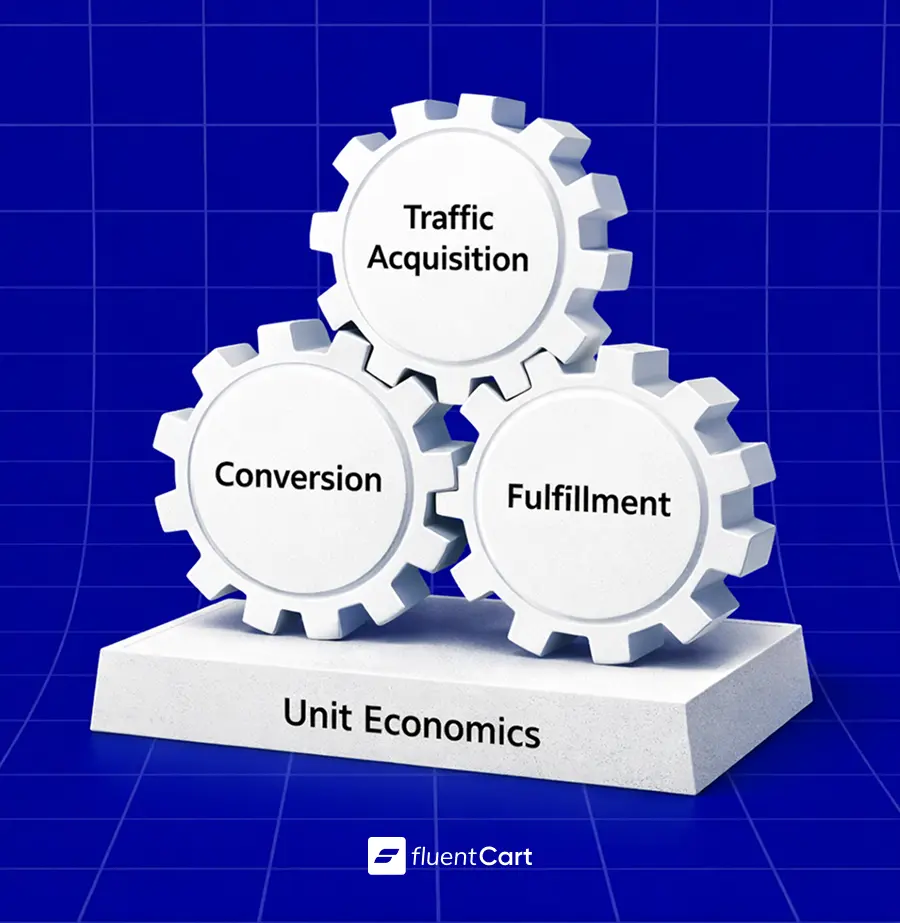
- Traffic acquisition is the engine. Every visitor must be earned or paid for. There is no foot traffic, no location advantage, no passive walk-in. “Customer acquisition costs have risen 60% over the last five years”, which makes owned channels like SEO, email, and community increasingly important for sustainable unit economics. Knowing how to increase website traffic through non-paid channels is a financial necessity for any pure play operator.
- Conversion happens entirely on the product page and at checkout. There is no sales associate, no tactile product experience. The page must do all the work. This is why eCommerce product page design and product descriptions that convert are not cosmetic concerns. They are the mechanism through which sales actually close.
- Fulfillment is either managed in-house or outsourced to a third-party logistics provider. Pure play retailers have no stores to absorb walk-in returns. Every return generates a two-way shipping cost that compounds in high-return categories and must be built into margin modeling from day one.
The model is lean when all three functions work in alignment. It becomes expensive when any one breaks down.
Pros of Pure Play for Retailers
The model offers structural advantages that go beyond a simple cost comparison. For the right business at the right stage, these advantages are real and they compound. Here is where the model genuinely earns its place.
1. Lower Overhead, Higher Agility
A pure play eCommerce business avoids the fixed costs tied to physical retail. There is no commercial lease, no store build out, no in store staffing, and no utilities for a physical location. This keeps overhead lower than brick and mortar models and frees capital for product, marketing, and operational improvement.
In major US cities, retail leases range from $50 to over $200 per square foot per year. A 2,000 square foot store can cost $100,000 to $400,000 annually in rent alone before staffing and utilities. Pure play retailers replace these fixed obligations with platform, hosting, and fulfillment costs that scale with revenue.
Lower overhead also increases agility. A pure play retailer can adjust pricing, product mix, and marketing direction faster without long term lease commitments.
2. Full Focus on the Digital Experience
When the website is your only store, you invest in it accordingly. Navigation, product imagery, mobile checkout, and post-purchase communication all receive concentrated attention that split-channel retailers divide across multiple operational priorities.
Pure play sellers tend to have better conversion rates across direct, organic, and paid search traffic than brick-and-mortar retailers with minimal online presence. The reason is concentrated investment in one channel.
This is where infrastructure choices make a measurable long-term difference. Operators building on WordPress who want checkout and storefront performance that reflects the model’s standard will find that a tool like FluentCart gives them the control operation demands.
When your digital storefront is your only revenue surface, it has to be excellent. There is no physical store to compensate for a weak online experience.
3. Easier to Scale Globally
Physical retail scales by opening locations. Each new market requires capital, local staffing, regulatory navigation, and years of brand-building. The model scales by adjusting shipping zones, localizing product pages, and connecting to local payment processors.
Brand can address buyers in Germany, Australia, or Singapore without a single location outside its home market. That global accessibility is a genuine structural advantage. Particularly, for niche products where no single domestic market has enough addressable demand to support a physical retail footprint but the global aggregate does.
4. Richer Data, Faster Decisions
Every interaction in this type of store is measurable. Click paths, scroll depth, cart abandonment, checkout drop off, return patterns, and repeat purchase intervals are all visible in real time. Physical retailers rely mainly on point of sale data. These retailers have a complete behavioral record of each customer session.
Tracking eCommerce KPIs such as conversion rate, average order value, and customer lifetime value gives operators clear performance signals. Unlike physical retail, where insights come from observation and delayed reports, digital data can be analyzed and acted on within hours.
Cons of Pure Play for Retailers
Every structural advantage in the model comes with a corresponding constraint. These are not rare edge cases but core operational realities. Any serious operator needs to account for them from the outset and build the business with those trade-offs in mind.
1. Returns Cost More
In a physical store, a customer who changes their mind can walk back in and hand the item over. The cost to the retailer is usually limited to staff time and simple restocking.
In a pure play operation, every return triggers shipping in both directions, inspection, restocking or disposal, and refund processing. These steps add real expense and operational friction. For categories such as apparel, where fit and expectations often vary, return volumes can quickly pressure margins.
Brand needs to account for return costs directly in its contribution margin modeling from the start. A clear and well-communicated returns policy can reduce hesitation before purchase and help maintain conversion, partially balancing the financial impact.
2. Brand Visibility Takes Longer to Build
Physical stores do passive brand work that the model cannot replicate. Signage on a busy street. A shopping bag carried through a neighborhood. A window display seen by thousands who never entered. Staff who become natural brand advocates in their communities. These are not marketing campaigns. They are ambient brand presence that exists simply because the store is there.
Pure play brands must earn every single impression through advertising, SEO, content, and community building. Discussions among eCommerce operators often highlight the challenge pure play brands face in gaining traction without offline visibility, with many emphasizing the need for strong digital marketing, SEO, and community engagement.
The answer is almost always the same. The product is fine, the site is fine, but the brand has no presence anywhere in the physical world. This eCommerce model operators must treat brand building as an active and ongoing cost of doing business.
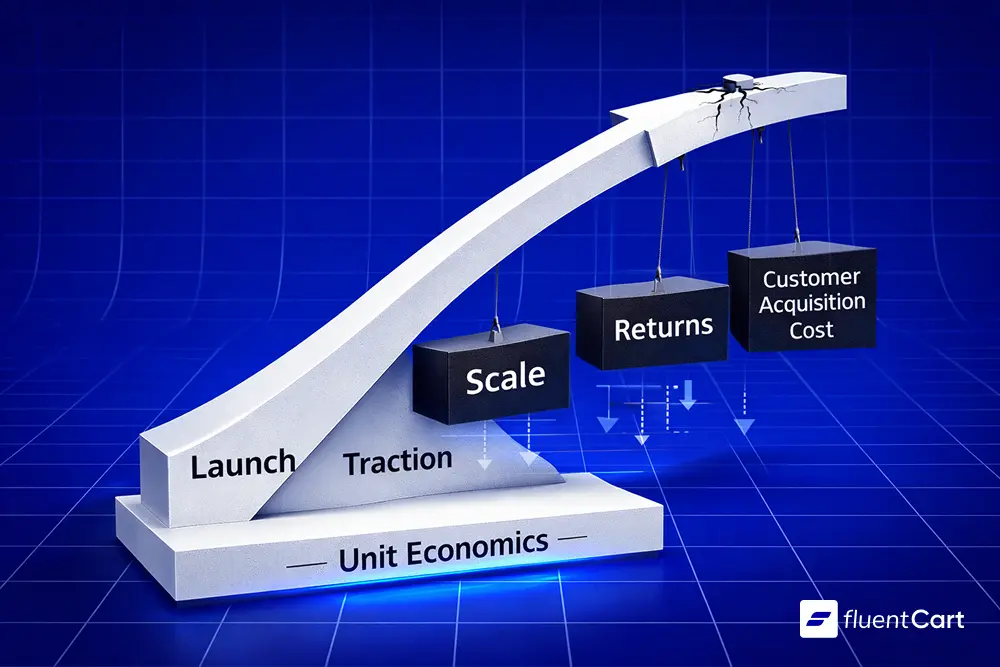
3. Customer Acquisition Gets Expensive Fast
Customer acquisition has become one of the most significant structural challenges for pure play retailers. Costs have risen sharply in recent years, driven by platform competition and tighter privacy regulations that limit targeting efficiency.
A brand that was profitable at a lower CAC a few years ago may now be operating close to break even with the same product and conversion rate. The underlying economics have shifted.
Brands adapting successfully are investing in organic channels such as SEO, focusing on customer lifetime value, and strengthening retention programs to reduce dependence on paid acquisition.
Image 2
Pure Play eCommerce Examples (That Worked)
The most instructive examples are not Amazon and ASOS. Every competitor article leads with them and neither tells you much about the decisions a growing brand actually faces. These three are more useful.
1. Warby Parker
Launched in 2010 selling prescription eyewear exclusively online at a fraction of what optical retailers charged. They addressed the core objection to buying glasses without trying them through a home try-on program shipping five frames to test before committing.
By 2015 they had served over one million customers as a pure play brand before expanding to over 300 physical stores. Their progression is the clearest template in modern eCommerce: validate with the model, expand channels when the economics make sense.
2. Zalando
Launched in Berlin in 2008 selling shoes online and scaled across Europe by making free returns a core operational principle rather than a reluctant cost center. Their pure play origins forced them to solve returns structurally.
That discipline became a competitive moat that brick-and-mortar competitors could not match on price or convenience.
3. Adored Vintage
Adored Vintage has remained online only and built a loyal customer base through aesthetic consistency and a curated product selection that does not try to compete with volume retailers.
Their market does not require physical locations. The lesson is simple: not every brand needs to go omnichannel. Some pure play operations stay like it is because the model fits the market cleanly and permanently.
The pattern is consistent. Pure play model works when the digital experience is excellent, the product has genuine online fit, and the acquisition strategy builds compounding value rather than burning through paid budgets.
Is Pure Play Right for Your Business?
Whether the model is right for your business depends on what you sell and what stage you are at.
| Consider Pure Play If | Consider Expanding Channels If |
| You are at the validation stage and need to test demand before committing capital to physical infrastructure. | Your category carries return rates above 20% that are compressing margins at scale. |
| Your product ships easily, photographs well, and does not require physical inspection before purchase. | Paid acquisition costs have made growth unprofitable without unusually strong lifetime value and retention. |
| You have a niche audience reachable through organic content, community, or referral rather than relying entirely on paid advertising. | Your product requires physical evaluation before purchase (e.g., furniture, luxury goods, complex-fit apparel, high-value technical hardware). |
| Your category has a proven track record of online purchasing behavior without structurally high return rates. | You compete directly against omnichannel retailers who offer faster fulfillment through local inventory and in-store pickup. |
| Your target customers expect a strong digital-native experience and are comfortable buying without touching the product first. | Your margins are being pressured by logistics, returns, and acquisition costs at higher order volumes. |
One honest question to answer
Would your customer buy this product without seeing or touching it first? If yes, Pure Play eCommerce Model fits. If a meaningful segment would not, that segment is your ceiling until you expand.
Starting the model and expanding when the data supports it is different from staying like that permanently. The first is a growth path. The second works for some categories and becomes a constraint for others.
If you are building or refining a pure play operation today, eCommerce management, product pricing, and a clear returns policy are the three fundamentals that determine whether your store retains customers or constantly replaces them.
Wrapping Up
The online-only retailer is a proven starting point for retail in the digital age. It lowered the barrier to entry dramatically and created brands that never needed a physical location to build real scale.
The model still works, but the environment around it is more demanding than it was five years ago. Acquisition costs are higher, consumer expectations are broader, and omnichannel competitors are better resourced.
The pure play brands that last are the ones that invest in owned channels, build retention into their operations, and get their digital infrastructure right from the beginning.
If you are building an online store today, FluentCart gives you the foundation to do exactly that on WordPress.
Once In a Lifetime Offer

Deputy Marketing Lead, published literary author, and musician. I thrive on marketing for tech companies while composing music, collecting books of lasting depth, exploring cinema with a discerning eye, and studying the arts and history.

Subscribe now
Related Articles and Topics
-
Is Dropshipping Worth It in 2026? Profitability, Trends & Real Challenges
Is dropshipping worth it in 2026? A practical look at profitability, market trends, challenges, and which sellers tend…
-
Custom CSS For Online Product Card Design in FluentCart
We have built styles with Custom CSS for your online product card design in FluentCart to give your…
-
What’s New in WordPress 6.9: Walkthrough
The year is almost coming to a close, and we have brand-new WordPress release news. WordPress 6.9 is…




Leave a Reply