
What is Retail? Definition, Types, and How It Works in 2026
Every time you grab groceries, order a hoodie online, or walk into a bookstore, you are participating in retail. It is one of the oldest economic activities in human history and one of the largest industries on the planet today. Yet most people who work in it, sell through it, or study it, cannot define it cleanly when asked.
So, in today’s blog, we will break down what retail really means, how it works across the supply chain, how retailers make money, and what it takes to succeed in today’s evolving marketplace.
TL;DR
- Retail is the sale of goods or services directly to end consumers for personal use.
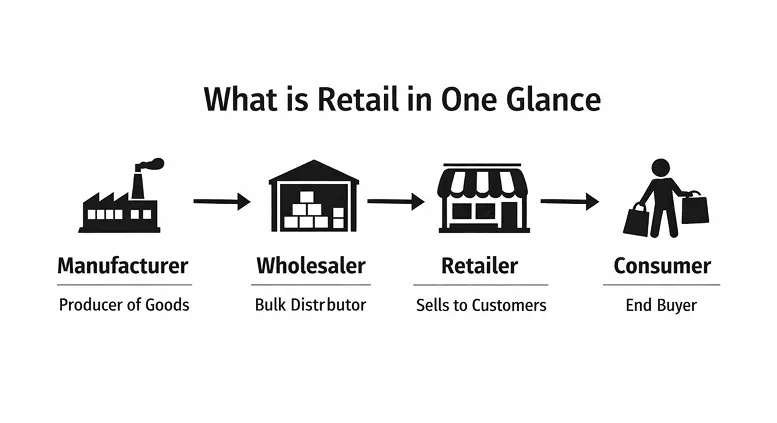
- Retailers sit at the final stage of the supply chain: manufacturer → wholesaler → retailer → consumer.
- Retail differs from wholesale in that it sells to individuals in small quantities, not to businesses in bulk.
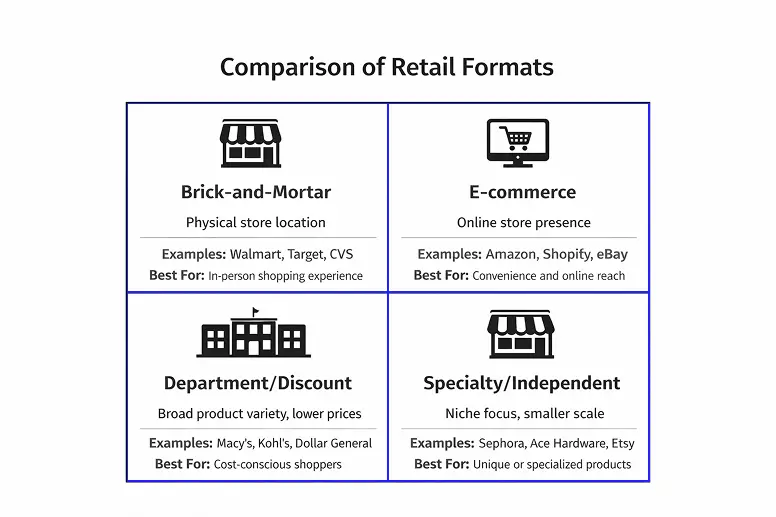
- The main retail formats include brick-and-mortar stores, ecommerce stores, department stores, discount stores, and specialty/independent shops.
- Retailers make money through markup: the difference between what they pay for goods and what they charge customers.
- Success in retail depends on customer experience, omnichannel presence, smart pricing, and inventory discipline.
- Technology such as AI, POS systems, and data analytics is rapidly reshaping how retail operates.
- Global retail sales reached approximately $30.6 trillion in 2024 and are projected to exceed $37 trillion by 2030.
What is Retail?
Retail is the process of selling goods or services directly to individual consumers for personal use, in small quantities, typically at a marked-up price above what the retailer paid to acquire those goods.
It is the final transaction in a product’s journey from creation to consumption. When someone buys a pair of running shoes at a sports store, books a flight through a travel agency, or checks out a skincare product on an ecommerce website, that is a retail transaction. The buyer is not reselling the item; they are using it.
The word itself traces back to the Old French retaillier, meaning “to cut into pieces” or “to sell in small amounts.” That origin still defines the concept perfectly. Retail cuts large quantities down into individual units and delivers them to the people who will actually use them.
This covers an enormous range of businesses. Physical stores, online shops, service providers, subscription boxes, pop-up stalls, and vending machines all qualify. If the transaction is between a business and a final-use consumer, it is retail.
How Retail Works: The Supply Chain Explained
Retail does not happen in isolation. It is the final step in a four-stage supply chain that begins long before any product reaches a shelf or a checkout page.
- Manufacturers produce the goods. They source raw materials, run production, handle quality control, and package the product. A shoe manufacturer, for example, manages everything from rubber soles to lace eyelets before a single pair ships out.
- Wholesalers buy those finished goods in large volumes at lower per-unit prices. They warehouse stock and distribute smaller batches to multiple retailers. Their role is logistics and bulk distribution.
- Retailers then purchase from wholesalers (or directly from manufacturers) and sell to individual buyers at a higher price. That price difference is how they cover operating costs and generate profit.
- Consumers are the endpoint. They buy in small quantities for personal use and complete the chain.
Each link adds value. Wholesalers create availability at scale. Retailers create convenience, accessibility, and context. A consumer does not need to call a factory to buy a toothbrush. The retailer has already done that work.
Retail vs. Wholesale: What’s the Difference?
The simplest way to understand the difference: wholesale sells to businesses, retail sells to people.
A wholesale transaction involves bulk quantities at a lower unit cost. A mattress brand selling 500 units to a furniture chain is wholesale. That same furniture chain selling one mattress to a customer walking through the door is retail.
Key distinctions:
- Buyer type: Wholesalers sell to businesses or institutions. Retailers sell to individual consumers.
- Quantity: Wholesale deals in large volumes. Retail sells single or small units.
- Price: Wholesale prices are lower per unit because buyers take on storage and redistribution costs. Retail prices are higher to cover overhead, staffing, and service.
- Relationship: Wholesale is often B2B and contract-driven. Retail is consumer-facing and transaction-by-transaction.
Some businesses do both. Amazon sells individual products to consumers (retail) and also sells bulk inventory solutions to businesses (wholesale-adjacent). The defining rule, in most legal jurisdictions, is that if at least 80% of sales go to end-use consumers, the business is classified as a retailer.
Types of Retail Businesses
Retail is not one thing. It is an umbrella term that covers dozens of business models, formats, and operating structures. The format a retailer chooses shapes everything: their cost structure, their customer relationship, their marketing approach, and their growth ceiling.
Physical retail still accounts for approximately 80.1% of worldwide retail sales, while ecommerce represents around 19.9%. But that ratio is shifting fast. By 2026, ecommerce is forecast to claim 21.1% of total global retail, pushing physical retail’s share below 79% for the first time. Understanding the formats helps you see where the industry is today and where it is heading.
Here are the four formats that matter most:
1. Brick-and-Mortar Stores
These are physical retail locations: the supermarket down the street, the clothing boutique in the mall, the hardware store around the corner. Customers walk in, browse, touch the product, and buy on the spot.
The strength of brick-and-mortar retail is immediacy and sensory engagement. Customers can try things before buying. Staff can answer questions in real time. The shopping experience itself can become a reason to return.
The challenge is overhead. Rent, utilities, staffing, and in-store fixtures all cost money regardless of how many people walk through the door. On Black Friday 2024, 81.7 million consumers shopped in stores, up from 76.2 million the previous year, marking the highest in-person turnout since the pandemic. Physical retail is not dying. It is evolving.
Retailers like Apple have turned the physical store into a brand statement. Grocery chains have doubled down on prepared foods and in-store experiences. The physical format, when done well, still builds loyalty that no algorithm can fully replicate.
2. Ecommerce Stores
Ecommerce retailers sell through digital channels: websites, apps, and online marketplaces. The customer browses, selects, pays, and waits for delivery, all without leaving home.
Global online retail sales were forecasted to reach approximately $6.56 to $6.86 trillion in 2025. This represents roughly 21% of total global retail spending as eCommerce steadily takes share from physical stores every year.
The appeal is scale. An ecommerce store can reach buyers in dozens of countries without a single physical location. Operating costs are lower, and the data collected from browsing and purchasing behavior is extraordinarily rich.
The challenge is standing out. Competition online is intense and customer acquisition costs are rising. Conversion rates on most ecommerce sites hover between 1% and 4%. Winning requires more than a good product listing. It requires speed, trust signals, mobile optimization, and a checkout experience that removes every possible point of friction.
For sellers building or growing an ecommerce store, understanding ecommerce product page design and how to write a product description that converts are foundational skills that compound over time.
3. Department and Discount Stores
Department stores offer a wide variety of product categories under one roof, organized by department. Think clothing, cosmetics, homewares, and electronics all in the same building. Macy’s, Nordstrom, and John Lewis are classic examples. Their draw is variety and convenience for shoppers who prefer one-stop trips.
Discount stores operate on a similar multi-category model but prioritize low prices over brand prestige. Dollar General, Aldi, Kmart, and similar chains serve price-sensitive shoppers who want functional products without paying premium rates. These stores generate profit through high volume on thin margins.
Both formats face pressure from online competition, but discount stores have proven more resilient. When cost-of-living pressure rises, discount retail tends to grow. A Reddit thread in r/personalfinance once ranked dollar stores among the first businesses to see foot traffic spikes during recessions, and the data backs that up.
4. Specialty and Independent Stores
Specialty retailers focus on one product category and go deep. A running shoe store. A kitchen supply shop. A comic book retailer. A plant nursery. These stores attract customers who want expertise, curation, and selection that a general retailer cannot offer.
Independent stores, often called mom-and-pop shops, are small-scale retail businesses run by individual owners or families. They tend to serve a specific neighborhood or niche community. Their advantage is personal connection and local trust. Their disadvantage is limited buying power and thin margins compared to chain retailers.
Both specialty and independent formats thrive when they offer something chains cannot: deep product knowledge, community relationships, or a shopping atmosphere that feels personal rather than transactional.
How Retailers Make Money
Retailers make money through markup: buying goods at one price and selling them at a higher price. The gap between acquisition cost and selling price is called the gross margin. What remains after operating expenses is the net profit.
For example, a product costs $4 from a wholesaler. The retailer sells it for $10. The gross margin is $6, or 60%. But from that $6, the retailer must pay for rent, staff wages, marketing, packaging, returns processing, and payment handling fees. What survives all of that is profit.
Understanding the difference between margin and markup is essential for any retailer trying to price correctly. Markup is the percentage added to cost. Margin is profit expressed as a percentage of revenue. Confusing the two leads to systematic underpricing.
Retailers also use tools like contribution margin analysis to identify which products genuinely drive profitability and which ones look good on the surface but drain resources.
Pricing strategies vary widely. Everyday low pricing builds trust with habitual buyers. High-low pricing (regular price + periodic sale) drives traffic spikes. Loss leaders attract shoppers with one deeply discounted item, counting on them to buy higher-margin products alongside it. Psychological pricing, like ending a price at $9.99 instead of $10, exploits the way buyers perceive value.
Knowing how to price a product well is arguably one of the most leveraged skills in retail. A 5% improvement in pricing strategy can double profitability for businesses operating on 10% net margins.
What Makes a Retail Business Successful?
The basics of retail are simple. Run the business well, and the details get complicated fast. Across Reddit forums, industry reports, and the experience of operators who have scaled stores to millions in revenue, the same patterns keep appearing.
- Customer experience is the moat. Products can be copied. Prices can be matched. The way a customer feels when they interact with your brand is much harder to replicate. In the US, 75% of consumers shop both online and in physical stores, and 70% of shoppers use three or more channels during a single purchase journey. Meeting customers across those touchpoints, consistently, is what builds the kind of loyalty that survives competition.
- Inventory discipline separates profitable retailers from struggling ones. Dead stock ties up cash and takes up space. Understanding inventory deeply, knowing your turn rates, and keeping deadstock under control are habits that show up directly in cash flow.
- Omnichannel presence is no longer optional. Retailers who offer seamless experiences across in-store, web, and mobile consistently outperform those who treat channels as separate operations. 34.2% of US consumers use buy online, pick up in-store (BOPIS) services, and 70% turn to social media to discover, review, and purchase products.
- Returns policy affects buying decisions. Shoppers read return policies before purchasing, especially online. A clear, generous return policy reduces purchase anxiety and often increases conversion rates more than a discount would.
- Marketing must be measurable. Understanding ecommerce KPIs like conversion rate, average order value, customer acquisition cost, and lifetime value tells you whether your marketing is working or just spending money.
Therefore, success in retail is not one big thing. It is a dozen small disciplines executed consistently.
How Technology is Changing Retail
Technology has always changed retail. The barcode changed stocktaking. The credit card changed checkout. The internet changed everything. What is happening now is arguably the most transformative period in retail history since the department store era of the 19th century.
The global AI in retail market size was estimated at USD 11.61 billion in 2024 and is projected to reach USD 40.74 billion by 2030, growing at a CAGR of 23.0%. That growth reflects how deeply artificial intelligence is being woven into demand forecasting, dynamic pricing, personalization, fraud detection, and inventory optimization.
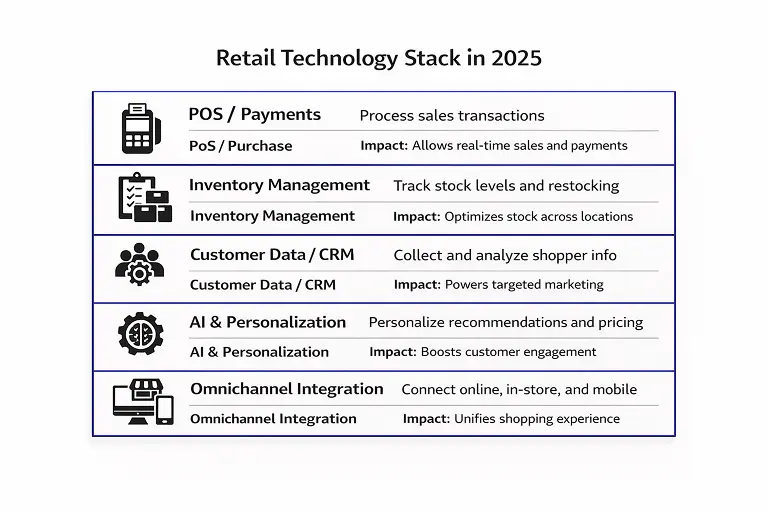
- Point-of-sale (POS) systems have evolved from cash registers into full retail management platforms. Modern POS tools track sales in real time, manage inventory across locations, collect customer data, and integrate directly with ecommerce backends. For retailers using WordPress, tools like FluentCart bring this kind of integrated commerce infrastructure natively into the system without requiring complex third-party stitching.
- AI-powered personalization now drives product recommendations, email timing, and search result ranking. Retailers who use personalization report significant lifts in average order value and repeat purchase rates. Nearly 54% of retail marketers already use AI-driven personalization across channels (Invesp).
- Mobile commerce is now central, not supplementary. In the US, mobile accounts for approximately 44% of online retail sales. Therefore, retailers who have not optimized for mobile checkout are not just behind on UX. They are actively losing transactions.
- Data analytics gives retailers visibility that previous generations never had. Understanding which products drive traffic but not profit, which customers have high lifetime value, and which marketing channels generate real returns is now table stakes for any serious retail operation. Ecommerce CRO audits and systematic data review are how modern retailers find the margin that basic operations miss.
Wrapping Up
Retail is the act of selling directly to the people who will actually use what they buy. It is the final link between production and consumption, and it accounts for tens of trillions of dollars in economic activity every year.
Understanding what retail is, how it works, and what separates successful retailers from struggling ones is not just academic. It is practical knowledge for anyone building a business, managing a store, or selling products online.
The fundamentals have not changed in centuries. Buy well, sell at the right price, treat customers properly, and keep your operations lean. What has changed is the speed, the competition, and the tools available to execute those fundamentals better than ever before.
Once In a Lifetime Offer

Deputy Marketing Lead, published literary author, and musician. I thrive on marketing for tech companies while composing music, collecting books of lasting depth, exploring cinema with a discerning eye, and studying the arts and history.

Subscribe now
Related Articles and Topics
-
What Is Petty Cash? Examples, Uses, and Smarter Alternatives
Learn what petty cash is, how the imprest system works, how to record and reconcile it, and whether…
-
What Is Order Management? (And Why It Gets Messy Fast) [Guide]
Order management is the process of order capturing, tracking, and fulfilling customer orders. The order management process begins…
-
SKU: Definition, Examples, and How to Use It for Your Store
Learn what SKU means, how stock keeping units work, and how to create SKU codes for your ecommerce…




Leave a Reply