
What is Brand Equity? Meaning & How to Build One

Two products sit side by side on a shelf. Same ingredients. Similar price. One has a name you know; the other you have never heard of. You reach for the familiar one without much thought. That moment is brand equity in action.
Brand equity determines whether customers choose you instinctively, pay more without hesitation, and come back without being asked. For businesses at any stage, understanding what drives that preference is the difference between competing on price and competing on reputation.
In this blog, we will cover what brand equity means, its core components, how it is measured, how to build it, and what damages it.
TL;DR
- Brand equity is the commercial value a brand generates beyond its product features, based on consumer perception
- It is built through awareness, perceived quality, brand associations, loyalty, and proprietary assets
- Positive brand equity drives higher prices, stronger loyalty, and easier expansion
- Negative brand equity happens when one scandal, recall, or sustained failure erodes trust
- It is measured through brand awareness surveys, Net Promoter Scores, and financial brand valuation
- Consistency over time is the single most reliable way to build it
What Is Brand Equity?
Brand equity is the commercial premium a brand generates through consumer perception, trust, and recognition, beyond the functional value of the product or service itself. It represents how favorably customers perceive, feel about, and respond to a brand.
That consumer-side perception gives businesses the ability to charge higher prices, attract repeat buyers, and extend into new markets with lower risk.
The concept was formally introduced by David Aaker, a marketing professor at the University of California, Berkeley, in his 1991 book Managing Brand Equity.
Aaker defined it as the set of brand assets and liabilities linked to a brand name that add to, or subtract from, the value of a product. His framework shifted how businesses thought about brands.
For the first time, brand was treated as a long-term financial asset to be built, protected, and leveraged.
The 5 Components of Brand Equity
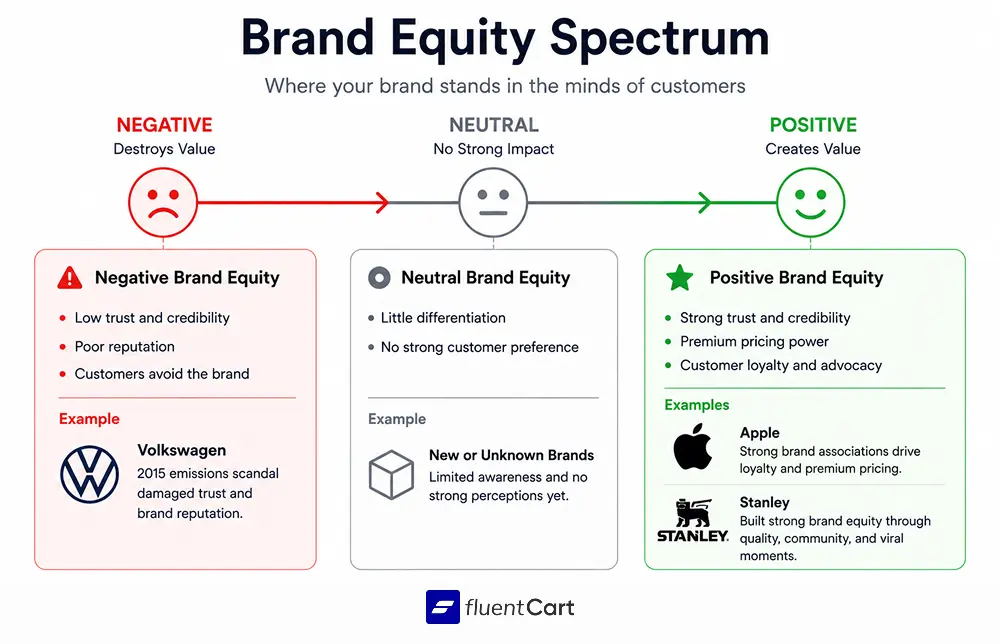
Aaker’s model organizes brand equity into five dimensions. Each one contributes to how consumers value and relate to a brand.
1. Brand Awareness
Awareness is the foundation. Before consumers can trust a brand, they have to know it exists. Awareness ranges from simple recognition, knowing a brand when you see it, to recall, thinking of it unprompted in a product category. Higher awareness gives a brand the first-mover advantage in a consumer’s decision process.
2. Perceived Quality
Perceived quality is not the same as actual quality. It is the consumer’s judgment of a brand’s overall excellence relative to alternatives. A product can be technically superior, but if it is perceived as average, the brand earns no premium. Perceived quality shapes willingness to pay.
3. Brand Associations
Associations are the ideas, emotions, and characteristics consumers connect to a brand. Nike signals peak performance. Apple signals simplicity. These connections build through consistent messaging and long-term customer experience.
4. Brand Loyalty
Loyal customers are the financial backbone of brand equity. They resist competitor offers and generate word-of-mouth that ad spend cannot replicate. According to Zappi’s research, “71% of people buy more from brands they trust.”
5. Proprietary Brand Assets
These include trademarks, patents, logos, packaging, and channel relationships that are difficult for competitors to replicate.
The Coca-Cola bottle shape, Nike’s swoosh, and the McDonald’s golden arches are proprietary visual assets that carry recognition globally, without a single word attached.
Positive vs. Negative Brand Equity
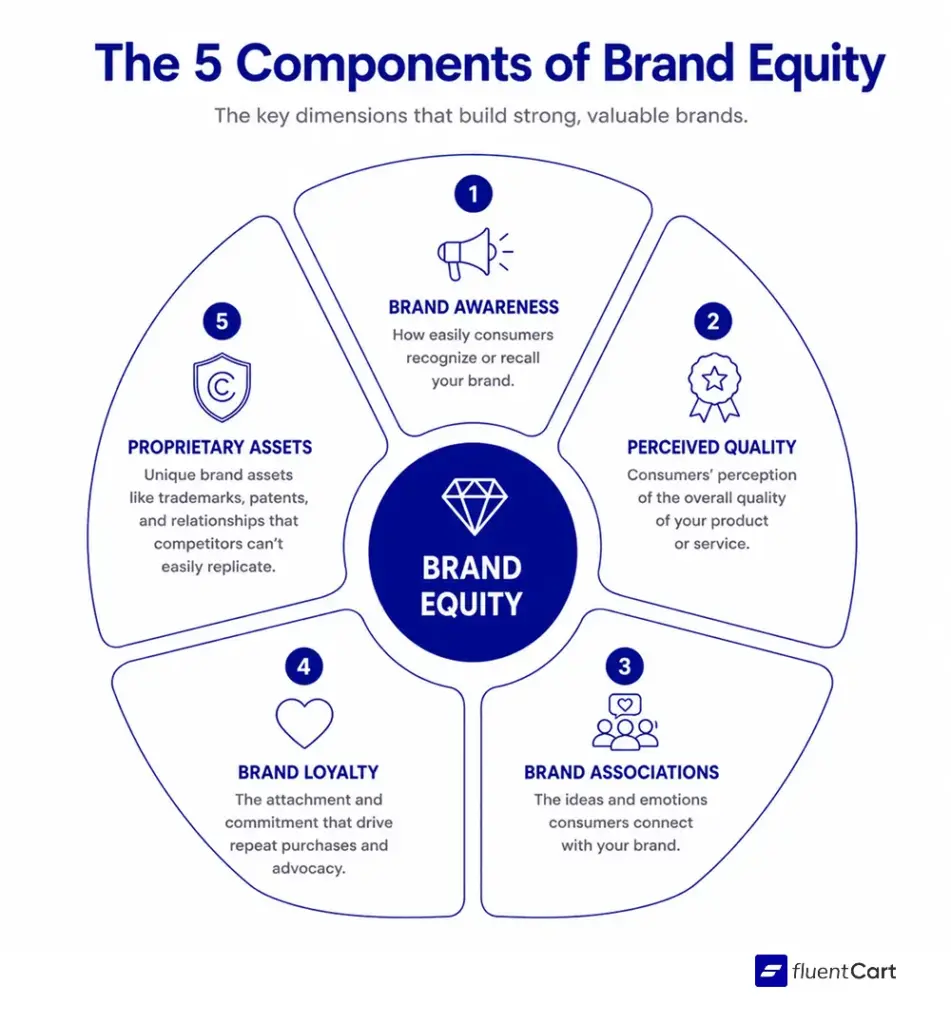
Positive brand equity means customers choose you at a premium, forgive occasional mistakes, and advocate on your behalf. Apple releasing a new product and customers lining up before it ships is positive brand equity working at full strength.
Negative brand equity happens when consumer perception turns unfavorable. It does not always require a dramatic scandal. Inconsistent product quality, poor customer service, or broken promises erode trust incrementally.
Volkswagen’s 2015 emissions scandal is a widely cited example: years of carefully built brand reputation were damaged in a short period because of a deliberate deception, and the company faced billions in fines alongside a sustained credibility problem.
Brand equity takes years to build and can be lost in weeks. That asymmetry is why businesses with strong equity protect it aggressively.
How Brand Equity Is Measured
Brand equity is notoriously difficult to quantify precisely. Most practitioners use a combination of qualitative and quantitative signals.
- Brand awareness surveys: Measure what percentage of a target audience can recall or recognize a brand without prompting. These are typically run on a quarterly or annual basis to track trends over time.
- Net Promoter Score (NPS): NPS measures how likely customers are to recommend a brand to others. A high NPS reflects strong loyalty and positive brand associations, both of which are core components of equity.
Financial valuation models like Interbrand’s Best Global Brands report assign a dollar value to brand equity by isolating the portion of revenue attributable to brand perception rather than physical assets.
No single method captures everything. Most practitioners combine several of these to track how equity shifts over time.
How to Build Brand Equity
Building brand equity is an operational commitment, not a campaign. These are the key levers.
Deliver on the promise, every time
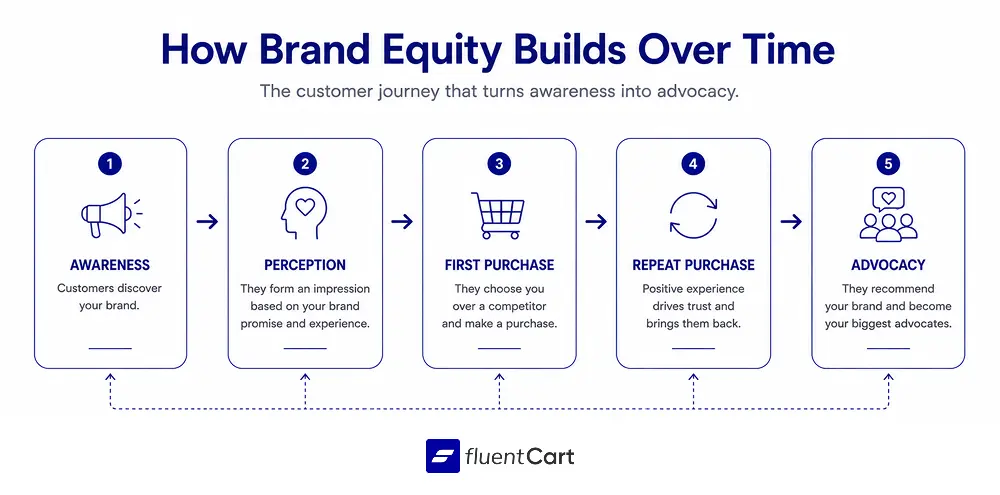
Brand equity starts with the product or service experience. If what you sell consistently meets expectations, positive associations accumulate. If it frequently fails, no marketing spend recovers them. In ecommerce, the checkout experience, delivery speed, and returns process all shape how customers feel about the brand long after purchase.
Be consistent across every touchpoint
Visual identity, tone, support language, and product quality should all feel like they come from the same source. Inconsistency dilutes brand associations fast. A business logo checklist is a useful starting point, but consistency runs deeper than visual assets alone.
Build emotional connection
According to the Edelman Trust Barometer, “84% of consumers say they need to share values with a brand to buy from it.” Brands that communicate a clear purpose and act on it earn associations far stickier than any promotion.
Lean on social proof
Reviews, testimonials, and user-generated content reinforce brand perception in ways paid advertising cannot. Visible customer experiences are trust signals for every new buyer who encounters the brand.
Use product pages to reinforce brand
In digital commerce, the product page communicates brand values before the product arrives. Strong product page design with clear descriptions and trust signals contributes directly to perceived quality.
Real Examples of Brand Equity in Action
Apple is the most cited example. Its customers pay a premium for hardware competitors sell for less, because Apple’s associations of simplicity, reliability, and status go beyond what the product alone justifies.
Stanley expanded its audience from industrial workers to lifestyle consumers with a color range and strong social media presence. A viral TikTok of a Stanley cup surviving a car fire and keeping its drink cold became a brand equity moment because it dramatized the product promise in a way no ad could replicate.
Volkswagen illustrates the downside. Its 2015 emissions scandal damaged equity across multiple markets and took years of effort to partially recover.
Wrapping Up
Brand equity is one of the most durable competitive advantages a business can build. It makes customers choose you without a discount, forgive you when you stumble, and recommend you without being asked.
It grows through repeated positive experiences and consistency. Every touchpoint, from product quality to checkout, either adds to that equity or subtracts from it.
FAQ
How is brand equity built?
Brand equity builds through consistent delivery on brand promises, strong emotional connection with consumers, visible social proof, and long-term investment in brand awareness and messaging.
What is brand equity in marketing?
In marketing, brand equity is the premium a brand generates through consumer perception. It influences pricing power, customer retention, and the success rate of new product launches.
How does brand equity impact customer loyalty?
Strong brand equity makes customers less sensitive to competitor offers. High perceived quality and strong emotional associations create a habitual preference that sustains loyalty even in competitive markets.

Deputy Marketing Lead, published literary author, and musician. I thrive on marketing for tech companies while composing music, collecting books of lasting depth, exploring cinema with a discerning eye, and studying the arts and history.

Subscribe now
Related Articles and Topics
-
WordPress Coupons: How to Create and Manage Discounts
Set up a WordPress coupons plugin and manage discount codes in minutes.
-
Buy One Get One Free: A FluentCart Guide for WordPress Store Owners
A complete buy one get one free setup guide in FluentCart, using three methods, so you can pick…
-

What Is a Business Proposal? Things to Know in 2026
A business proposal is a formal document that pitches your product or service to a client. Learn its…




Leave a Reply