
Economies of Scope: Definition, Examples, and Benefits
Every growing business eventually asks the same question. Is it better to specialize in one product or expand into several? The answer often comes down to economies of scope, a concept that explains why producing multiple goods together can cost less than producing them apart. Dairy farms, factories, and online stores all use this principle in different ways.
In this blog, we will cover what economies of scope mean, how it works, real examples across industries, and why it matters for anyone building a multi-product business.
TL;DR
- Definition: Economies of scope is the drop in average cost when a business produces multiple goods together instead of separately.
- Scale vs scope: Scale grows from producing more of one product. Scope grows from producing several products together.
- Key drivers: Shared resources, byproducts, and overlapping processes create most of the savings.
- Business use: Businesses use this concept to justify diversification, mergers, and new product lines.
- Ecommerce fit: Online stores gain economies of scope through shared inventory, staff, and marketing.
What Is Economies of Scope?
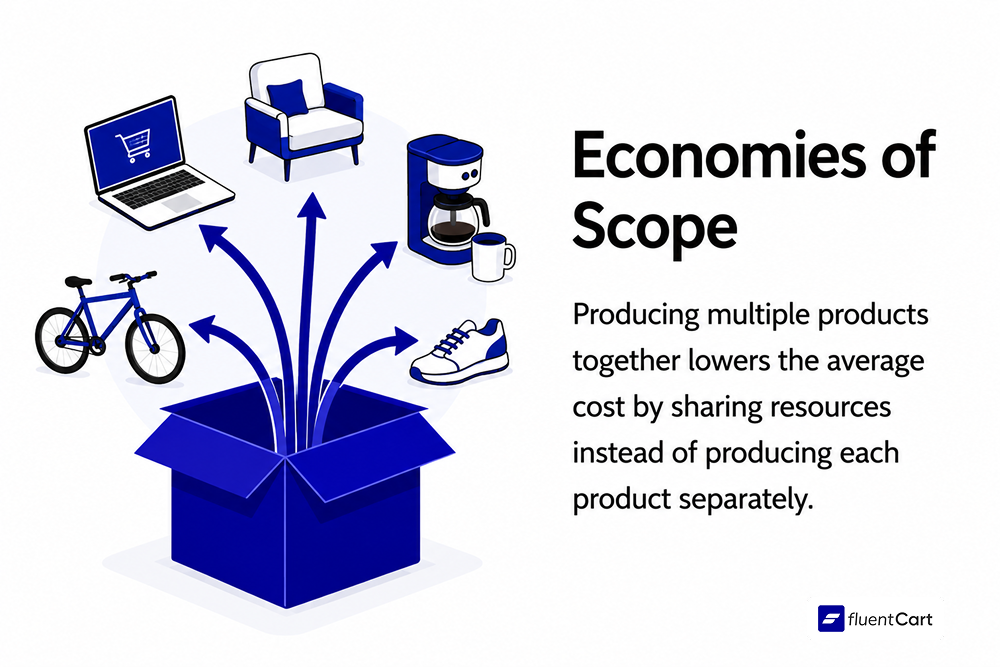
Economies of scope is the reduction in average cost that happens when a business produces two or more goods together rather than separately.
The saving comes from shared resources, not from higher output of one product. Investopedia describes an economy of scope as “the cost-savings that result from the production of multiple goods simultaneously” rather than individually.
A simple example makes this clear. A single delivery van carrying groceries and mail costs less to run than two separate vans for each job. Wikipedia calls economies of scope “efficiencies formed by variety, not volume,” a distinction that separates the concept from economies of scale.
Whenever staff, equipment, or facilities serve more than one product line, the business gains an economy of scope.
Economies of Scope vs Economies of Scale
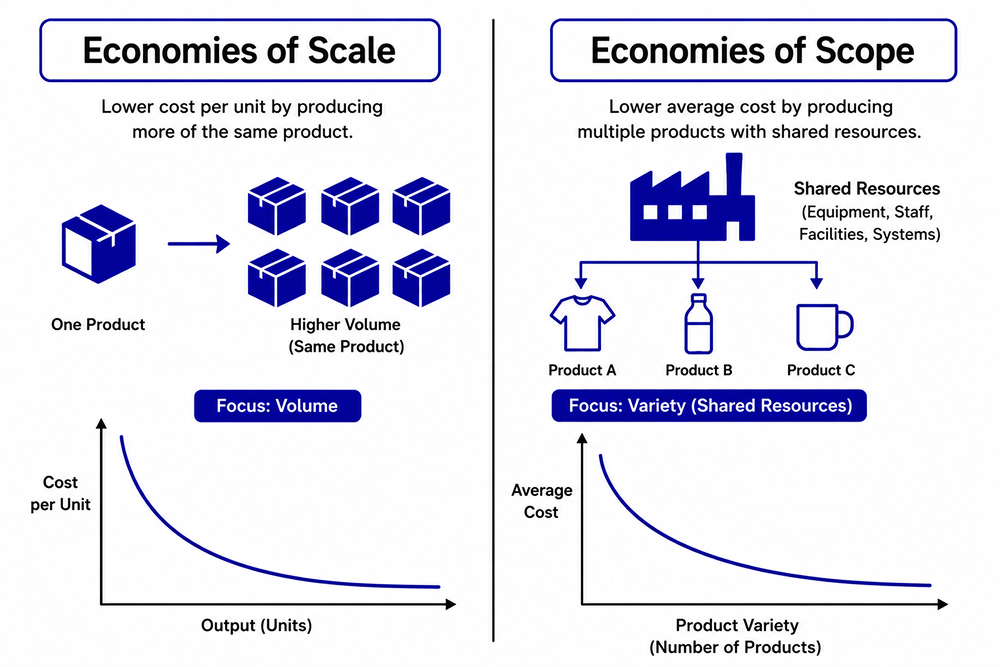
Economies of scope and economies of scale often get confused because both lower average costs. The difference lies in what drives the saving.
Economies of scale grow from producing more units of a single product, where fixed costs spread across more output. Economies of scope grow from producing several different products with the same resources. The saving comes from variety rather than volume.
A bicycle factory gains economies of scale by doubling its output. The same factory gains economies of scope if it also builds scooters on the same machines.
Most large companies pursue both strategies together. They scale one product line and expand into related ones at the same time.
How Economies of Scope Work
Economies of scope usually come from three sources.
- Shared inputs: Shared inputs happen when the same equipment, staff, or facility serves two or more products at once.
- Co-production: Co-production happens when one process creates a second good as a natural byproduct instead of waste.
- Complementary processes: Complementary processes happen when two production activities support each other so total output rises without added cost.
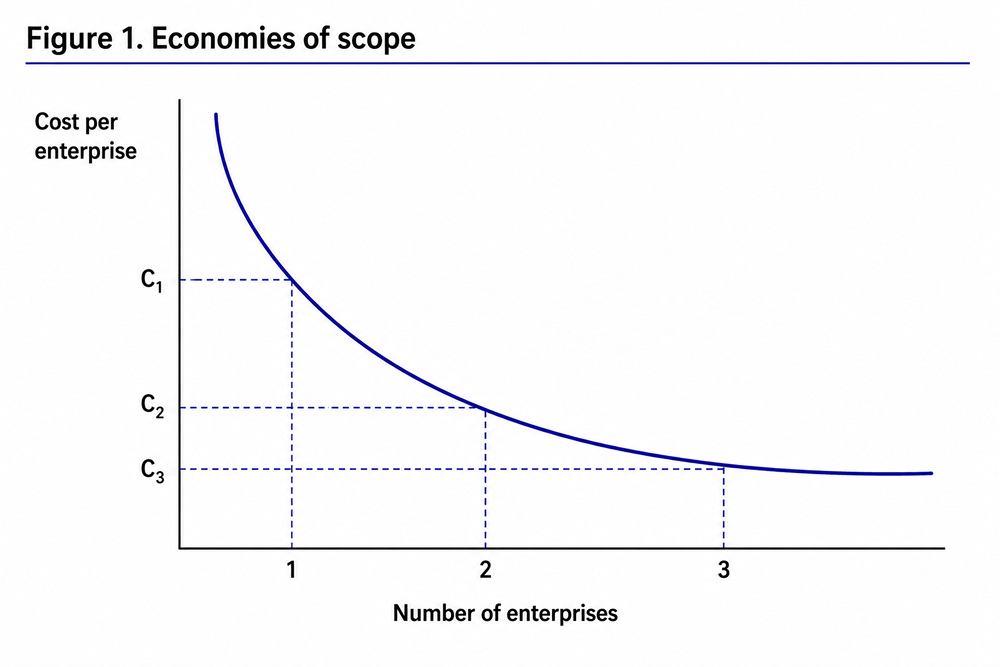
The Ag Decision Maker from Iowa State Extension describes the concept as “spreading the use of these resources and skills over two or more enterprises.” That description holds true across farms, factories, and online stores alike.
Real-World Examples of Economies of Scope
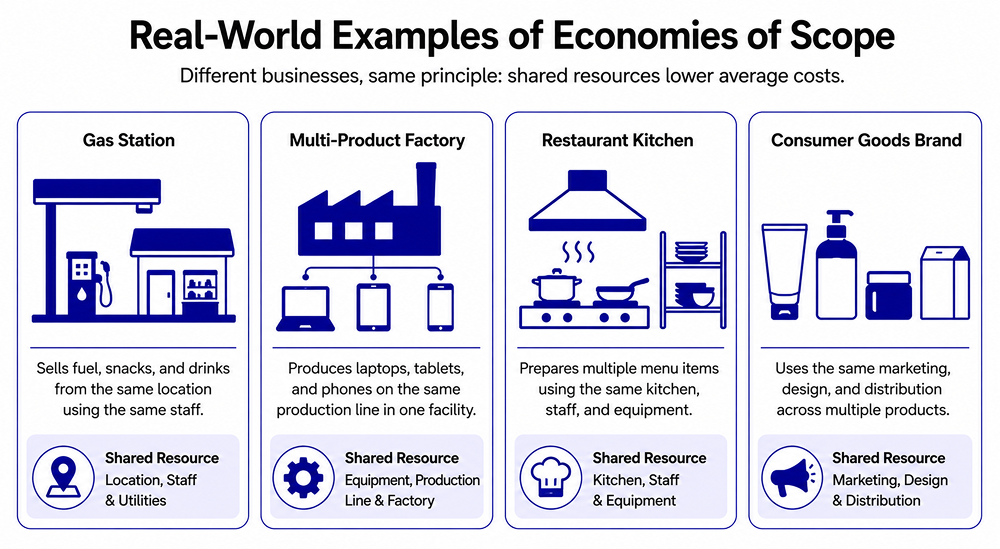
These savings show up across very different industries.
- Retail stores: Retail stores like gas stations earn more by selling snacks and drinks alongside fuel from the same location.
- Manufacturing: Manufacturing plants that build laptops, tablets, and phones in one facility spread factory costs across all three products.
- Food service: Food service businesses such as restaurants share fryers, storage, and cooks across multiple menu items.
- Consumer goods: Consumer goods companies use the same marketing and design teams across an entire product range.
A 2025 study on manufacturing firms found that “cutting shared resources in half lowered average revenue by more than three percent, with a larger effect for firms running several product lines.”
Economies of Scope in eCommerce
Online stores gain economies of scope every time they add a product without adding new overhead. One storefront, one hosting plan, and one support team can serve ten products almost as easily as one.
Expanding a product catalog often lowers cost per item because inventory management, staff, and marketing spread across more listings. Growing SKU count follows the same logic, since more variations use the same warehouse space and checkout system.
Cross-selling and upselling reflect the same principle. Selling related products to existing customers costs less than acquiring new customers for a single item.
For WordPress-based stores, FluentCart handles inventory, checkout, and customer data in one system, which makes these savings easier to capture without adding operational complexity.
Benefits of Economies of Scope
The advantages tend to fall into a few clear categories.
- Lower costs: Lower costs come from sharing resources across products instead of running them separately.
- Higher revenue: Higher revenue comes from selling more products through the same operation and customer base.
- Reduced risk: Reduced risk comes from spreading revenue across several products instead of relying on one.
- Resource use: Resource use improves when staff, equipment, and facilities run closer to full capacity.
How Businesses Achieve Economies of Scope
Businesses build economies of scope in a few practical ways.
Related diversification works best when new products use existing skills, equipment, or supply relationships. A bakery adding pastries alongside bread uses the same ovens and staff while expanding revenue.
Mergers and acquisitions offer a faster route. Two retail chains merging can combine warehouses and buying power right away instead of building shared infrastructure from scratch.
Some businesses form shared production agreements instead of merging outright. Two firms might share a factory, delivery fleet, or research team while staying independent. This works well when neither business wants full control, but both want lower costs.
Wrapping Up
Economies of scope explain why variety often costs less than expected. A business that shares resources across products spreads its expenses further, earns more from the same operation, and lowers the risk tied to any single item.
Whether it is a farm, a factory, or an online store, the same rule applies. Growth through shared infrastructure tends to cost less than growth through complete separation.
FAQs
What is the formula for economies of scope?
The degree of economies of scope compares the combined cost of producing two goods together against producing them separately. A positive result means combined production saves money.
Can economies of scope turn negative?
Yes. When combining production raises costs instead of lowering them, the result is called diseconomies of scope, and separate production becomes more efficient.
Do small businesses benefit from economies of scope?
Often, yes. Sharing tools, staff, or space across a few products can meaningfully lower fixed costs relative to revenue for a small operation.
Is there a difference between economy of scope and economies of scope?
No. Economy of scope, singular, and economies of scope, plural, describe the same concept. The difference is only in phrasing, not in meaning.

Deputy Marketing Lead, published literary author, and musician. I thrive on marketing for tech companies while composing music, collecting books of lasting depth, exploring cinema with a discerning eye, and studying the arts and history.

Subscribe now
Related Articles and Topics
-

WordPress Coupons: How to Create and Manage Discounts
Set up a WordPress coupons plugin and manage discount codes in minutes.
-

Buy One Get One Free: A FluentCart Guide for WordPress Store Owners
A complete buy one get one free setup guide in FluentCart, using three methods, so you can pick…
-

What Is a Business Proposal? Things to Know in 2026
A business proposal is a formal document that pitches your product or service to a client. Learn its…




Leave a Reply