
What Is a Business Proposal? Things to Know in 2026
A potential client shows interest, but nothing moves forward until you put that offer in writing. That document is a business proposal, and how well you write it can decide whether a deal closes or stalls.
In this blog, we will cover what a business proposal means, the types you will run into, and the elements that make one work.
TL;DR
- A business proposal is a written document that pitches your product or service to a potential client.
- Proposals fall into two broad categories: solicited and unsolicited.
- A strong proposal includes an executive summary, problem statement, solution, pricing, and a call to action.
- A proposal targets one specific client. A business plan maps out your company as a whole.
- Clear structure and research matter more than length.
What Is a Business Proposal?
Business proposal definition: a formal document that a business sends to a potential client, investor, or partner to pitch a product, service, or opportunity. It explains the problem the client faces, presents a specific solution, and outlines pricing and timelines needed to move forward.
Unlike a casual pitch, a proposal is detailed enough for the recipient to review, share internally, and use as the basis for a decision. As Salesforce explains, “a proposal acts as an early blueprint for the relationship. It gives the client a first look at your strengths before any contract exists.”
Businesses use proposals to win new clients, secure funding, or gain approval for a project. Some proposals run only a few pages. Others stretch much longer based on how complex the work is.
Business Proposal vs Business Plan
People often confuse a business proposal with a business plan, but the two serve different purposes. A business plan is an internal document that maps out your company’s vision, structure, and long-term goals. It usually supports fundraising or day-to-day management.
A business proposal, on the other hand, is written for one external audience. It addresses a specific client’s problem and asks for a decision, such as signing a contract or approving a budget. A business plan explains who you are as a company. A proposal explains why a particular client should work with you right now.
Types of Business Proposals
Every business proposal falls into one of two broad categories. The one that fits depends on how the conversation started, and that choice shapes your tone and structure from the first paragraph.
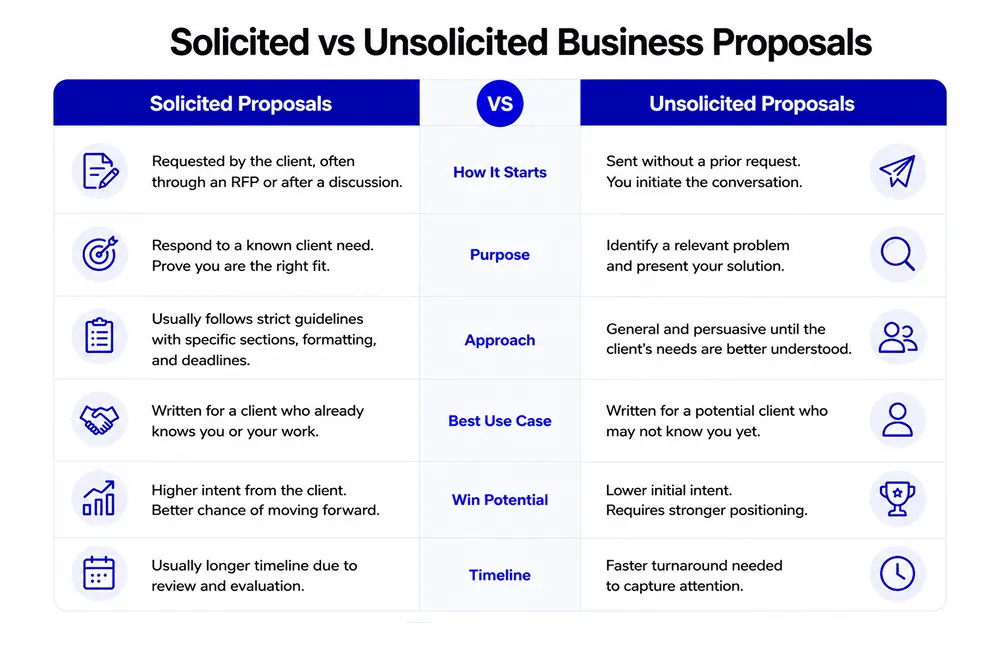
Solicited Proposals
Solicited proposal: A client actively requests this type, often through a formal request for proposal (RFP) or a casual ask after a conversation. Because the client already knows they need help, your job is to prove you are the right fit rather than convince them a problem exists.
Formal solicited proposals usually follow strict guidelines set by the client. These often cover required sections, formatting, and deadlines. Informal ones are more flexible but still need to answer the client’s specific questions directly.
Unsolicited Proposals
Unsolicited proposal: This type goes out without a prior request, much like a cold pitch in document form. Since the recipient never asked for it, the proposal must work harder to identify a real problem and present your solution as worth their time.
These proposals tend to run shorter and more general than solicited ones, since you have not yet had a detailed conversation with the prospect. A strong unsolicited proposal opens with a specific insight about the client’s business rather than a generic pitch.
Key Elements of a Business Proposal
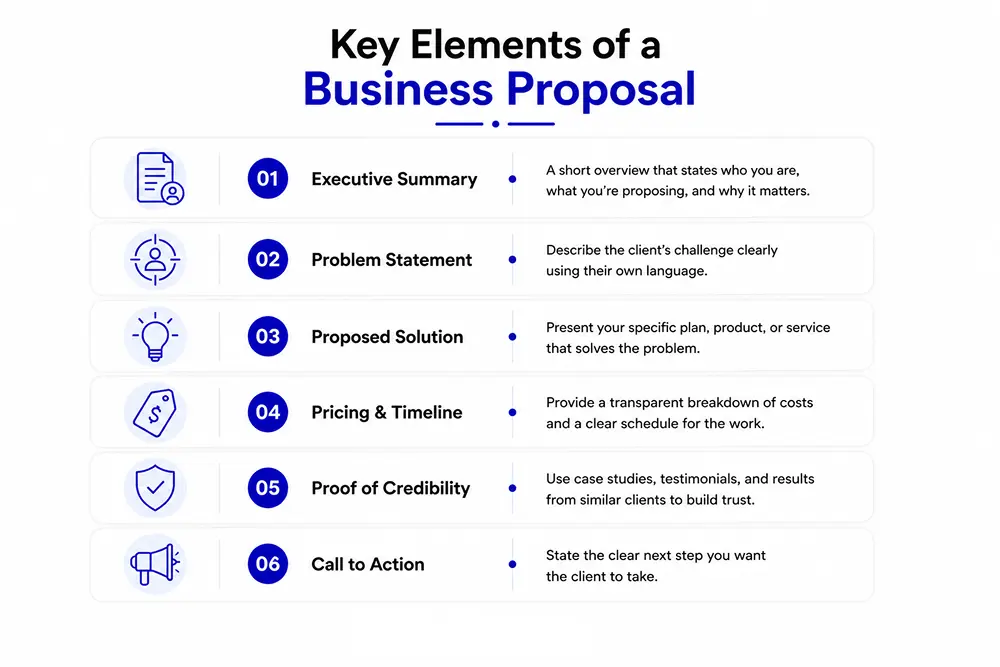
Most winning proposals share the same core sections, even when industries differ.
- Executive summary: This is a short overview that states who you are, what you are proposing, and why it matters to the reader.
- Problem statement: This section describes the client’s challenge clearly and uses the client’s own language rather than yours.
- Proposed solution: This is the specific plan, product, or service that solves the problem and ties directly to the client’s goals.
- Pricing and timeline: This section gives a transparent breakdown of costs and a schedule for when the work happens.
- Proof of credibility: Case studies, testimonials, and results from similar clients back up your claims here.
- Call to action: This is the clear next step, such as scheduling a call or signing an agreement. A well-placed call to action turns a good proposal into a signed deal.
How to Write a Business Proposal
- Client research: Look into the client’s industry, goals, and pain points before writing a single line. FluentCart’s guide on market research breaks down simple ways to gather this information.
- Clear structure: List every section in order, from executive summary to call to action, so nothing gets missed.
- Problem first: State the client’s challenge before presenting your solution. This keeps the connection between problem and fix obvious.
- Transparent pricing: Break down costs clearly and avoid hidden fees that create doubt later.
- Final proofread: A proposal full of errors signals carelessness. Read it twice and ask a colleague to check it as well.
Common Mistakes to Avoid
- Generic proposals: A proposal that could apply to any client rarely wins the specific client in front of you.
- Skipped research: As noted in Forbes Advisor, Sacha Walton, CEO of SWI Management Group, puts it plainly: “You can’t align what you don’t understand.” Proposals built without research usually miss the client’s real priorities.
- Unclear ask: If the call to action is vague, the client has no obvious next step to take.
- Heavy jargon: Language full of insider terms and technical shorthand slows the client down and weakens trust in the pitch.
- Proposal win rates: According to Loopio’s research, “the average RFP win rate has hovered around 45 percent when measured across 2019 through 2026.” Clear structure and consistent follow-up still make a measurable difference.
Wrapping Up
A business proposal turns interest into a decision. Whether you are responding to a formal request or reaching out cold, the proposals that win keep the client’s problem at the center and make the next step obvious. Get the structure right, keep the language clear, and let the value carry the pitch.
FAQs
How long should a business proposal be?
Length depends on complexity. Simple proposals often run two to five pages, while formal RFP responses for larger projects can stretch much longer.
Do I need design software to create a proposal?
No. A clean document made in a word processor works fine, though visuals like charts or tables can help explain complex ideas faster.
Can AI help write a business proposal?
AI tools can speed up a first draft, but the final version still needs a human review to match tone, priorities, and details to the specific client.

Deputy Marketing Lead, published literary author, and musician. I thrive on marketing for tech companies while composing music, collecting books of lasting depth, exploring cinema with a discerning eye, and studying the arts and history.

Subscribe now
Related Articles and Topics
-

WordPress Coupons: How to Create and Manage Discounts
Set up a WordPress coupons plugin and manage discount codes in minutes.
-

Buy One Get One Free: A FluentCart Guide for WordPress Store Owners
A complete buy one get one free setup guide in FluentCart, using three methods, so you can pick…
-
Economies of Scope: Definition, Examples, and Benefits
See what economies of scope mean, how they differ from economies of scale, and real examples with proven…




Leave a Reply