

How to Start a Digital Products Business: 6 Decisions Before Your First Sale
A digital products business sells files or online access, like templates, ebooks, and courses, that you build once and deliver without shipping anything. Each sale carries a high margin, but income usually starts small. So why do so many sellers upload a file, share the link, and hear nothing back? Because the file is the easy part.
Let’s say you finish the file, post it, and wait a week. Nothing. Now you can’t tell if the idea, the price, or the traffic is the problem. The steps below fix that, let’s continue.
TL;DR
- Income from a digital products business usually starts small, but profit per sale is high with no stock or shipping.
- Finish your first product in two or three weekends. Five starter ideas are in Decision 1.
- Ten buyer conversations and a priced pre-sale page tell you whether to build an idea.
- Know your break-even sales and the visitors you need before you build.
- Aim for ten customers before you polish anything.
- Write refund, license, and tax basics before sale number one.
- Collect emails from day one, and move to your own store once sales repeat.
How to Start a Digital Products Business
Pick one product you can finish in two or three weekends, like a template, a guide, a spreadsheet, or a short course. Then check that people want it by talking to ten buyers and sharing a pre-sale page with a price on it. If they say yes, set a price that covers your costs and work out your break-even sales before you build.
Next, get your first ten customers through search, communities, or your own list. Write a refund policy and license terms, and check your tax rules. Then sell from a place that delivers files and collects emails, and move to your own store once sales repeat.
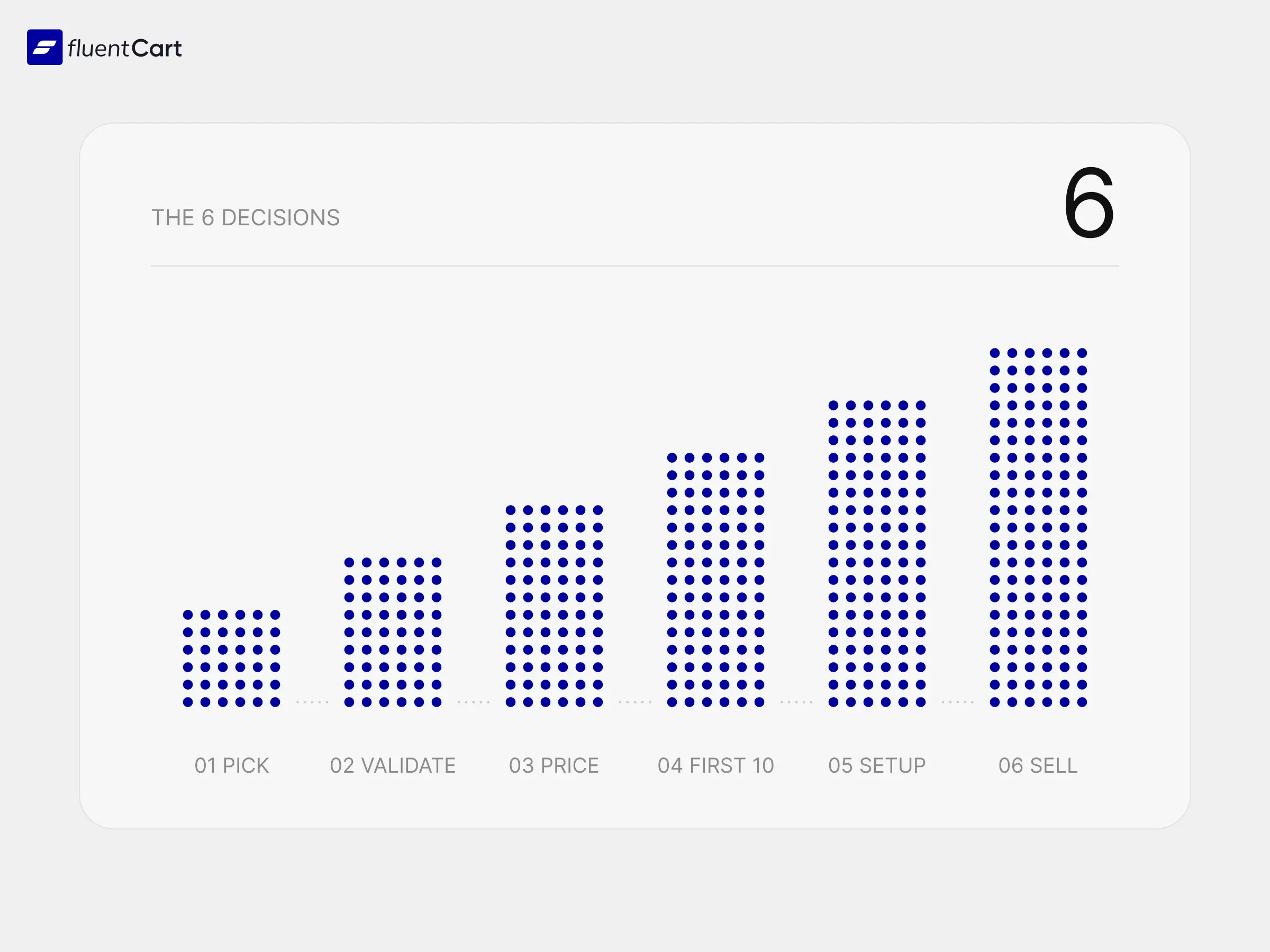
That’s the short answer. But before you start, there are a few things you need to know, because each of those steps hides a decision that decides whether your digital products business makes a sale or hears silence. So keep reading, and let’s take them in order.
If you want a business prompt pack, check our free 150+ business AI prompts pack, still in the brainstorming phase, then check our 100+ business ideas or want to check if your eCommerce system in on point or not, you can run through our eCommerce Checker.
Let’s continue reading mate.
Decision 1: Pick What to Sell
Pick one. That’s the whole job here. Lists with 100 ideas feel generous, and they’re how people end up with a half-built course.
If you’re short on ideas, start with one of these five. Each has a clear buyer and a build time you can count in weekends.
- Short playbook packs: a 15-page guide to one task, bought by someone who needs it solved today
- Lesson plans and teacher resources: ready to print, bought by people short on time
- Template packs for freelancers: proposals, client onboarding, simple contracts
- Financial models: one working spreadsheet for one business type
- Starter kits for developers: boilerplates and small scripts that save setup days
If none of these fits, our roundup of 80+ digital product ideas sorted by skill has your match. Chasing the most profitable digital products on a list is a good way to build something you can’t finish, so use it to find your fit and skip the urge to copy a winner.
Now match the idea to your situation. Most lists skip this part.
| Your situation | Start with | Why it fits |
|---|---|---|
| No audience yet | Low-price templates or playbooks that answer one search | Buyers find the problem, so they find you |
| A few hundred followers | A paid version of what people already ask you | You can ask them before you build |
| An email list or client base | A course, cohort, or small membership | Trust supports a higher price |
| Little free time | A spreadsheet or template from your own work | You built it already |
Some sellers start with free digital products to resell, usually PLR files. Read the license first, and add enough of your own work that your version stands apart.
Finish line: two or three weekends. If it needs more, shrink the idea.
Decision 2: Validate Before You Build
Nathan Barry launched his first ebook to an email list of under 1,000 people, and it made over $12,000 on day one. Before he finished it, he looked at two other designers who each made over $5,000 in a single day from their own design ebooks. He estimated he could build an audience of that size.
See what happened there. He checked someone else’s numbers first, and that gave him the push to finish.
Skipping that check is common. In one analysis of more than 100 failed startups, 35% cited no market need. Digital products are smaller bets, but the trap is the same. You build what’s fun to make, then hope.
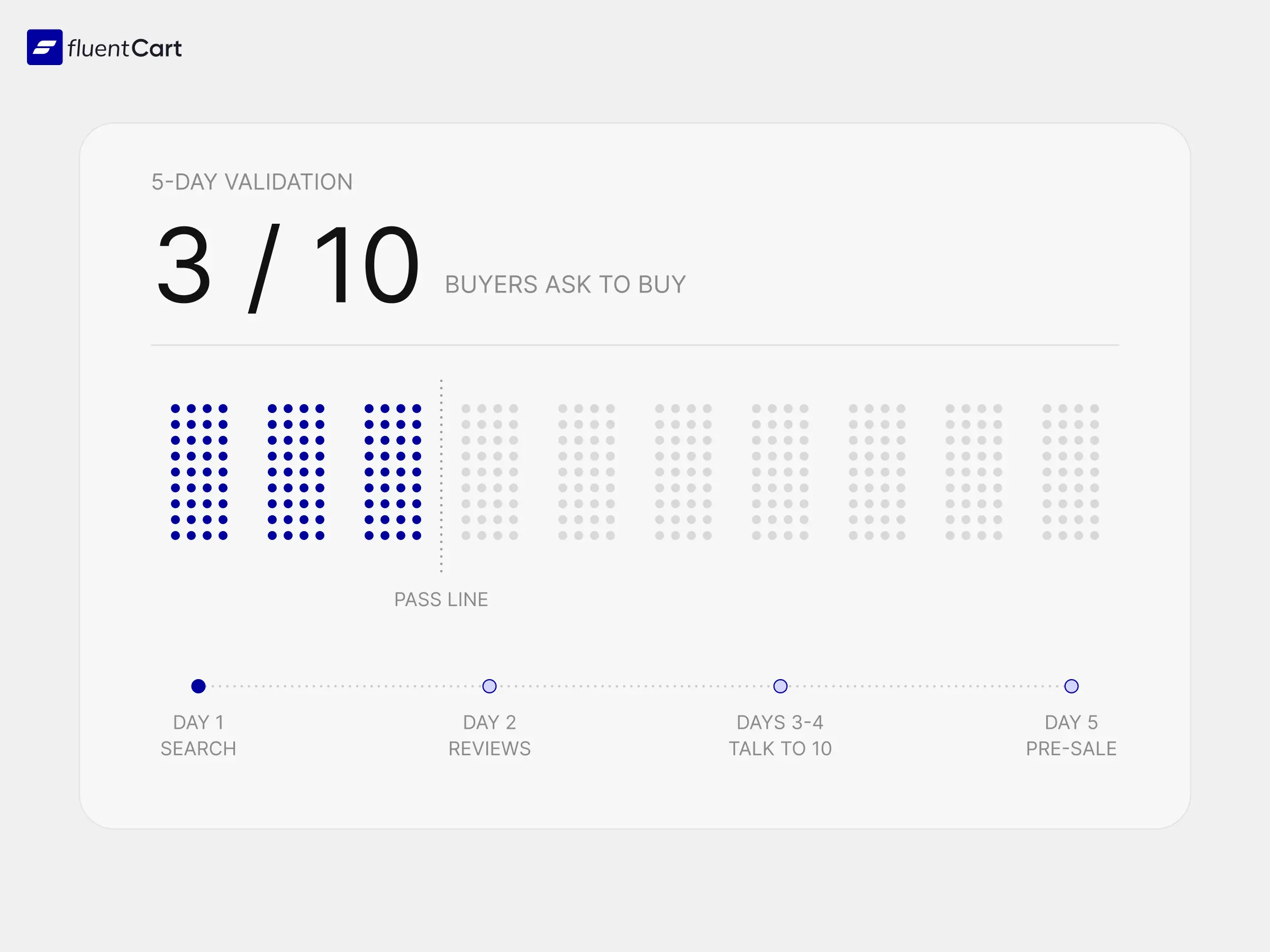
Most sellers don’t figure this out until the second flop. So how do you check demand without building anything? Run a five-day sprint.
- Day 1, search the problem. See what people already search for and what already sells. Our guide to product research walks through checking demand before you commit.
- Day 2, read the complaints. Open the reviews of three similar products. The one-star reviews list what’s missing.
- Days 3 and 4, talk to ten buyers. Ask what they tried. Ask what it cost. Ask what is still broken. Ask what they would pay.
- Day 5, put a price on it. Share a pre-sale or waitlist page with the price visible.
Hearing “nice idea” from a friend costs nothing. Money down means commitment, so step four carries the most weight.
If you don’t know ten buyers yet, go where they ask questions: forums, groups, comment sections. Offer a 15-minute chat or a free sample in return for honest feedback.
Our rule of thumb, not a law: if three of the ten ask when they can buy, build it. If none do, change the idea. If the pre-sale page gets no clicks after a week of sharing, change the angle.
Let’s say you plan a client onboarding pack for freelance designers. You open three similar packs, and the one-star reviews all say the same thing: no contract template.
Add one, and you have your angle before you’ve written a page. See what we did here? We let the complaints write the brief.
Five days. Ten conversations. One price on a page.
Decision 3: Price It and Run the Numbers
Pricing might feel like art, but mostly it’s arithmetic. Our guide on how to price a product covers the methods, so here we only need enough math to know whether your plan can work.
Three lines do the job:
- Profit per sale = price, minus payment and marketplace fees, minus refunds
- Break-even sales = your costs divided by profit per sale
- Visitors needed = break-even sales divided by your conversion rate
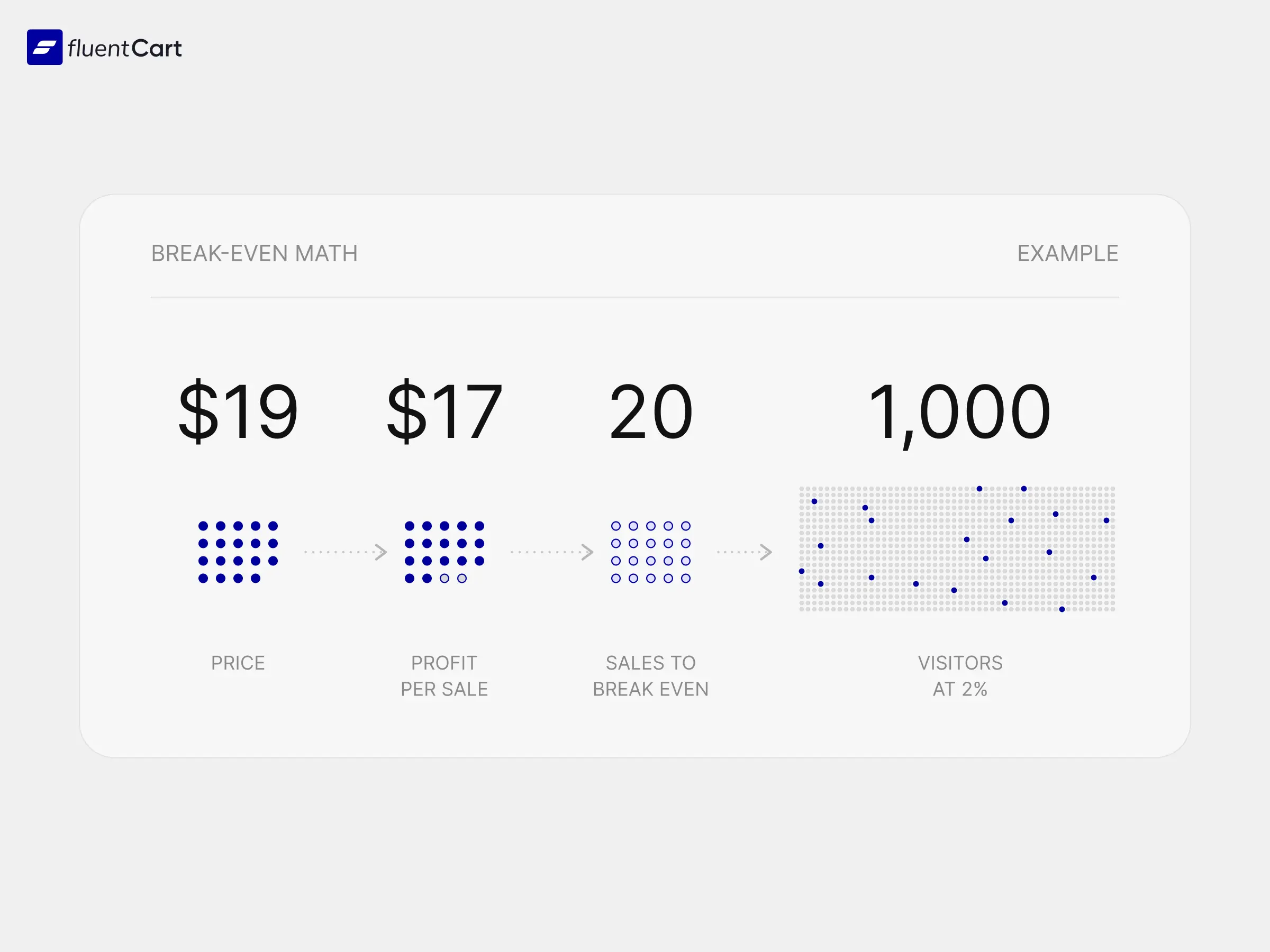
Let’s say you sell a $19 template. Fees and refunds eat $2 per sale, so profit is $17. Your costs are $340 in tools and design time, which means 20 sales to break even. If 2 in 100 visitors buy, you need 1,000 visitors.
As you can see, 20 sales sounds small. 1,000 visitors does not. That gap is why traffic gets its own decision below. Swap in your own numbers, and use a conversion rate you can defend.
Then check three more things:
- Check the range buyers already pay for similar products.
- Check what your result saves them in time or money.
- Check that the price still works at the sales number you can reach.
Lower launch prices can earn your first reviews, as long as the math holds at that price.
Run the math first.
Decision 4: Find Your First 10 Customers
Aim for ten customers first. They give your digital products business reviews, feedback, and proof that your validation was right.
Selling digital products as a beginner means you start with zero trust. This is where things break: sellers publish a product page, wait, and call the silence a failed idea. The idea was fine. Nobody saw it.
So pick the playbook that matches your audience today.
If you have no audience
- Answer questions where buyers already ask them, and give the answer before the link
- Publish one helpful post a week on the exact problem your product solves
- Offer a free sample in exchange for an email address
- Ask early buyers for a short review
If you have a small audience
- Send the pre-sale offer personally
- Reply to comments with a question, not a pitch
- Add a bonus for the first ten buyers
If you already have an audience
- Announce in a short email series
- Open early access at a lower price
- Invite partners to share it
That way, your first ten sales come from people who already trust you a little. Early buyers are happy to tell you what’s missing, and a few are excited enough to share your product. Every one of them teaches you something the validation sprint couldn’t.
Decision 5: Set Up the Business Side
It’s 11 PM. A buyer emails: “This isn’t what I expected. Can I get a refund?” You have no policy, so you invent one on the spot. Now picture that happening every week.
Write the rules before you need them. That way, a refund is a two-minute reply instead of a debate.
Refunds, licenses, and delivery
- Refund policy: state it on the product page
- License terms: personal use, commercial use, or no resale
- Delivery limits: capped downloads or stamped PDFs
- Chargebacks: a chargeback is a payment dispute your buyer files with their bank, and a clear product page can make them less likely
Tax
Tax rules for digital goods often depend on where your buyer lives. If you sell into Europe, our guide to EU VAT and OSS for digital goods covers what to charge and file.
A merchant of record is the company legally responsible for the sale, including collecting and paying the tax. Some checkout tools take that role for you, and others leave it with you, so check which one you use.
Business structure
You can start as a sole proprietor in the US without filing anything. The IRS notes that a sole proprietorship has no legal identity apart from its owner, so business debts are your debts. Some sellers form an LLC once revenue or risk grows.
In the UK, you must register for Self Assessment as a sole trader once you earn more than £1,000 in a tax year. In Australia, most businesses need an ABN, though it is not compulsory for all.
Check your local rules before you commit.
Decision 6: Choose Where to Sell
You don’t have to pick forever. Pick for your stage.
- Testing, the first 10 sales: sell wherever you can go live fastest, and collect an email address with every order
- Repeating, sales most weeks: move to your own store to keep the margin and the customer list
- Growing, past one product: add bundles, subscriptions, and license keys
The reason to move is control. On a marketplace, you often can’t email your own buyers, and fees add up on low-priced files. We compared the trade-offs in our platform vs marketplace breakdown.
If you’re running on WordPress and interested in how to start a digital product business for free, something like FluentCart just handles this for you, from selling digital products on your own site to keeping every customer on your list.
It takes no commission on your sales. So when your digital products business sells from your own store, the margin and the relationship stay with you.
Now you know the path: start where you can go live fast, and move when sales repeat.
You can start your store now
Download FluentCart for free and setup your online store and start selling from today.
What Comes After the First Product
One sale rarely repeats. Someone who owns your template doesn’t need it twice.
Here’s what’s actually happening when a digital products business grows: each buyer gets a next step.
- Bundle: group related files at one price
- Bump: offer a small add-on at checkout
- Update: release new versions so past buyers come back
- Subscribe: sell recurring access to a library
Income from this model comes in waves, so plan for slow months. The sellers who last treat the first product as the start of a catalog, and they keep their email list warm between launches.
Digital Products Business FAQ
Is a digital products business profitable?
It can be. Each sale carries a high margin because there’s no stock or shipping, but total profit depends on traffic, price, and refunds. Early income is usually small, so treat the first product as a test and run the break-even math before you build.
How do I start a digital products business with no audience?
Validate with ten conversations, build one small product, and answer questions where your buyers already ask them. Offer a free sample for an email address. That way, your first customers come from trust you earned in public.
What are the most profitable digital products?
No single product wins. The ones that earn tend to solve a narrow, urgent problem for a specific buyer, like playbooks, templates, and financial models. Our digital product ideas roundup sorts them by skill.
Do I need an LLC to sell digital products?
Usually not at the start. In the US you can begin as a sole proprietor with no filing, but you carry personal liability. Many sellers form an LLC as revenue or risk grows. Rules differ by country and state, so check local guidance.
Do I need a big following to sell digital products online?
No. You need a way to reach buyers, and that can be search, communities, or a small email list. Size helps with price and speed, but a clear problem and a tested offer matter more at the start.
Are digital products a scam?
The model isn’t, but the get-rich-quick courses built around it often are. In one r/passive_income thread asking if digital products are a scam, u/Threash78 wrote that “anyone giving you concrete advice is going to be charging for it.” That’s the guru loop, where the product is a course about selling courses. Judge any offer by one test: does a real buyer get a real result they couldn’t get as fast alone?
Start Small, Run It Like a Business
A digital products business rewards the seller who tests before building. Think of the 35% of failed startups that built something nobody needed. Ten conversations and one pre-sale page keep you out of that group. Pick your product, run the sprint, and run the numbers.
Validation is a must.
Real store owners. Real-life problems. Real answers. Join the FluentCart Community.

Hi, this is Abir, a Deputy Marketing Lead, passionate product designer, and WordPress core contributor. Creating interesting content and products that ensure a 360-degree customer experience is my daily job.

Subscribe now
Related Articles and Topics
-
What Is Browser? How It Works & Examples
What is browser? Under 8% of people in a Times Square test knew. Get the plain-English answer, how…
-
Custom Checkout Page: How to Build One That Converts
Build a custom checkout page that cuts drop-offs: icluding chekcout types, checkout steps, best practices and best platforms…
-
Black Friday Marketing Strategies That Protect Profit
A 20% sale can mean selling double the units to earn the same profit. Here’s how to plan…




Add your first comment to this post