
eCommerce Platform vs Marketplace: Which Makes Sense

Everyone tells new sellers the same thing. Start on a marketplace, get traction, then build your own site later. That advice sounds safe, and it’s exactly why so many people get the eCommerce platform vs marketplace decision backwards. It also skips the part where “later” rarely comes, because by the time you have traction, you’re addicted to someone else’s traffic.
Let’s say you sell hand-poured candles. You list on Etsy in March. By August you’ve done 400 orders, Etsy takes its cut on every single one, and you still don’t have a single customer email address to show for it. That’s not a hypothetical. That’s what happens to most sellers who never plan an exit from the marketplace they started on.
TL;DR
- An eCommerce platform (Shopify, WooCommerce, FluentCart on WordPress) lets you own the storefront, the data, and the brand. A marketplace (Amazon, Etsy, eBay) gives you instant traffic in exchange for a cut of every sale and almost no control.
- Marketplaces charge referral fees that typically run 8% to 15% per category on Amazon, plus fulfillment costs if you use FBA, source: Amazon’s 2026 fee update.
- eCommerce platforms usually run on a flat monthly subscription plus payment processing, so your margin improves as volume grows, instead of shrinking.
- You cannot build an email list, run retargeting, or message past buyers on most marketplaces. In your own store, that data is yours from day one.
- Marketplaces are genuinely useful for testing demand, clearing inventory, or reaching an audience that already trusts the platform.
- 59% of global online retail sales are projected to happen through marketplaces by 2027, source: Stripe.
- The strongest sellers usually run both, marketplace for reach, own store for margin and loyalty, not one instead of the other.
What’s the actual difference here
An eCommerce platform is software you use to build a store you own. A marketplace is a shared storefront where many sellers list side by side under someone else’s brand.
That’s it. One sentence each. Everything else is just what falls out of that difference.
The three things that actually separate a platform from a marketplace
So before we go deep on any one angle, here’s the quick version. Every real comparison between an eCommerce platform and a marketplace comes down to three things.
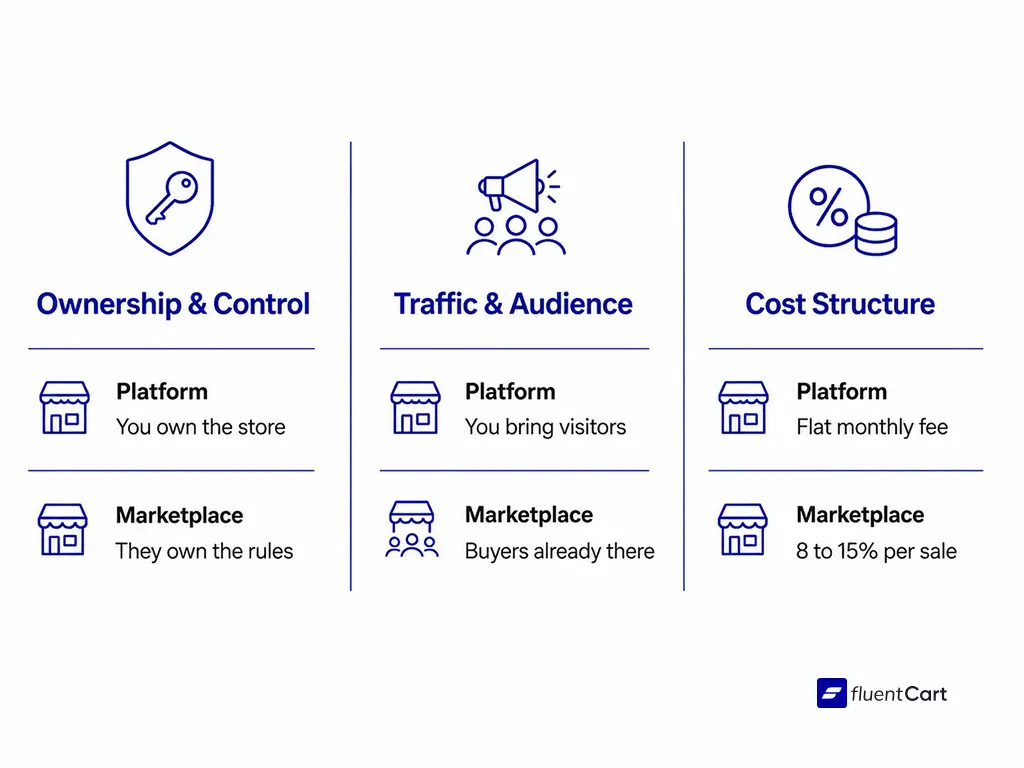
Ownership and control Platform: you own the design, the data, the rules. Marketplace: the operator owns all three, and you rent space inside them.
Traffic and audience Platform: you have to bring your own visitors, through SEO, ads, or email. Marketplace: buyers are already there searching, no marketing setup required.
Cost structure Platform: a flat monthly fee plus payment processing, roughly 2 to 3%. Marketplace: a referral fee per sale, commonly 8 to 15% on Amazon, on top of any fulfillment cost.
Three factors. Everything else in this article is one of these three, explained in more depth.
Why the ownership question matters more than people admit
So here’s a scenario. Let’s say two sellers launch the same product in the same week. One goes all in on Amazon. The other builds a WordPress store and slowly drives traffic through content and email.
Six months in, the Amazon seller has more orders. But is that actually a win?
The Amazon seller doesn’t know who bought the product. Amazon does. If Amazon changes its fee structure, buries the listing under a new algorithm update, or suspends the account over a policy dispute, that seller loses the business overnight. That’s not a scare tactic. That’s just how a marketplace is built.
Meanwhile the WordPress seller, slower at first, now owns an email list of actual buyers. That way, every new product launch doesn’t start from zero. This is where things break for a lot of small brands. They mistake early marketplace sales for a working business model, when really it’s rented traffic with a countdown clock on it.
Here’s how the money actually breaks down
Let’s say you sell a $40 item.
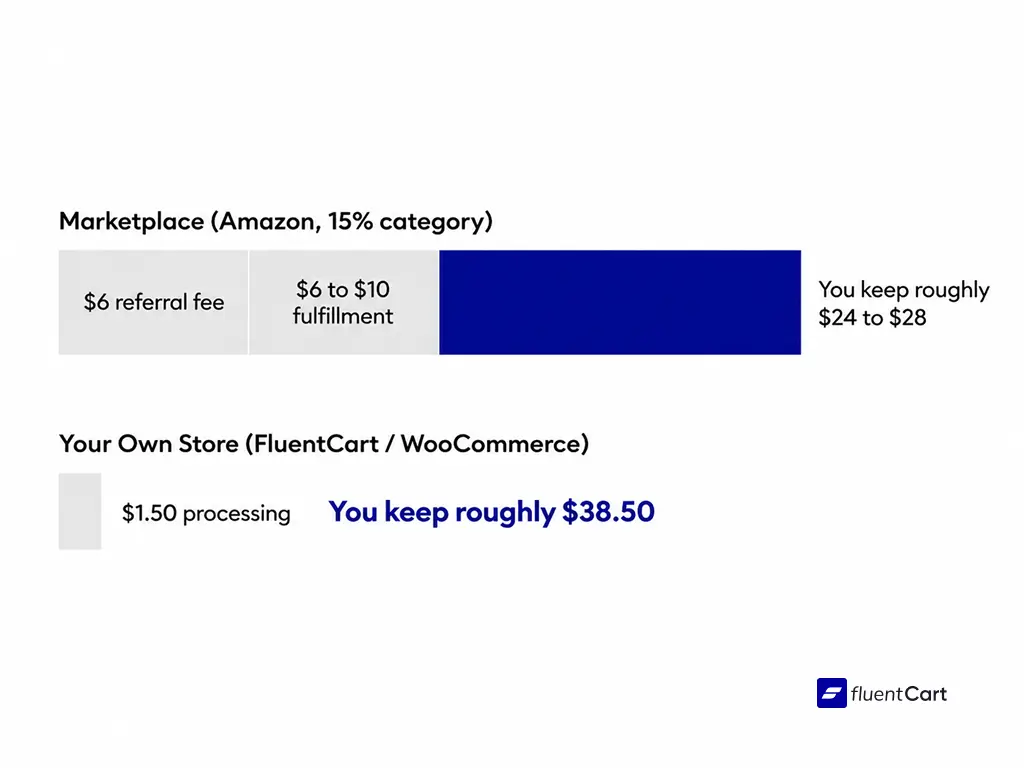
On Amazon, in a 15% referral category, you lose $6 to the referral fee before shipping or FBA costs even enter the picture. Add fulfillment and you’re often down $12 to $16 before you’ve paid for the product itself.
On your own WooCommerce or FluentCart store, you pay a flat monthly platform cost and a card processing fee, usually 2.9% plus a small fixed fee. On that same $40 sale, you’re looking at roughly $1.50 in processing, not $12.
As you can see, the marketplace math punishes volume. The platform math rewards it. Amazon actually raised its FBA fulfillment fees again for 2026, an average increase of about $0.08 per unit sold, on top of no increase the year before, source: Amazon Seller Central. Small number. But it stacks across thousands of units, and sellers don’t get a vote on it.
eCommerce platform: the pros and the real costs
Pros
- Full control over design, pricing, and checkout
- You own customer data and can market to it forever
- No competitor ads sitting on your own product page
- Predictable monthly cost instead of a percentage taken from every sale
Costs
- You’re responsible for every visitor who lands on your site
- Setup takes real time, even with a builder
- SEO, ads, and email marketing become your job, not someone else’s
If you’re running on WordPress, something like FluentCart just handles this for you, checkout, product pages, subscriptions, all inside the site you already own. No separate platform bill, no rented storefront.
Marketplace: the pros and the real costs
Pros
- Instant access to buyers already looking for products like yours
- No traffic-building work required to get your first sale
- Trust is inherited from the marketplace’s reputation, not built from scratch
Costs
- Referral fees between 8% and 15% per category on Amazon, plus fulfillment charges if you use FBA, source: Feedvisor’s 2026 fee breakdown
- No access to buyer emails or purchase history
- Your product sits next to a cheaper competitor’s listing, on their turf
- Rules, suspensions, and fee hikes are entirely out of your hands
eCommerce platform vs marketplace: what are you actually trying to decide
Most people asking this aren’t choosing blind. They already run something, or they’re about to launch, and they want to know if they’re leaving money on the table.
So the real question isn’t “which is better.” It’s “what am I optimizing for right now.”
- Optimizing for speed: a marketplace gets you a sale this week.
- Optimizing for margin: your own store keeps more of every dollar.
- Optimizing for brand: only your own store lets you build one that outlasts any single channel.
Or is it really an either-or choice? Not for most sellers who last.
The hybrid model nobody talks about enough
Amazon itself runs both models at once. It sells its own inventory directly, and it hosts millions of third-party sellers on the same site. Roughly two-thirds of Amazon’s unit sales now come from those third-party sellers, not Amazon’s own retail arm.
That’s the tell. Even the biggest marketplace on earth understands that owning the direct channel and running the marketplace side by side beats picking only one.
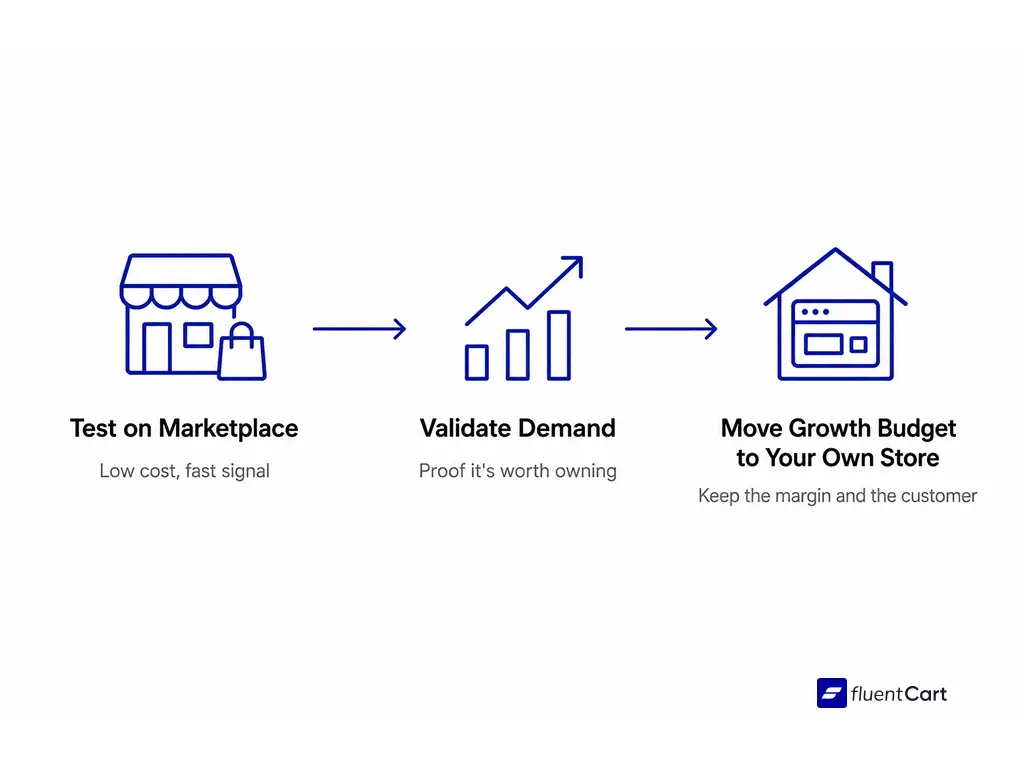
Here’s how it can go for a smaller seller. Use Etsy or Amazon to test a new product against real demand, cheaply, without building a whole store for something that might not sell. Once it proves itself, move the bulk of your growth budget into your own store, where the margin and the customer relationship are yours to keep.
Just be smart about the order. Test cheap. Own expensive.
How to actually choose
Here’s a straightforward way through it.
Check your product type. One-of-a-kind or high-margin goods do fine on a marketplace, since fees eat less of the spread.
Check your resources. If you have zero time for marketing, a marketplace buys you a shortcut. If you can invest a few months, your own store compounds.
Check your long-term goal. Building a brand you can sell someday, or one you can pass down? That has to live on a platform you own, not a marketplace listing that disappears the moment you stop paying fees.
So the decision isn’t really about which model is smarter in the abstract. It’s about what stage your business is at, and what you’re excited to build past that stage.
If you are planing to move your store to some other server or platform. Make not to miss anything. Here is something for you for a solid store migration.
Get the free printable migration checklist.
Nothing missed, nothing left to chance.
Print 3 copies and check them off by hand.
A few things people get wrong
People also assume marketplace traffic converts better because it’s “already warm.” Sometimes true. But that same warm buyer is one click away from a competitor’s identical listing, sitting right there on the same page.
People also assume their own store needs a huge budget to start. It doesn’t. A basic WordPress setup with a plugin like FluentCart costs a fraction of what most sellers pay in marketplace fees during their first busy month. If you’ve read about why relying entirely on Etsy can quietly limit a small brand, this is the same pattern playing out with any marketplace, not just Etsy specifically.
Closing thought
So, eCommerce platform vs marketplace isn’t really a fight between two rivals. It’s a question of who gets to own the relationship with your customer, you or the platform hosting your listing. Marketplaces are a legitimate way to test a product fast and reach buyers who’d never find you otherwise. But the businesses that last build their own store as the real foundation, and use marketplaces as a channel on top of it, not the other way around.
Owning your storefront is a must, not a nice-to-have.
If you’re already running a store or planning to, or thinking about moving your store onto WordPress, the FluentCart community is where people with real expertise and experience talk about things like this. Worth a look while you are juggling the eCommerce platform vs marketplace question.
Real store owners. Real problems. Real answers. Join the FluentCart Community.

Hi, this is Abir, a Deputy Marketing Lead, passionate product designer, and WordPress core contributor. Creating interesting content and products that ensure a 360-degree customer experience is my daily job.

Subscribe now
Related Articles and Topics
-
How Much Does WooCommerce Cost? Real Budget Calculation
How much does WooCommerce cost? The plugin is free, but your store isn’t. See what each store type…
-

Best WooCommerce Plugins: For Physical and Digital Sellers
Skip the 30-plugin lists. 12 WooCommerce add-ons sorted by store type, with an honest note on what’s free,…
-
Teachable vs Kajabi vs MemberPress: Which One Fits You Best in 2026?
Teachable vs Kajabi vs MemberPress compared on pricing, fees, and features to help you choose the right platform…




Leave a Reply