

7 Lemon Squeezy Alternative: Solid Picks Before the March 2027 Shutdown

Lemon Squeezy stops processing payments, subscription renewals included, on March 31, 2027. Stripe Managed Payments is the official exit, but it only covers some countries, and it drops file delivery, license keys, storefronts, affiliates and PayPal. So the real job is picking a lemon squeezy alternative that covers what your store actually used. The seven below do that, each for a different kind of seller.
|
Alternative |
Best for |
Key point |
|---|---|---|
|
Paddle |
SaaS and apps selling globally |
Full merchant of record built for software |
|
FluentCart |
WordPress sellers who want to own the store |
Self-hosted, 0% commissions, sell direct or with Paddle as MoR |
|
Stripe Managed Payments |
Eligible sellers staying with Stripe |
Official migration tooling, no file or license delivery |
|
Polar |
Developers selling software |
MoR with built-in license keys |
|
Creem |
Indie SaaS that needs a fast move |
CLI imports Lemon Squeezy products |
|
Dodo Payments |
Founders outside Stripe’s supported countries |
MoR, imports Lemon Squeezy license keys |
|
Gumroad |
Creators selling downloads and courses |
MoR with a built-in marketplace |
Here Are 7 Lemon Squeezy Alternative Picks, Matched to How You Sell
A merchant of record is the company that legally sells your product, so it collects and pays the sales tax instead of you. That’s a bigger job than what a payment gateway does, which only moves the money.
Lemon Squeezy did that job for every store. Six of the seven lemon squeezy alternatives below do it out of the box. The seventh lets you choose: file the tax yourself, or plug an MoR in behind your own store.
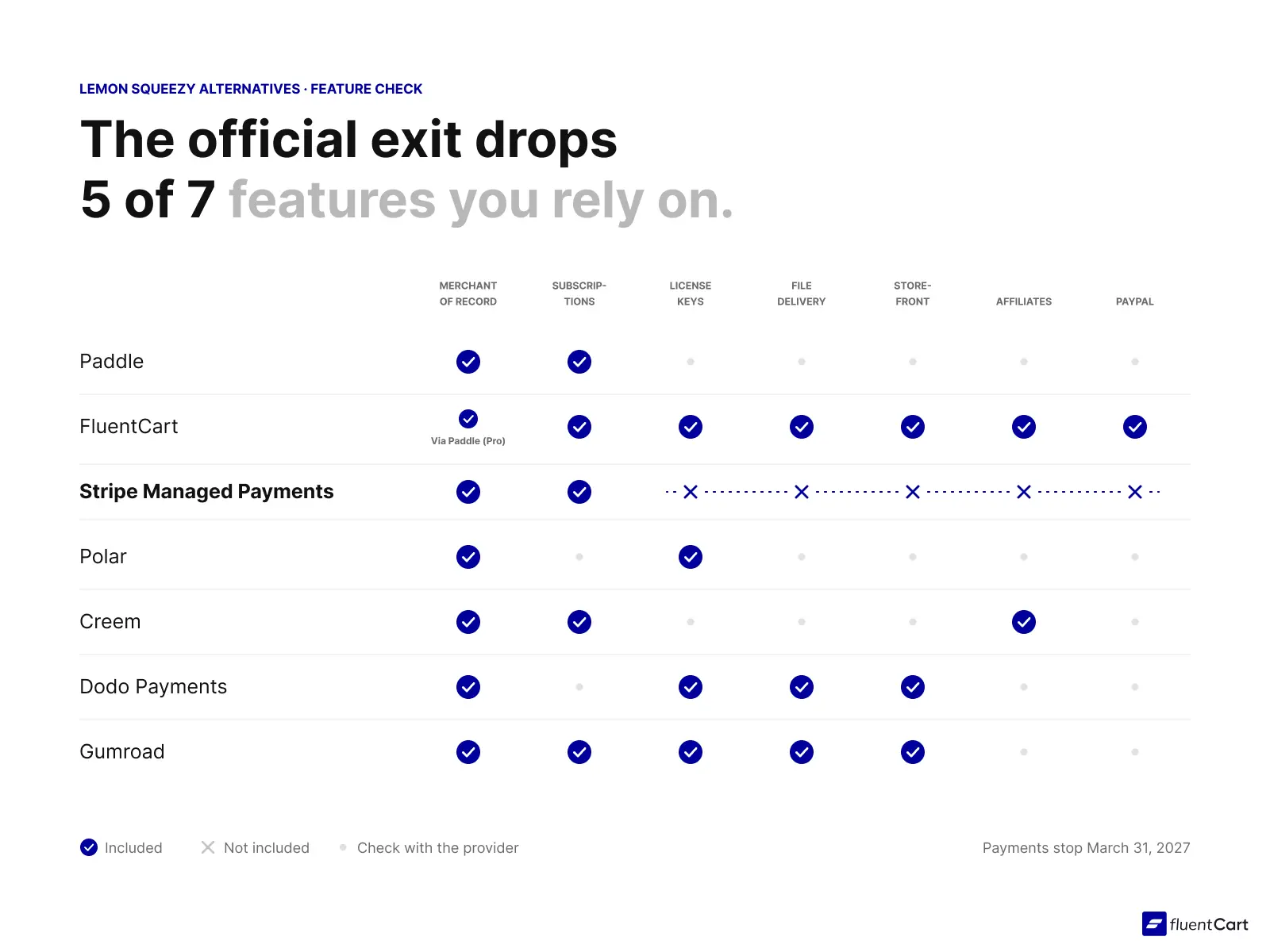
And that trade is the first thing to decide.
1. Paddle
Paddle is the closest like-for-like Lemon Squeezy alternative. It’s a merchant of record built for SaaS and apps, and sales tax is calculated, charged and remitted on every purchase. Lemon Squeezy and Paddle were always compared side by side, and the Paddle vs Lemon Squeezy question now has a simple answer: one of them will still be running in April.
What you get:
- Tax off your plate: global sales tax handled as the legal seller
- Local checkout: local currencies, languages and payment methods
- Fraud cover: chargeback protection on every payment
- Help moving: migration specialists who build a transition plan with you
Paddle also reports that PostNitro tripled its conversions after switching from Lemon Squeezy. That’s a vendor-reported figure, so read it as a direction.
The catch? Paddle is built around subscriptions and software billing. So if Lemon Squeezy delivered your files or license keys, confirm how you’ll handle that piece before you sign.
2. FluentCart
FluentCart is the pick for sellers who are tired of renting their checkout. It’s a self-hosted eCommerce plugin for WordPress with 0% commissions, so your store, your checkout and your customer records live on your own site. Nobody can close it down with a blog post.
Here’s where the five things Managed Payments drops end up:
- Storefront: your WordPress site becomes the store, with design control through Gutenberg, Elementor, Divi or Bricks
- Files: downloads stay gated behind the purchase, served from your own Amazon S3 bucket in the free plugin or Cloudflare R2 in Pro
- PayPal: recurring billing runs on PayPal’s own subscription system in the free plugin, with renewals, cancellations and status changes syncing back to your orders, and existing Lemon Squeezy PayPal subscribers approve a new subscription once on your checkout
- Affiliates: FluentAffiliate plugs straight into FluentCart, so commissions track against your own orders
- License keys: customers get a link to their new account, where they download the product and grab a fresh key, and FluentCRM sends that note to every buyer in one go
FluentCart’s free plugin covers digital and physical products, subscriptions, invoices and PDF receipts. Its licensing module needs Pro, and once it’s on, license keys are generated the moment an order completes and access is revoked when a license expires.
Let’s say you sell a WordPress plugin with yearly licenses. In this fake scenario, a customer buys on Monday, gets a key in the receipt, and that key stops working the day the license expires. As you can see, the whole license lifecycle runs on your own site with no third party in the middle.
Payments run through the gateway you choose:
- Global: Stripe, PayPal, Square, Airwallex
- Merchant of record: Paddle, in Pro
- Regional: Mollie, Razorpay, Paystack, Mercado Pago, Authorize.net
- Custom: any other gateway through webhooks
Now the honest part. FluentCart itself is not a merchant of record, so on Stripe or PayPal you are the seller and the tax filing is yours. FluentCart’s tax engine handles the calculation side in the free plugin (global VAT, EU OSS, VAT ID checks and reverse charge), but returns and remittance stay with you or your accountant. If you sell into Europe, read up on the EU VAT rules for digital goods before your first sale.
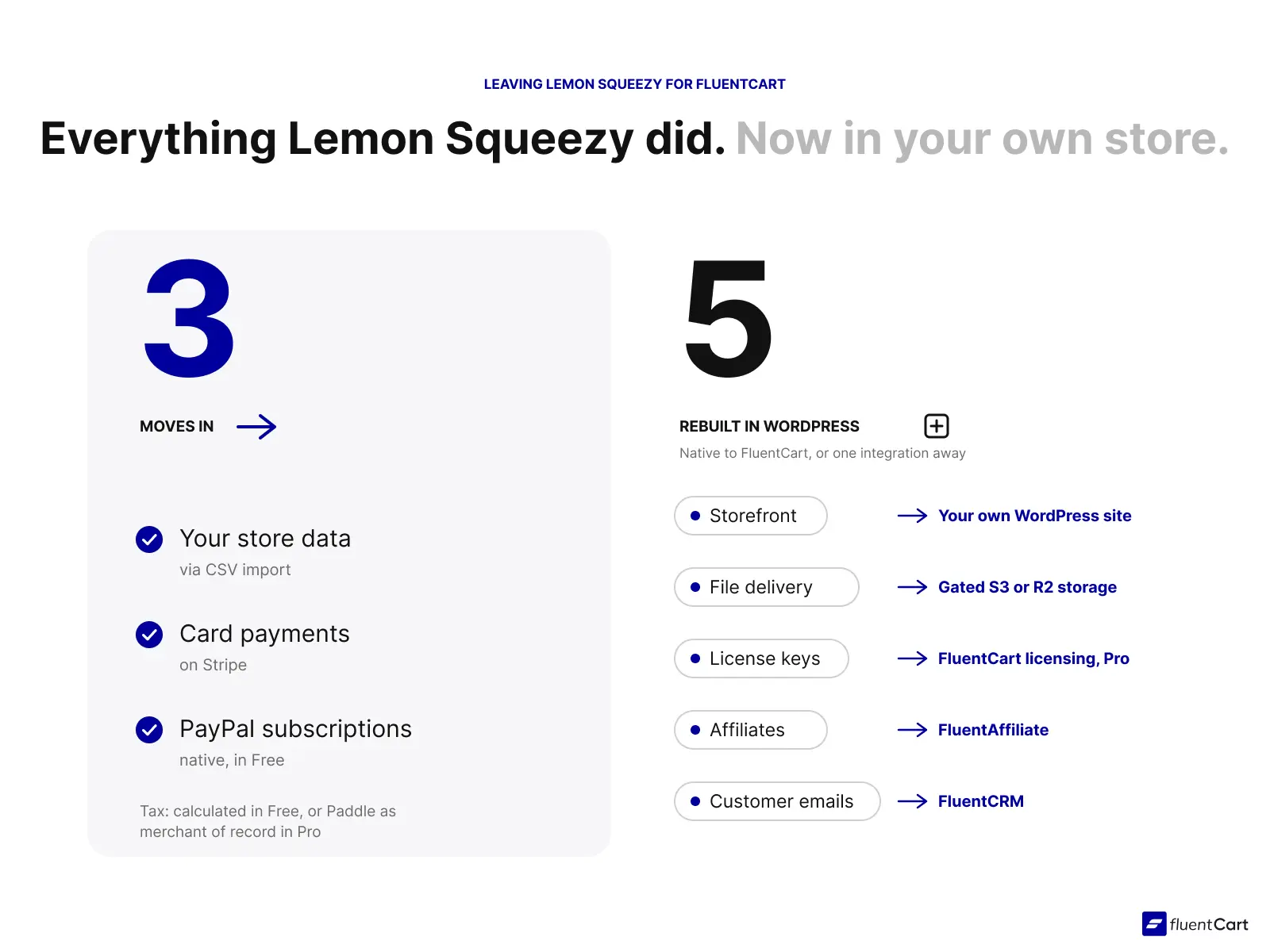
But pair FluentCart Pro with Paddle, and Paddle becomes the merchant of record on those orders, collecting and remitting the tax for you. Customers can pay on FluentCart’s own checkout page or on Paddle’s, while the store, the licenses and the customer records stay on your site. Just switch off FluentCart’s own tax for those orders so nobody gets taxed twice.
Moving in runs through CSV. Export your data with Lemon Squeezy’s export guide, then bring it in through FluentCart’s CSV import. Live card subscriptions are a separate step, handled through Lemon Squeezy’s migration intake form. That way, the move is a one-time job, and the next platform shutdown never lands on your desk.
Sell More. Pay 30% Less.
FluentCart’s BFCM deal is live on annual plans. Keep every sale with zero transaction fees.
3. Stripe Managed Payments
Stripe Managed Payments is where Lemon Squeezy is sending its merchants, and the same team built it. It’s Stripe’s own merchant of record for SaaS, software and digital downloads, and it handles sales tax, VAT and GST in more than 80 countries. Migration tooling opens on December 2, 2026, and your customers get at least 14 days’ notice before their subscriptions move.
Sounds like the safe default. Or is it?
It isn’t a full replacement, and Lemon Squeezy’s own migration notes list what’s left behind:
- PayPal: not supported, and PayPal subscriptions can’t migrate
- Storefront: none, so you need a separate site
- Fulfillment: no files, license keys or download links
- Affiliates: none, so setting up affiliate links moves to a separate tool
- Checkout: Stripe Checkout and Payment Links only
Big gaps.
It’s also limited to businesses based in supported countries. Now, if you’re based outside that list, Lemon Squeezy can’t move you there at all, and the rest of this page is your shortlist.
4. Polar
Polar is a merchant of record that grew up around developers and open source, and it shows. License keys are built in, so you can sell keys without hosting your own validation API.
Where it fits a Lemon Squeezy seller:
- Keys: brandable prefixes and usage quotas per key
- Tax: handled by Polar as the legal seller
- Plans: paid tiers swap part of the per-sale fee for a fixed monthly one
If your Lemon Squeezy store was mostly software licenses, Polar covers the part Stripe leaves out. Short verdict: software sellers lose the least by moving here.
5. Creem
Creem is a newer merchant of record aimed at indie SaaS, and it has one feature that matters right now: its CLI has a built-in Lemon Squeezy migration tool that imports your product catalog. That saves a weekend of copy and paste.
Around that tool, Creem collects and remits VAT, GST and sales tax in 50+ countries. Revenue can be split automatically with co-founders, affiliates and contractors, which covers part of what Lemon Squeezy affiliates did. Payouts land on the 1st and 15th of each month.
But the migration tool moves products only. Subscriptions and customer data still need planning, so ask Creem how it handles live subscribers before you switch your checkout links.
6. Dodo Payments
Dodo Payments is the answer for the merchants Stripe left out. It says businesses based in 186 countries can sell through it, with tax handled in 190+ countries and 40+ payment methods, including UPI and Pix.
It also matches the Lemon Squeezy feature list closely. According to Dodo’s migration guide, license keys and file delivery are included, Lemon Squeezy license keys can be imported, and there’s a storefront plus hosted, overlay and inline checkout. If your customers use overlay checkout today, they won’t notice much.
If Stripe turned you away, Dodo is the lemon squeezy alternative built for that exact gap. Now, these claims come from Dodo’s own pages. A test purchase from your own country settles it before you move live subscribers.
7. Gumroad
For creators who sold ebooks, templates and courses, Gumroad is the most familiar lemon squeezy alternative. It has acted as a merchant of record since January 1, 2025, so tax collection and remittance are handled worldwide.
What makes it different:
- Discover: a built-in marketplace that can send you new buyers
- Keys: license keys for software sellers
- Memberships: recurring access for courses and communities
But there’s a trade-off in the cost structure. Sales found through Discover carry a bigger cut than direct sales, and physical goods are off the table. If the cut feels heavy, these Gumroad alternatives compared on fees are a useful second look. For a creator who wants tax handled and a bit of free discovery, though, it’s a fair deal.
How to Pick Your Lemon Squeezy Alternative Before the Deadline
A full Lemon Squeezy migration can take up to 8 weeks, according to the company’s planning guide, and it recommends starting no later than mid-January 2027.
Here’s the thing: 8 weeks counted back from March 31 lands in early February. So mid-January is already cutting it close.
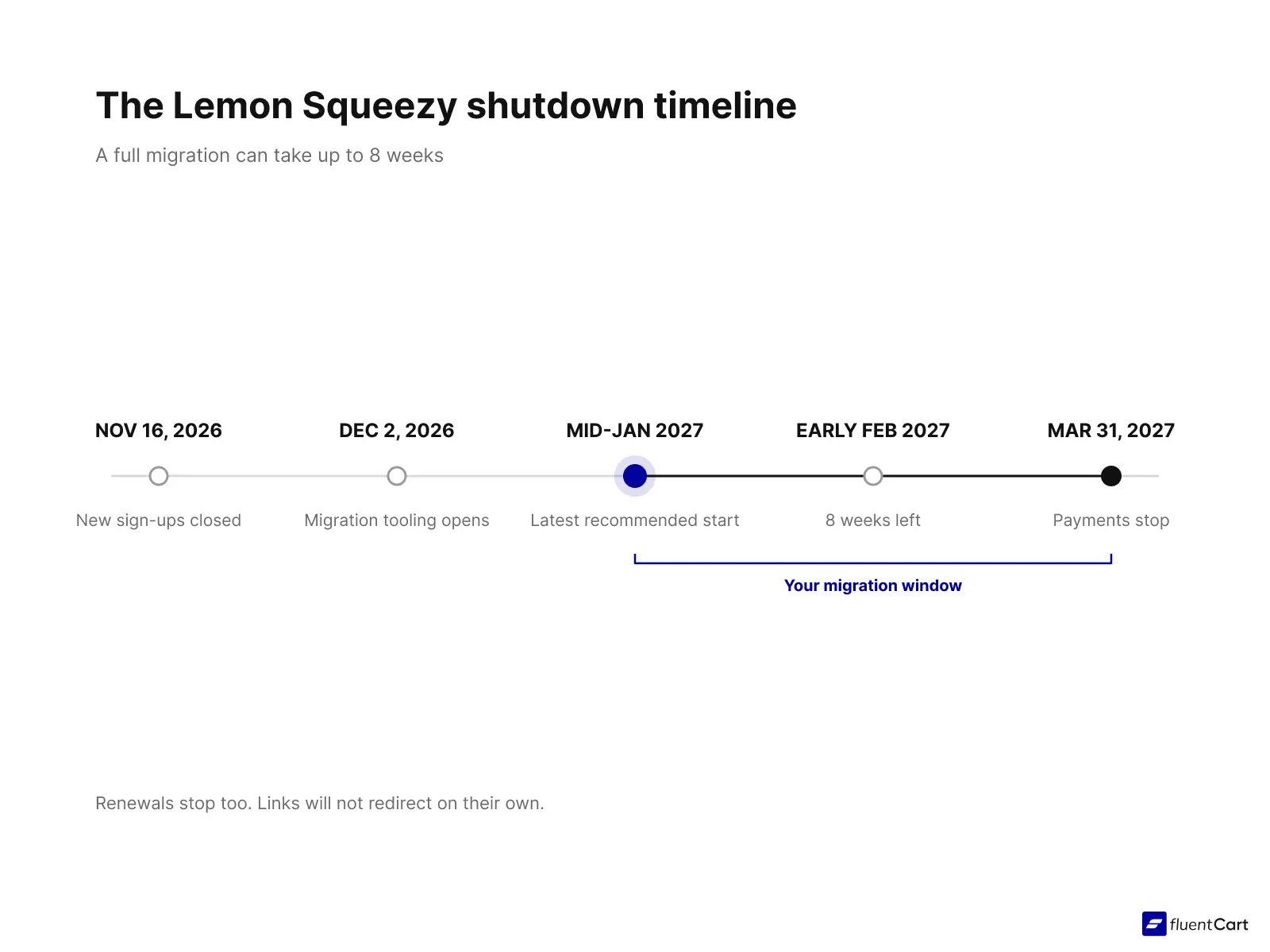
Tight, but doable.
So the decision has to be quick, and it has to hold. These seven questions narrow down the right lemon squeezy alternative fast.
1. Where is your business based?
Managed Payments only accepts businesses from supported countries. If yours isn’t one of them, Stripe is off the table, and Dodo, Paddle, Polar, Creem or a self-hosted store are what’s left.
2. Who should be the legal seller?
A merchant of record files the tax returns, so you never see them. Selling as yourself means you register, collect and file, usually with an accountant’s help. If tax is the job you never want back, you need an MoR somewhere in the setup, either as the whole platform or as the gateway behind your own store.
3. How do you run the store day to day?
Let’s say you’re a solo founder selling three plans, so a hosted checkout and a payout dashboard cover everything. Add a team juggling refunds, coupons, customer questions and reports, and you want all of it in one admin, with roles for who can touch what. As you can see, the bigger the team, the more the admin matters.
4. How big is your catalog?
Most MoR tools are built around checkout and billing first. A handful of SaaS plans fits that shape well. Dozens of downloads, bundles and variations, or a mix of digital and physical goods, need real catalog tools.
5. Who owns the customer data?
This shutdown already answered that one for hosted platforms. Your records sit on someone else’s servers, and you get an export window when their plans change. On a self-hosted store the customer table lives in your own database, and building your own store means nobody else sets your deadlines.
6. How much of each sale do you want to keep?
Every MoR takes a percentage of each sale for the tax, fraud and dispute work it carries. A self-hosted store has no platform fee, only your payment processor’s charges. Put Paddle behind it and you pay Paddle’s MoR fee on those orders, with still no platform cut on top.
7. Who maintains it?
Hosted tools handle updates and uptime, but their roadmap becomes yours, shutdowns included. Self-hosted means you look after eCommerce hosting, updates and backups. In return, you decide when things change and how far the store bends.
Now, if your answers keep landing on ownership, a growing catalog and no platform cut, a self-hosted setup like FluentCart fits that profile, with Stripe for selling direct or Paddle in Pro when you want an MoR handling the tax.
Once you’ve picked, run the move as a real migration. Two hosted platforms share no database, so every record travels through an export or an API, and testing is your safety net:
- Back up first: customers, orders and subscriptions, plus any files and license data Lemon Squeezy held
- Test before going live: use a sandbox or trial account, and the Managed Payments tooling even builds a Stripe sandbox with copies of your products
- Verify by scenario: a one-time sale, a subscription renewal, a coupon order and a refund, then compare record counts
- Reconnect payments: gateway credentials never transfer, and PayPal subscribers must start a new subscription before moving to Managed Payments
- Run both in parallel: Lemon Squeezy keeps working until March 31, so cut over once every order type checks out
- Redirect every link: checkout links, emails, in-app flows and webhooks won’t redirect on their own
- Watch the first week: failed payments, missed renewals and broken download links show up early
The eCommerce migration best practices guide goes deeper on each step, and this phase-by-phase platform migration checklist keeps the cutover in order. So by the time March 31 arrives, your store has already been running somewhere else for weeks.
Wrapping Up
Lemon Squeezy shutting down is annoying. But it’s also a rare clean break.
Pick an MoR if tax is the job you never want back. Pick a self-hosted store if owning the customer relationship matters more. Or pair the two, with an MoR running behind your own checkout. Pick early, either way.
So the right lemon squeezy alternative gets picked calmly in December, with time left to test it.
Start the move this month.
You can start your store now
Download FluentCart for free and setup your online store and start selling from today.

Hi, this is Abir, a Deputy Marketing Lead, passionate product designer, and WordPress core contributor. Creating interesting content and products that ensure a 360-degree customer experience is my daily job.

Subscribe now
Related Articles and Topics
-

WooCommerce vs FluentCart: Which Fits Your Store
WooCommerce or FluentCart? See what each does from the start, what it costs as your store grows, and…
-

Best Black Friday and Cyber Monday Deals for WordPress (2026)
Black Friday and Cyber Monday deals for WordPress in one list: 2026 discounts on plugins, themes, and hosting,…
-
Types of Ecommerce Checkout and Where to Use Each
Checkout page, modal or inline? Compare the types of eCommerce checkout, what sits under each, and where to…




Add your first comment to this post