
8 Best Gumroad Alternatives for 2026: Compared on Fees and Creator Ownership

Gumroad takes 10% plus 50 cents from every sale. It keeps taking that cut for as long as you keep selling. At $400 a month, nobody notices. At $15,000 a month, you’re paying to a company that does not work for you. Looking for Gumroad alternatives is the logical next step.
That math is why most people searching for Gumroad alternatives are not unhappy with the product. They are unhappy with the invoice. This guide ranks eight platforms on the two things that decide your take-home pay. What the platform charges, and how much of the store you get to own. FluentCart sits at number one because it starts free, charges nothing per sale, and runs on hosting you already pay for. Weighing the case for building your own store against staying hosted? That section is worth reading first.
TL;DR
Jump to the comparison table below if you want the short version.
Why You’re Looking for Gumroad Alternatives [probably!]
Most people leave Gumroad for one of three reasons. The percentage stops feeling small. The storefront starts feeling generic. Or the checkout refuses to do the one thing their business needs. None of those are Gumroad failing at its job. They are a creator outgrowing a tool built for the first sale.
The Fee Math Gets Worse as You Grow
Gumroad’s published rate is 10% plus $0.50 per direct sale. That rises to 30% when the buyer finds you through Gumroad Discover, according to Gumroad’s own pricing page. There is no volume tier. A creator doing $2,000 a year and a creator doing $200,000 a year pay the same rate.
Percentage pricing is a rental agreement dressed up as a service fee. It scales with your success rather than with the cost of serving you. Delivering a 4MB PDF to your thousandth customer costs Gumroad roughly what the first one did. Your bill grows in a straight line anyway.
Here is the part people miss. The fee is charged on gross revenue, not on profit. Run paid ads at a 3x return and a 10% platform cut eats a much bigger slice of your real margin than the headline number suggests.
You Rent the Storefront, You Do Not Own It
Every Gumroad store looks like a Gumroad store. That consistency helps buyers trust the checkout, and it is a real advantage early on. It also means your brand lives inside someone else’s template, on someone else’s domain, under someone else’s terms.
The deeper issue is the customer relationship. When a platform sits between you and your buyer, the platform owns the pipe. It sets the payout schedule, the refund policy, and the rules about what you may sell. Anyone who has watched a marketplace change its terms overnight knows the feeling. We made the same argument about the real cost of selling through a marketplace.
The Checkout Is Not Yours to Change
Gumroad’s checkout is fixed. You cannot add a custom field or restructure the flow. You cannot insert your own fee logic or wire in a regional payment gateway your buyers prefer. For a creator selling one ebook, that is fine. Sell a $900 annual license to European companies that need a compliant invoice with a VAT number on it, and the ceiling arrives fast.
What the Average Gumroad User Wants From a Platform
Ask people why they switched and the same six wants come up. They want to keep more per sale and own their customer list. They want to look like a real brand, sell more than one kind of product, get paid quickly, and stop worrying about tax. Gumroad handles two of those well and the rest partially.
Here is the honest scoring, want by want:
Read that list again and notice the pattern. The wants Gumroad satisfies are the ones a hosted platform is structurally good at. It misses the ones that need control. A hosted platform cannot hand you control without ceasing to be hosted.
That is the real fork in the road. Cheaper hosted platforms fix the fee line and leave the control problem alone. Self-hosting fixes both, at the cost of setting things up yourself.
The Case for Self-Hosting Instead of Renting a Storefront
Self-hosting means the store runs on your domain, on hosting you control, with the database in your hands. No platform sits between you and the buyer. So no platform takes a percentage or sets the rules. The trade is that setup and maintenance become your job.
Renting Versus Owning
Think of a hosted platform as renting a shop in a mall. The foot traffic is handy, the lease is short, and the landlord fixes the plumbing. You also pay rent forever and cannot knock down a wall. The landlord can raise the rate whenever the business plan shifts.
Self-hosting is buying the building. The first month costs more effort, and you are the one who calls the plumber. Every month after that, the payment you were sending to a landlord stays in your account. The walls are yours to move.
A second analogy fits digital sellers even better. A platform fee is a royalty. Publishers take royalties because they took the risk of printing and distributing the book. A checkout page that hands over a file you already made carries no comparable risk. Paying a permanent royalty on it is a strange arrangement to accept forever.
What Self-Hosting Costs in Practice
The honest cost of self-hosting is three things: hosting, a domain, and your time. Already running a WordPress site? The first two are paid for. The plugin layer is where the choice gets interesting. A free core plugin plus your existing hosting can put a full store online with no per-sale cut at all.
Time is the real variable. Expect an afternoon to configure products, payments, tax rules, and email templates properly. Budget an hour or two a quarter after that for updates. Set against a 10% royalty on every future sale, most sellers doing meaningful volume find the trade obvious.
Where Self-Hosting Is the Wrong Answer
Self-hosting is not right for everyone, and pretending otherwise would be dishonest. Sell one product occasionally at under a few hundred dollars a year, and the fee you save will not cover the setup time. Refuse to touch a WordPress dashboard, and none of this will feel worth it. Want a marketplace to send you buyers? A self-hosted store brings no built-in audience.
Everyone else, keep reading.
The Best Gumroad Alternatives for 2026
The eight platforms below cover the realistic range of options. Self-hosted WordPress, fully hosted checkouts, and merchant-of-record services all appear. Each entry lists what it is good at, what it charges, and who should skip it. The best Gumroad alternative for you is the one whose trade-offs match how you sell.
FluentCart
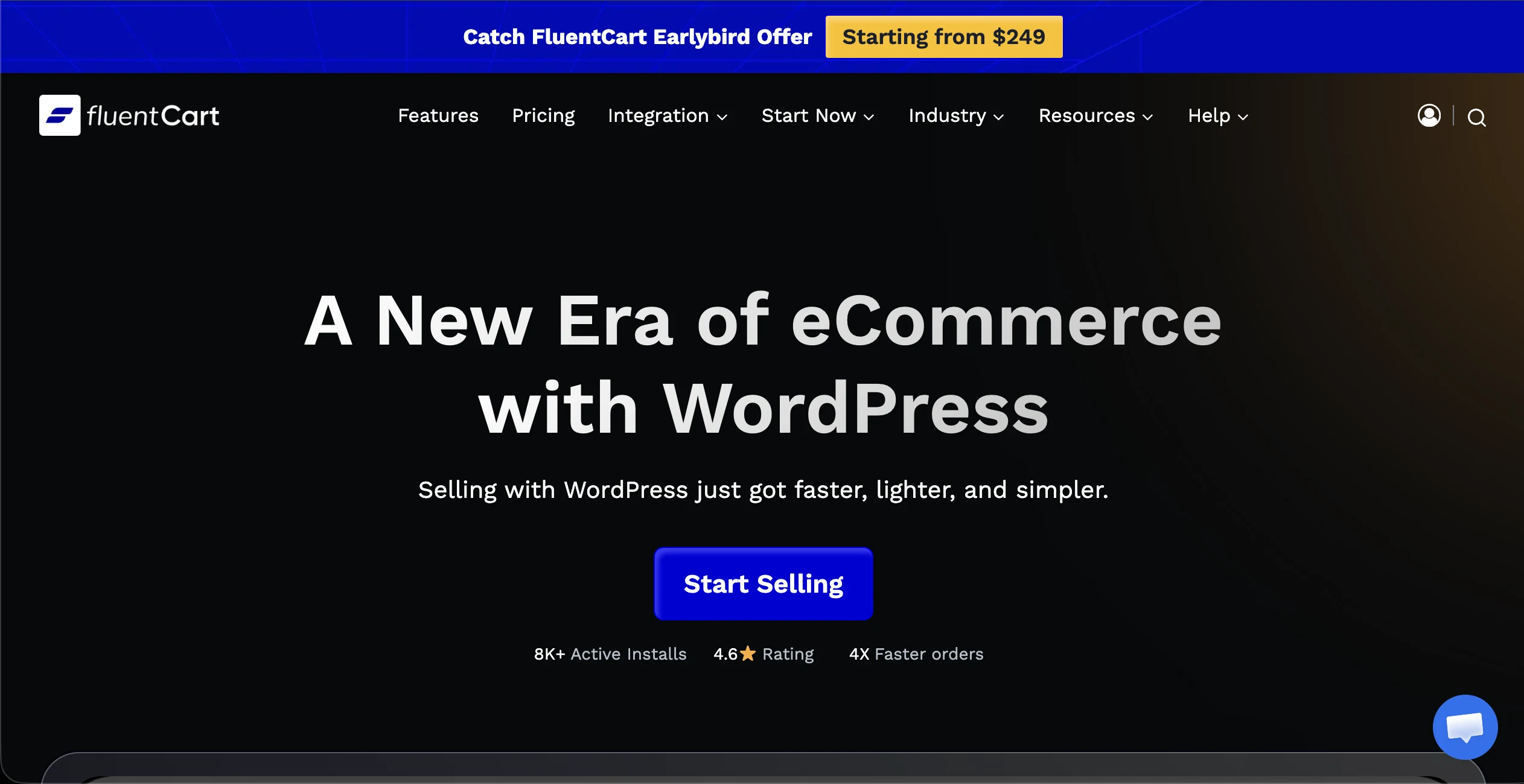
Best for: creators who want a free starting point, zero platform fees, and ownership of the whole store.
FluentCart is a self-hosted WordPress commerce plugin. The core is free on the WordPress plugin repository, and neither the free nor the paid tier charges a transaction fee. That combination is rare. Most free plans buy their freeness back through a percentage. Most 0% plans charge a monthly subscription for the privilege.
The store lives on your domain. Orders, customers, and subscription records sit in dedicated database tables on your own hosting. Your customer list is yours in the literal sense rather than the export-a-CSV sense. Nothing sits between the buyer’s card and your Stripe or PayPal account except the payment processor.
Best for: Creators who want a free starting point, zero platform fees, and ownership of the whole store.
For digital sellers, the free core already covers what most Gumroad users need. Multiple downloadable files per product, secure signed download URLs, and expiry controls all ship without a paid upgrade. So do guest checkout, coupons, and native subscriptions. The free versus Pro breakdown lays out where the line sits, feature by feature. If you’re looking to sell courses, pairing with FluentCommunity (also free) gives you a complete course engine with gated access, dripped lessons, and renewals. It also comes with built-in community features like a feed, comments, and private messaging. That combination is the only one on this list that starts free and stays free on the core features most creators need.
Get the Gumroad Migration Toolkit.
Nothing missed, nothing left to chance. Shift your sales platform in an afternoon!
Three capabilities matter for people leaving Gumroad because they hit a ceiling:
That last point deserves emphasis for anyone selling into Europe. A German business buyer will ask for an invoice that satisfies EN 16931. Producing one from a platform that was not built for it is painful. The tax and compliance setup is a genuine reason to move rather than a checkbox on a feature list.
Checkout is the other lever. You get a one-page checkout, a modal checkout, custom fields with your own validation, a custom fee API, and hooks throughout the flow. Building a checkout shaped around your own funnel is possible here. On a fixed hosted page, it is not.
Pricing: free core with 0% transaction fees. Pro is $199/yr for one site, or $249 one-time for a lifetime single-site license. Higher site counts are available on both tracks.
Honest limits: you need a WordPress site and hosting. No built-in marketplace sends you traffic. Pricing rules like BOGO and tiered bulk discounts are not built in yet. But there are workarounds you can explore. If Download limits is essential for your business model, it’s not directly included in FluentCart.
Skip it if: WordPress is not something you want to run, or Gumroad Discover brings you meaningful discovery revenue.
Payhip
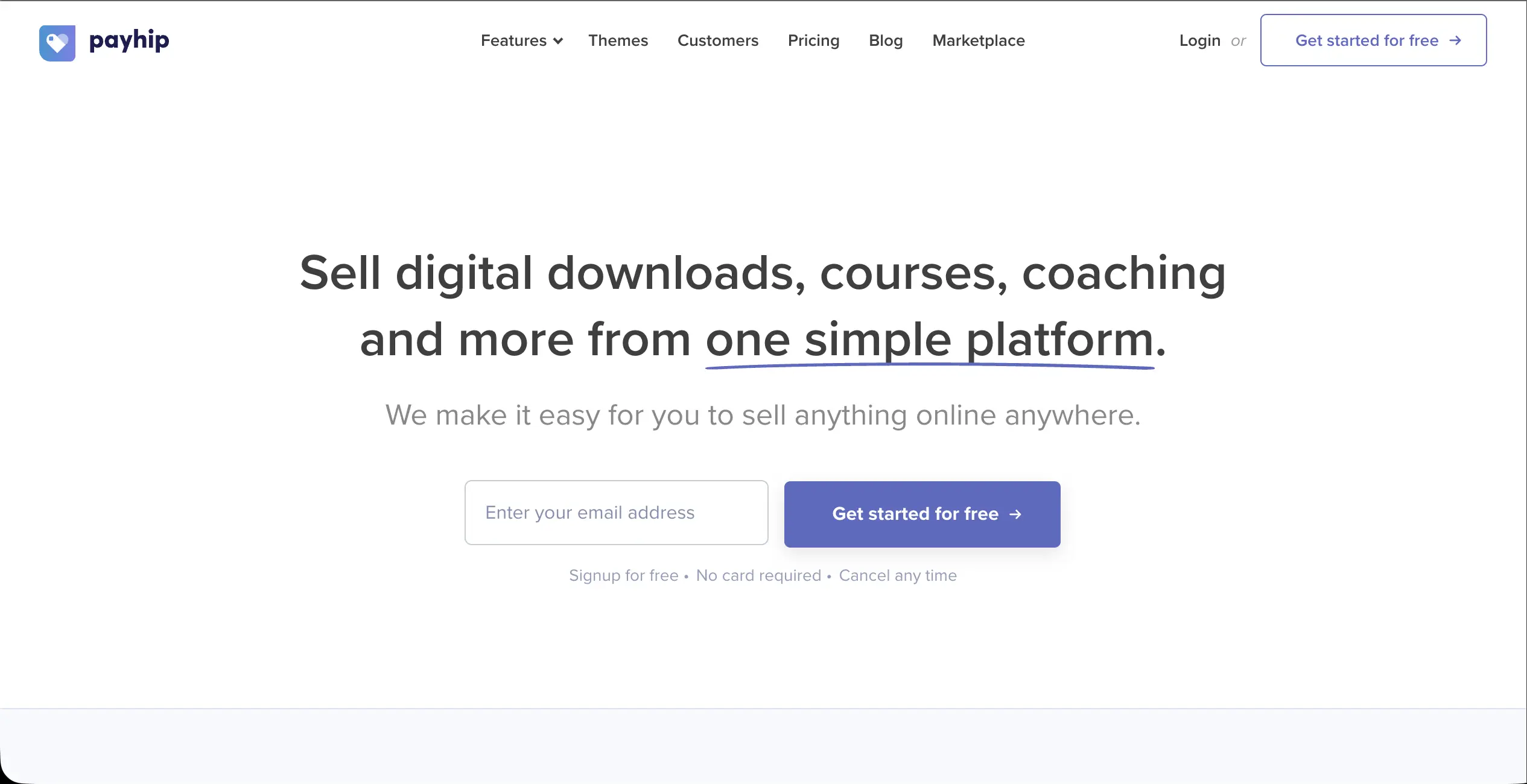
Payhip is the closest like-for-like swap on this list. Setup takes minutes, the storefront builder is friendlier than Gumroad’s, and it handles EU and UK VAT for you. If you like how Gumroad works and only object to the bill, this is the shortest move.
The fee structure is a genuine choice rather than a single rate. Free costs $0/mo with a 5% transaction fee. Plus costs $29/mo with 2%. Pro costs $99/mo with no transaction fee at all. Payment processing sits on top of all three.
Best for: Creators who want the Gumroad experience with a smaller cut.
Payhip also carries a light LMS. Course videos can be organized into modules with quizzes and completion certificates, instead of shipped as a folder of files. Cross-sells and referrals go slightly further than Gumroad’s marketing tools.
Honest limits: storefront customization beats Gumroad’s, though it still falls well short of what your own site gives you. Payhip is a hosted platform, so the ownership question stays unresolved.
Skip it if: control rather than cost is the reason you are leaving.
Lemon Squeezy
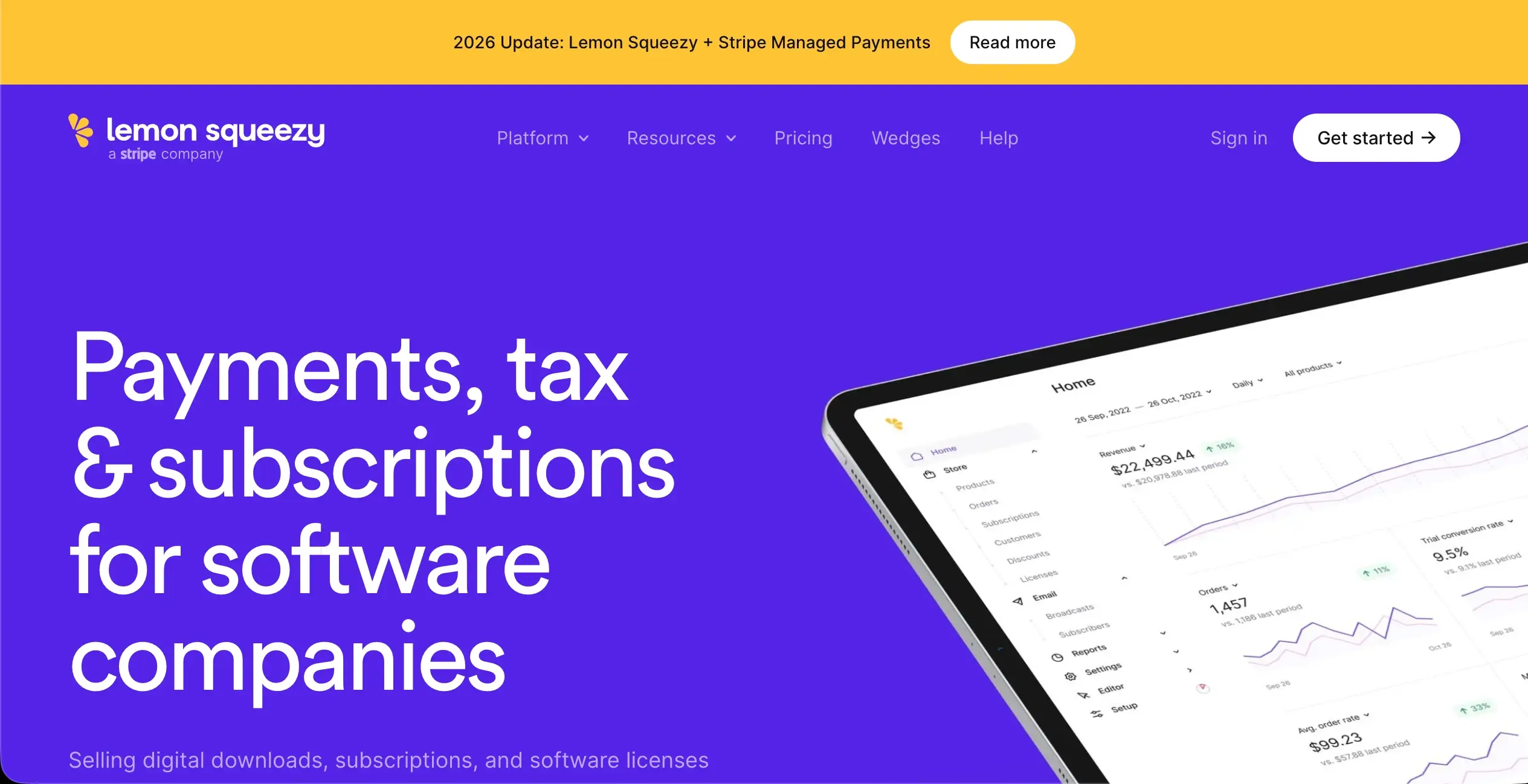
Lemon Squeezy acts as merchant of record. It becomes the legal seller and takes on collecting and remitting VAT, GST, and US sales tax for you. For an indie developer selling to 40 countries, that is a real service worth paying for. It also fights chargebacks and fraud disputes rather than leaving them to you.
The build quality is high. You get a hosted storefront, an embeddable checkout, license key generation, subscription billing, an affiliate program, and cart recovery emails. Stripe runs the payments underneath.
Best for: Software, SaaS, and license-key sellers who want tax compliance handled.
The fee needs care, because the headline number is not the number you pay. The base is 5% + $0.50 per transaction. From there, the documented fee stack adds 1.5% for international transactions, 1.5% for PayPal, and 0.5% for subscription renewals. Cart abandonment recovery adds another 5%. A European customer paying by PayPal on a renewal can push the effective rate near 9% before payout fees.
Honest limits: Cost still remains a percentage of every sale, forever. The add-on percentages stack quickly on the exact features you would want to use. Physical products and print-on-demand fall outside its scope.
Skip it if: your buyers are mostly domestic. You would be paying merchant-of-record pricing for compliance work you do not need.
Podia

Podia is the pick when the product is teaching rather than a file. Courses, drip content, cohort programs, webinars, memberships, and a community feed live in one place. An email tool and a simple site builder come with it. For a coach or educator, that consolidation is worth real money.
Best for: Course creators who want content hosting, memberships, and community in one login.
Pricing runs $42/mo on Mover with a 5% fee, $84/mo on Shaker with no transaction fee, and $150/mo on Earthquaker. All three bill annually, with payment processing separate. There is a 30-day trial and no permanent free plan.
Honest limits: the entry price is high for someone testing an idea. Paying $42/mo plus 5% is worse than Gumroad’s flat rate below roughly $12,000 a year. The checkout stays basic, and the customization ceiling arrives sooner than the price suggests.
Skip it if: you sell files rather than teaching. You would be paying for a course platform you never open.
Sellfy
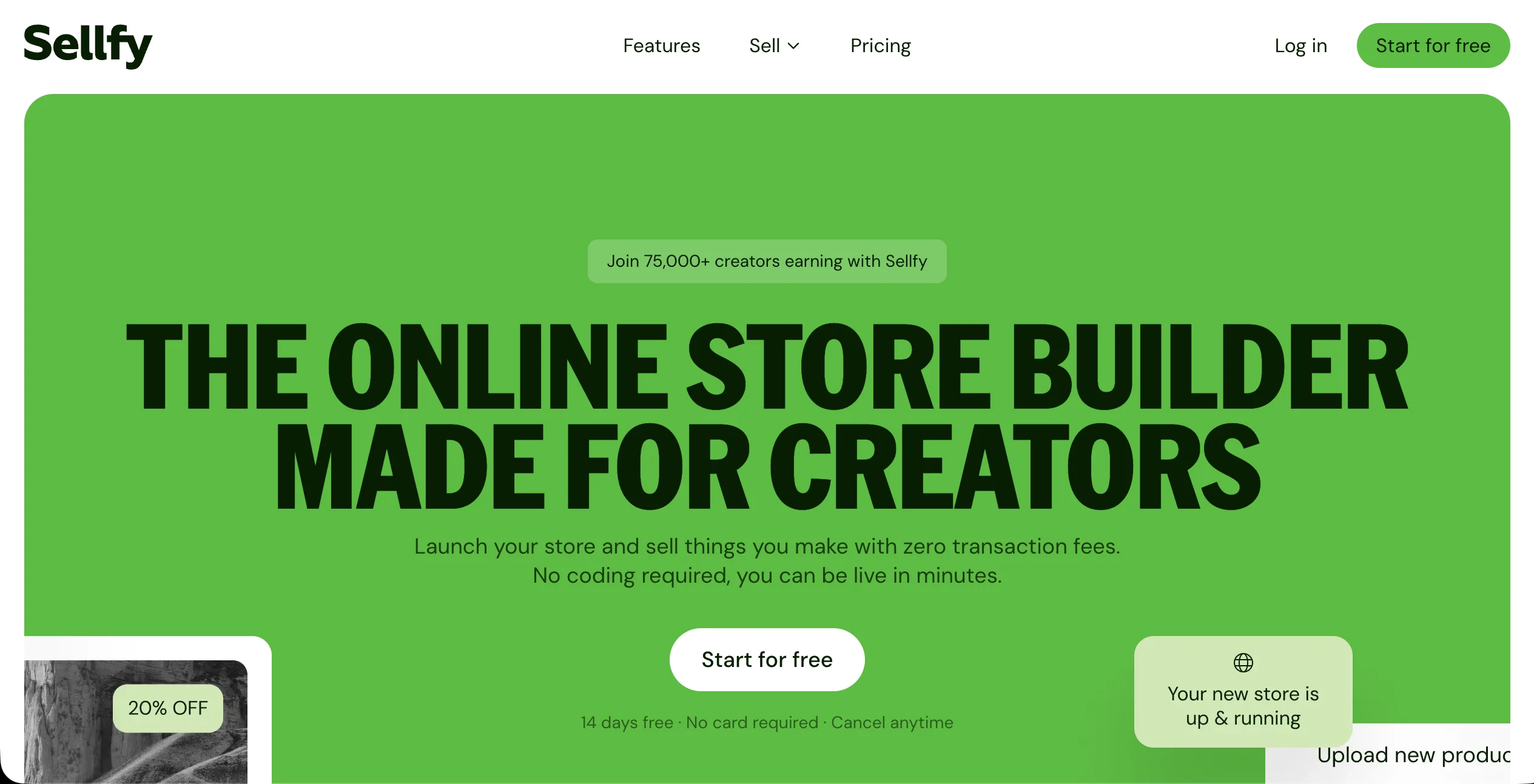
Sellfy is a hosted store handling digital downloads, physical goods, subscriptions, and print-on-demand from one dashboard. The POD side is the differentiator. Pick from a product library, upload your design, and Sellfy prints and ships each order after it sells. No upfront inventory required.
Plans are $29/mo on Starter, $59/mo on Business, and $119/mo on Premium. All carry 0% transaction fees, with processing paid separately.
Best for: Creators selling branded merch next to digital products.
Read the caps before committing, because they are the catch. Starter covers up to $10,000 in annual sales, Business up to $50,000, and Premium up to $200,000. Past the limit, a 2% overage applies. That is a transaction fee wearing a different hat, and it arrives exactly when things start going well for your store.
Honest limits: the revenue caps make the “no transaction fee” claim conditional. There is no marketplace, so all traffic is yours to bring.
Skip it if: merch is not part of the plan. The POD engine is most of what you are paying for.
SendOwl
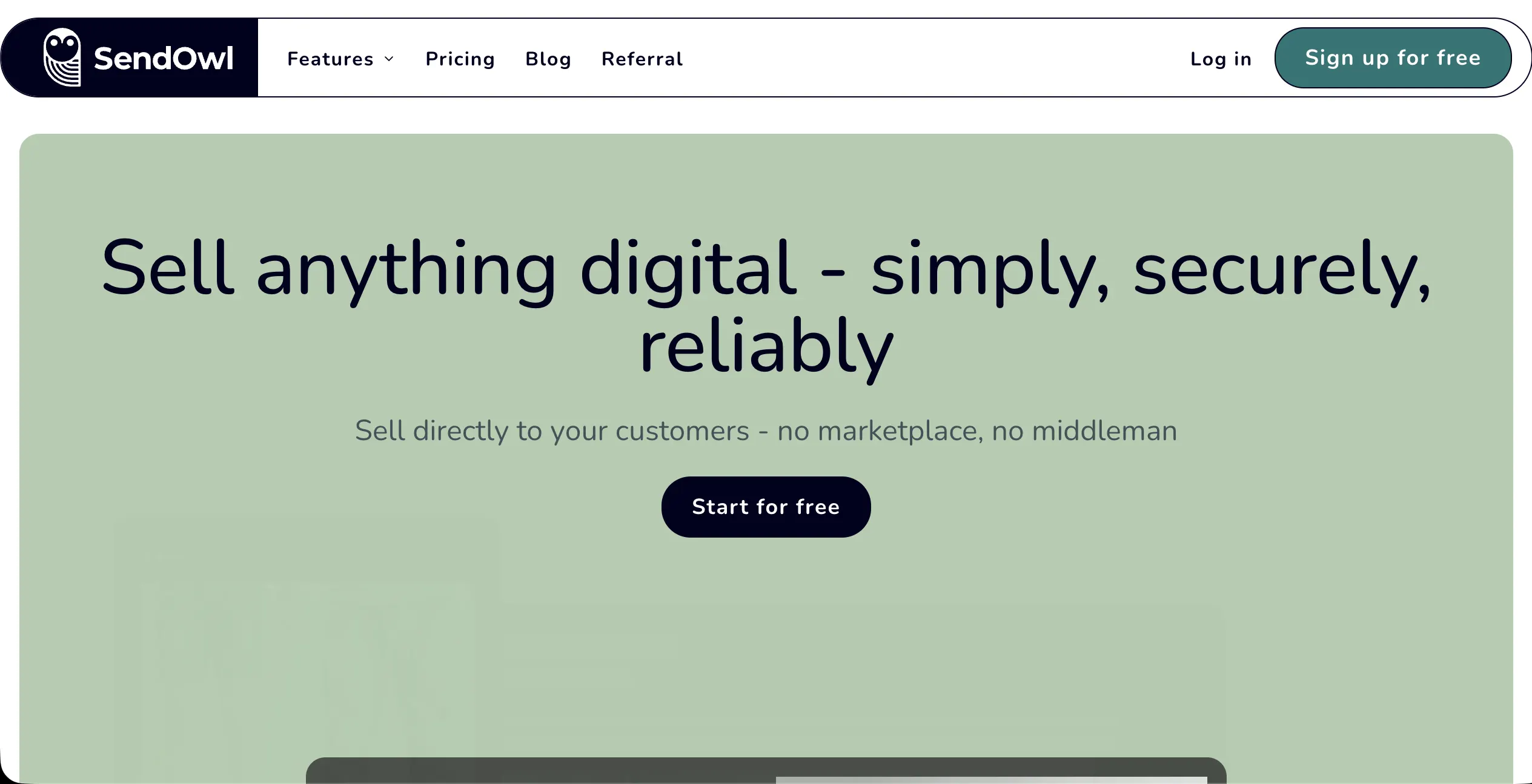
SendOwl does one job carefully. It turns an existing website or blog into a shop without asking you to rebuild it. Upload a product, get a buy link and an embed snippet, and drop it wherever you like. Content protection goes further than most, with PDF stamping, streaming-only video, expiring links, download attempt limits, and license keys.
Plans start at $39/mo on Launch, $87/mo on Grow, and $159/mo on Scale. Every feature is included on every tier, with no percentage cut on sales.
Best for: Sellers who already have a site and want a selling engine bolted onto it.
The same caveat as Sellfy applies. Launch covers up to 5,000 orders and $10,000 in annual sales. Grow reaches $36,000 and Scale reaches $100,000. Higher volume moves you to business plans starting at $299/mo.
Honest limits: the storefront builder is minimal, so this works best as a back office rather than a shop window. No email marketing or blogging is included.
Skip it if: you need a real storefront. That is the thing SendOwl deliberately does not build.
Easy Digital Downloads
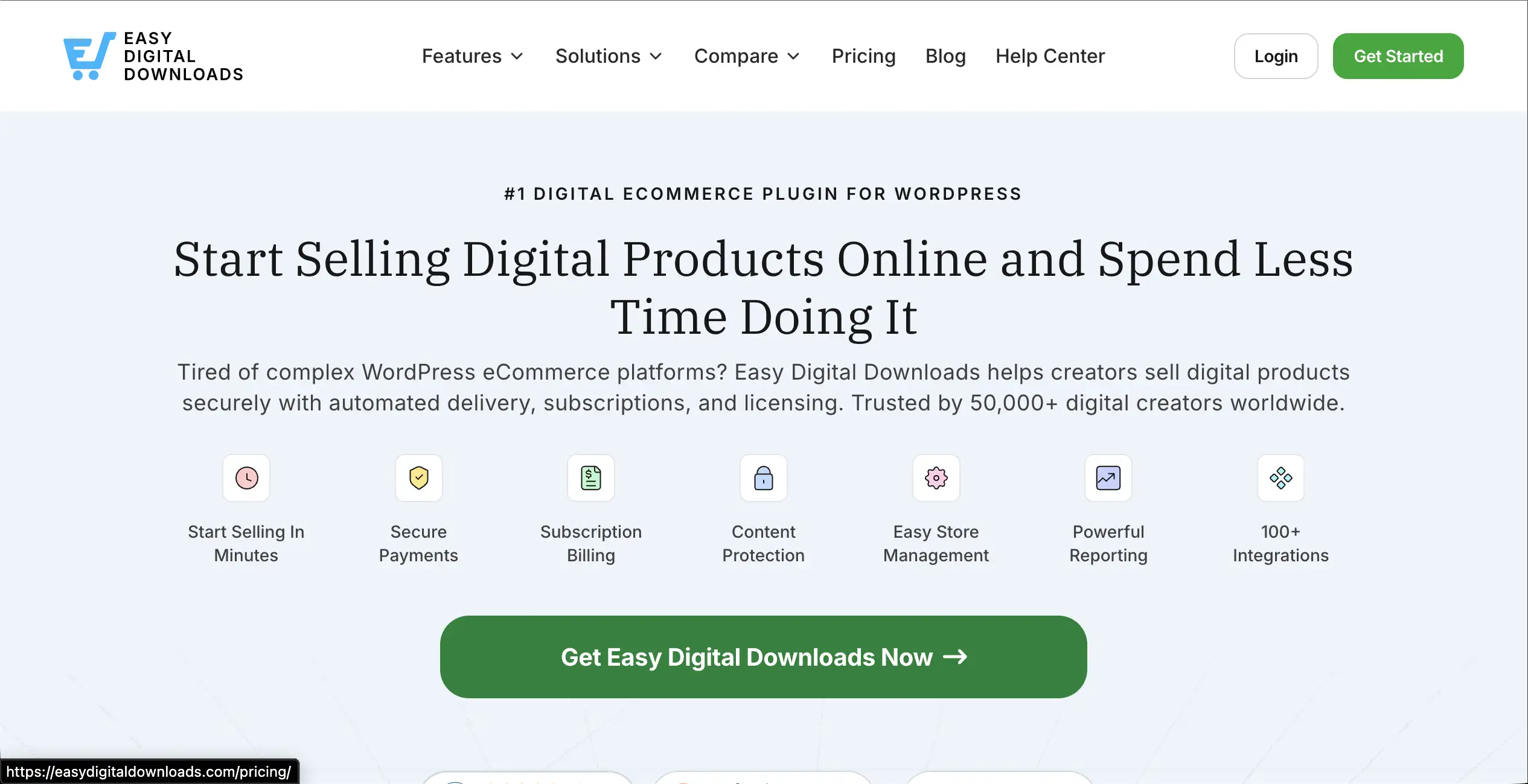
Easy Digital Downloads has sold files on WordPress for over a decade, and the extension library runs deep. Recurring payments, software licensing, discount rules, affiliate programs, and multi-vendor marketplaces are all available through add-ons. No tier charges a platform fee.
The free Lite version on WordPress.org is genuinely basic: one-time purchases and a thank-you email. Paid access runs $99.50/yr introductory for Personal on one site, $199.50 for Extended, $299.50 for Professional, and $499.50 for All Access on three sites. Renewals land at $199, $399, $599, and $999 respectively.
Best for: WordPress users who want the long-established plugin route.
That renewal jump is the number to plan around. First-year pricing looks close to competitive and roughly doubles a year later. The features most people leaving Gumroad want, subscriptions and licensing, sit in the higher tiers.
Honest limits: most useful capability arrives as separate add-ons, so cost and maintenance grow with your feature list. The admin experience shows its age next to newer plugins.
Skip it if: you would rather have subscriptions, licensing, and invoicing built into the core plugin than assembled from parts. FluentCart ships an EDD migrator for exactly this move.
ThriveCart
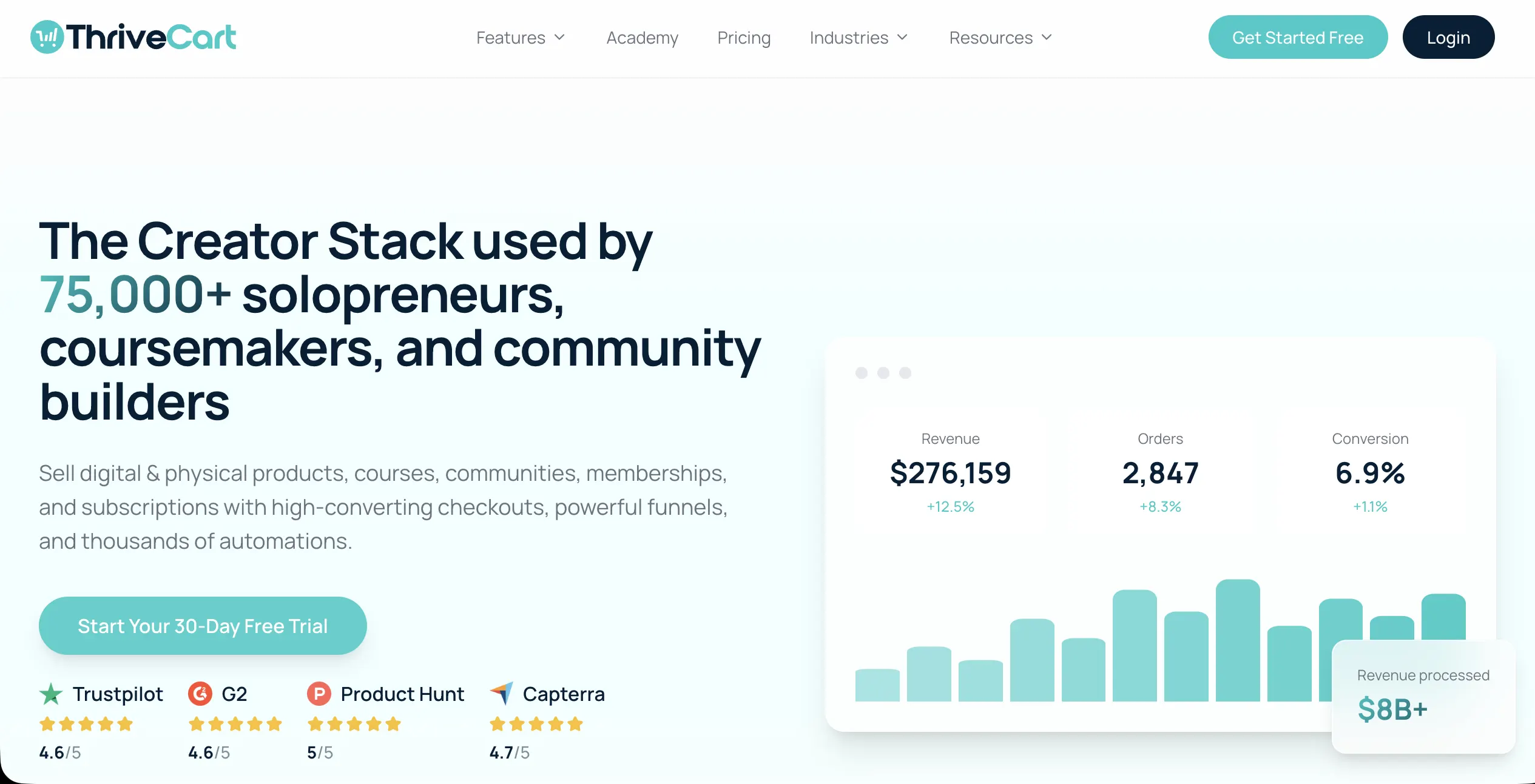
ThriveCart is a checkout and funnel tool rather than a store. It exists to raise the value of each transaction. Order bumps, one-click upsells, A/B tested checkout pages, installment plans, and an affiliate center all sit at the center of the product. There is a built-in LMS for course delivery, and it charges 0% on sales.
Best for: Sellers whose revenue comes from the checkout page itself.
One thing changed worth knowing about. ThriveCart no longer publishes plan prices publicly. The widely quoted $495 lifetime figure from older comparison articles is not something you can confirm on the site today. Standard, Pro+, and Enterprise tiers each list features and a 30-day trial, with pricing behind a trial signup or a sales conversation.
Honest limits: unpublished pricing makes budgeting awkward. There is no website, blog, or storefront, so it assumes you are driving traffic from somewhere else.
Skip it if: you want a browsable shop. ThriveCart is built around single-offer pages.
Gumroad Alternatives Compared on Fees and Ownership
The table below sets every platform side by side. It covers hosting model, entry cost, what the platform takes per sale, and whether your customer data lives on infrastructure you control. Payment processing is excluded from every row, because it applies everywhere and varies by processor.
| Platform | Hosting Model | Entry Cost | Platform Fee Per Sale | Customer Data on Infrastructure You Control | Best For |
|---|---|---|---|---|---|
| FluentCart | Self-hosted WordPress plugin | Free core | 0% | Yes | Digital products subscriptions and licensing with no cut |
| Gumroad | Fully hosted | Free | 10% + $0.50 direct / 30% via Discover | No | Fast first sale and marketplace discovery |
| Payhip | Fully hosted | Free | 5% free tier / 2% on Plus / 0% on Pro | No | Closest like-for-like swap at a lower rate |
| Lemon Squeezy | Fully hosted merchant of record | Free | 5% + $0.50 base plus stacked add-ons | No | Software and SaaS with global tax handled |
| Podia | Fully hosted | $42/mo (annual billing) | 5% on Mover / 0% on Shaker and above | No | Courses memberships and community in one login |
| Sellfy | Fully hosted | $29/mo | 0% up to plan revenue cap then 2% overage | No | Merch and print-on-demand beside digital goods |
| SendOwl | Hosted back office for your own site | $39/mo | 0% within plan order and revenue caps | No | Bolting a checkout onto an existing site |
| Easy Digital Downloads | Self-hosted WordPress plugin | Free Lite / $99.50 yr Personal | 0% | Yes | WordPress selling built from add-ons |
| ThriveCart | Fully hosted checkout | Not published | 0% | No | Order bumps upsells and checkout-first funnels |
Two patterns jump out. Platforms advertising 0% fees mostly recover the money through a monthly subscription or a revenue cap. Only the self-hosted options charge nothing per sale and nothing per month at the entry level.
What You Keep on $10,000 in Sales
Headline rates are hard to compare, so here is one scenario priced across every platform. Assume $10,000 in annual sales spread over 200 orders at $50 each. Payment processing is excluded throughout, since it applies to every option equally.
| Platform and Plan | Subscription Cost Per Year | Percentage and Per-Order Fees | Total Platform Cost on $10000 | Notes |
|---|---|---|---|---|
| FluentCart Free | $0 | $0 | $0 | Runs on hosting you already pay for. No transaction fee on any tier |
| FluentCart Pro (1 site annual) | $199 | $0 | $199 | Adds licensing order bumps installments e-invoicing and advanced reports |
| FluentCart Pro (1 site lifetime) | $249 once | $0 | $249 in year one then $0 | One-time license so cost does not repeat |
| Gumroad (direct sales) | $0 | 10% + $0.50 x 200 orders | $1100 | Rate never drops with volume |
| Gumroad (via Discover) | $0 | 30% of gross | $3000 | Applies when the buyer finds you through the marketplace |
| Payhip Free | $0 | 5% of gross | $500 | Cheapest way to leave Gumroad with zero setup |
| Payhip Plus | $348 | 2% of gross | $548 | Breaks even against the free tier around $11600 in sales |
| Payhip Pro | $1188 | $0 | $1188 | Only wins above roughly $24000 in annual sales |
| Lemon Squeezy (base rate) | $0 | 5% + $0.50 x 200 orders | $600 | International PayPal and renewal add-ons push this higher |
| Podia Mover | $504 | 5% of gross | $1004 | More expensive than Gumroad below about $12000 in sales |
| Podia Shaker | $1008 | $0 | $1008 | Worth it only once volume clears the subscription |
| Sellfy Starter | $348 | $0 up to the cap | $348 | $10000 is the exact Starter cap. Past it a 2% overage applies |
| SendOwl Launch | $390 annual billing / $468 monthly | $0 | $390 to $468 | Capped at 5000 orders and $10000 in sales per year |
| Easy Digital Downloads Lite | $0 | $0 | $0 | One-time purchases only. No subscriptions or licensing |
| Easy Digital Downloads Personal | $99.50 first year then $199 | $0 | $99.50 in year one | Subscriptions and licensing sit in higher tiers |
| ThriveCart Standard | Not published | $0 | Not calculable | Pricing sits behind a trial signup or sales call |
At this volume the spread runs from roughly zero to $3,000. The whole gap is structural rather than a difference in what the buyer receives. They get the same file either way.
Run the same math at $50,000 and the picture sharpens. Gumroad’s cut becomes $5,100. The self-hosted plugin cost stays flat, because a fixed license does not care how much you sell. That is the moment most people stop reading comparison articles and move.
Creator Needs Versus What Gumroad Delivers
This table lines up the six things creators say they want against what Gumroad provides today. The third column names the gap. It is a fair scorecard rather than a hit piece, and Gumroad wins two rows outright.
| What Creators Want | What Gumroad Delivers | Where the Gap Sits |
|---|---|---|
| Keep more of each sale | 10% + $0.50 on every direct sale with no volume tier | The rate never falls so the cost rises in a straight line with revenue |
| Own the customer relationship | Email export is available | The buying relationship still lives on Gumroad’s domain terms and payout rules |
| Look like a real brand | A clean but fixed storefront template | Limited customization means stores are hard to tell apart from each other |
| Sell more than downloads | Digital files subscriptions and physical goods | Courses software licensing and installment plans are thin or absent |
| Get paid fast | Weekly payout cycle | Money sits in the platform after the sale clears instead of landing in your account |
| Stay tax compliant | Merchant of record since January 2025 covering sales tax and VAT worldwide | No real gap. This is a genuine Gumroad strength |
| Control the checkout | A single fixed checkout flow | No custom fields no custom fee logic and no regional gateway of your choosing |
Which Gumroad Alternative Should You Choose in 2026?
Pick by the shape of your business rather than by the headline fee. Here is the decision in one pass:
For most people reading this, the choice narrows to two. Either somebody else runs the store and you accept a percentage for it, or the store is yours. Gumroad, Payhip, Lemon Squeezy, Podia, Sellfy, and SendOwl are all the first answer at different prices. FluentCart and Easy Digital Downloads are the second. Only one of them starts free with subscriptions and 0% fees in the core.
Worth seeing before you decide. Our own community runs on FluentCommunity. Membership access, course drips, and renewals all run on the same plugin this article recommends. Want to see how community and course access get sold rather than read about it? Join, then look back at the checkout you came through.
Real store owners. Real problems. Real answers. Join the FluentCart Community.
How to Move Off Gumroad Without Losing Sales
Migrating takes an afternoon if you sequence it properly. The order below keeps your existing links alive while the new store comes online. Nothing breaks for a buyer mid-purchase.
One detail people forget: subscription customers cannot be moved automatically between platforms. Their payment tokens live with the old processor. Plan to email active subscribers and ask them to re-subscribe. Offer a discount for the inconvenience, because a share of them will not bother.
Frequently Asked Questions
What Is the Best Gumroad Alternative for Most Creators?
FluentCart is the strongest all-round alternative for creators selling digital products, subscriptions, or licenses. It starts free, charges 0% on every sale, and runs on hosting you control. Payhip is the better answer if you specifically want a hosted platform with no setup.
Is There a Free Gumroad Alternative?
Yes, several. FluentCart’s core plugin is free on WordPress.org with no transaction fee. Easy Digital Downloads has a free Lite version, and Payhip has a free tier that charges 5% per sale. The free WordPress plugins cost nothing per sale but require your own hosting.
Why Are People Leaving Gumroad?
The most common reason is the flat 10% + $0.50 fee. It never decreases with volume and rises to 30% on Gumroad Discover sales. Limited storefront customization, a fixed checkout, and weekly rather than immediate payouts come up next.
Does Gumroad Handle VAT and Sales Tax?
Yes. Gumroad became merchant of record on January 1, 2025. It now collects and remits sales tax and VAT worldwide at no extra charge. This is one area where Gumroad compares well against self-hosted options, where tax setup and filing stay your responsibility.
Is Self-Hosting Worth It for a Small Creator?
Below a few hundred dollars a year, probably not. Setup time outweighs the fees saved. Past roughly $3,000 in annual sales, a self-hosted store with no platform fee starts winning clearly, and the gap widens every month after that.
Wrapping Up
You came here for a list of Gumroad alternatives. What you have now is more useful: a way to tell which kind of platform you are choosing. Hosted tools sell you convenience and bill you a percentage for it. Self-hosted tools sell you ownership and bill you once. Both are legitimate. Only one of them charges you more as you succeed.
If your revenue is small and steady, stay hosted and pick the cheapest tier that fits. Building something meant to grow? The percentage is a tax on that growth, and every month you delay is a month of paying it.
FluentCart is free to start. Install the core plugin, list a product, and see what your checkout looks like when nobody takes a cut. The free and Pro comparison shows where the paid line sits, so you can tell before installing whether the free tier covers your store.

Rasel leads the marketing function at FluentCart, driving both high-level strategy and ground-level execution across the product’s growth engine. He plays a central role in defining how FluentCart is positioned, how it enters the market, and how it evolves based on user behavior and feedback. His responsibilities span go-to-market planning, funnel architecture, conversion strategy, and narrative development. He works across teams to ensure that product decisions, marketing efforts, and customer experience stay tightly aligned.

Subscribe now
Related Articles and Topics
-
FluentCart vs PrestaShop: Honest Comparison for Store Owners
FluentCart vs PrestaShop compared on features, pricing, and what comes built in. See which ecommerce platform fits your…
-
Credit Card Payment Plugins Compared: Which Should You Choose?
Compare 10 credit card payment plugins for 2026. See the hidden 1.9% to 3% fees on free plans,…
-
Best Membership Website Hosting in 2026
Membership website hosting isn’t a separate kind of hosting. It’s regular managed cloud or VPS hosting that happens…



Add your first comment to this post