
How to Do Product Research for Business (and Actually Get It Right)
Most products fail not because they were poorly built, but because nobody wanted them in the first place. Product research is the part of building a business that either saves you from that mistake or confirms you’re onto something real.
Here’s the painful truth: most people skip it, rush it, or confuse activity with insight. They look at a few bestseller lists, convince themselves there’s a market, and start spending money. Then they wonder what went wrong.
TL;DR
What Is Product Research
Product research is the process of gathering and analyzing data to figure out whether your product idea can succeed before you commit serious time and money to it. That covers customer demand, competitive landscape, pricing viability, and whether the product itself is practical to build, source, and ship.
It’s broader than pure market research. Market research zooms in on buyers, who they are, what they want, and which brands they’re already loyal to. Product research wraps all of that together with an eye on business viability: can you make money with this thing? Can you even get it to customers?
Here’s what’s actually happening when you skip product research: you’re not being bold. You’re just spending money without asking the most important question first.
Market Research vs. Product Research
These terms get used interchangeably, but they answer different questions.
Market research asks: who are these buyers, what do they want, and what’s the competitive landscape look like? It’s broad. It helps you understand the category you’re entering.
Product research asks: Will this specific product succeed in this market? It takes everything market research reveals and applies it to a concrete idea.
You need both. Market research without product research gives you context but no direction. Product research without market research is just guessing in a specific direction.
A good product research process typically runs four to twelve weeks for straightforward products. Complex categories with regulatory considerations, sourcing challenges, or significant technical requirements can take longer. The investment in that time almost always pays back faster than the cost of launching something the market doesn’t want.
Effective ecommerce management becomes dramatically easier when your product selection decisions are grounded in research rather than optimism.
The Two Lenses of Product Research
Every product research process filters through two sets of criteria. Getting clear on both before you go further will save you a lot of headaches.
1. Market-Based Criteria
Market size
This tells you how many potential buyers exist. Bigger isn’t always better; niche markets are often easier to enter and less expensive to reach. What you want is a market big enough to sustain a business, but specific enough that you’re not trying to out-shout Amazon and Walmart on day one.
Competitive landscape
This shows you what you’re walking into. A market with zero competition usually means there’s no demand. A market drowning in competition means you’d better have a clear angle. Use Google Search, Ahrefs, or Semrush to get a realistic read on search volume and keyword difficulty in your category.
Target customer
It is often the most under-researched part. You don’t need an elaborate persona document on day one, but you do need to know: do these people buy online or in stores? Do they impulse buy or research heavily? Are they budget-driven or quality-driven? Even basic demographic awareness shapes every decision you make downstream.
Product category trajectory
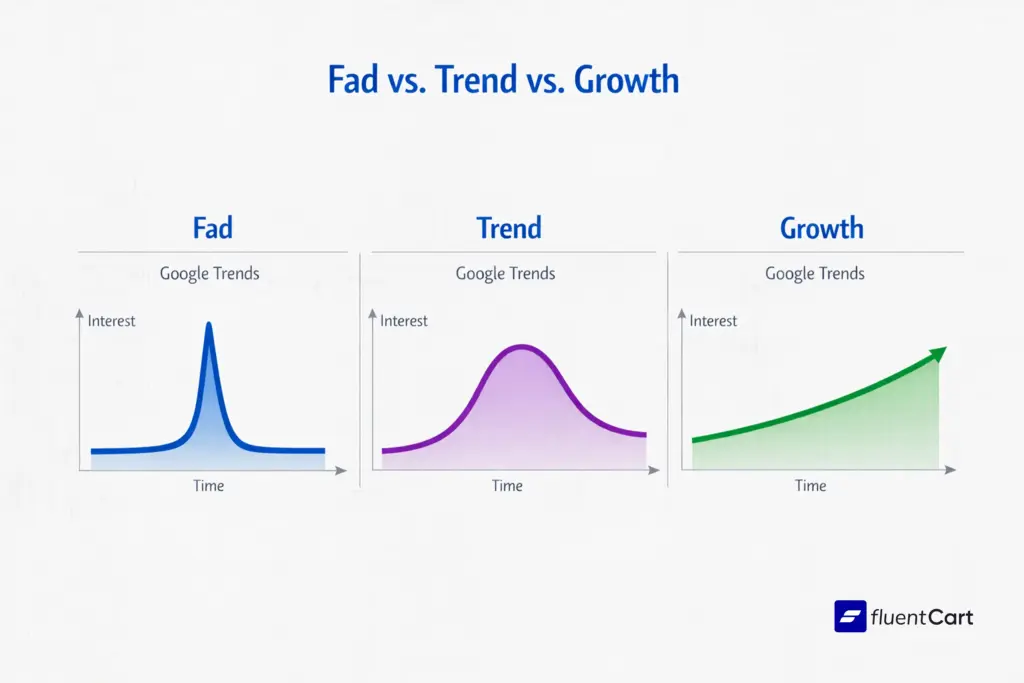
It matters more than most people realize. There’s a real difference between a fad (explodes, dies fast), a trend (grows steadily, may plateau), a stable product (consistent demand, low volatility), and a genuine growth market. Google Trends is your fastest way to spot which one you’re dealing with. A product spiking in January searches but flat the rest of the year is probably seasonal at best.
2. Product-Based Criteria
This is where things break for a lot of first-time sellers. They love the product idea but haven’t thought through the unit economics.
Markup and margin
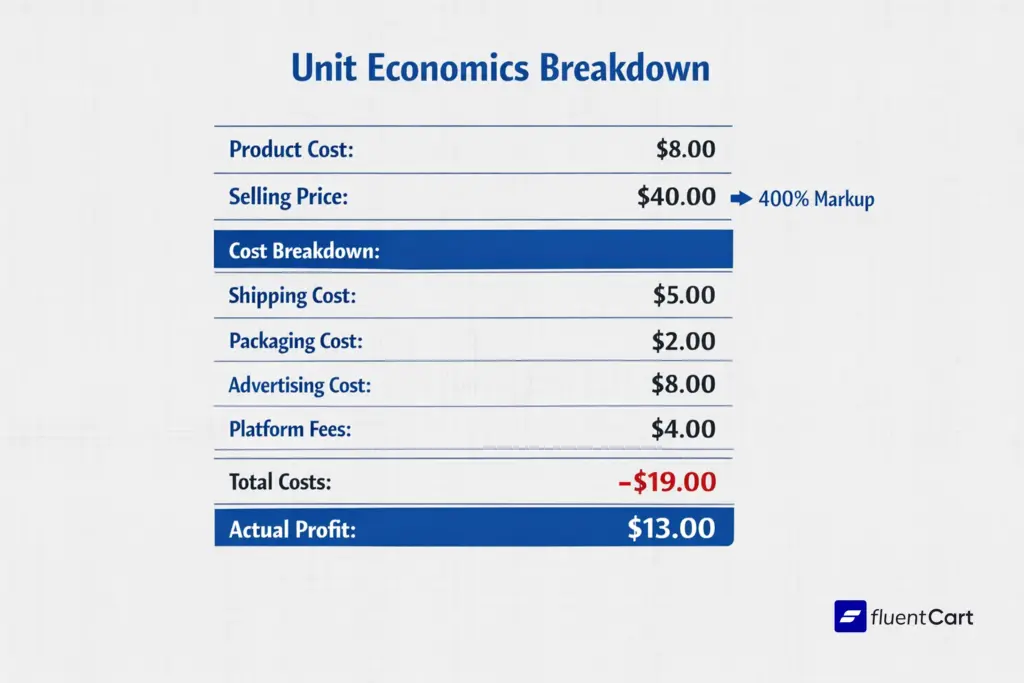
are the starting point. A high sticker markup means nothing if fees, packaging, shipping, platform cuts, and ad spend erode your actual profit. A product that costs $8 and sells for $40 sounds great, until you account for $6 in shipping, $4 in packaging, $5 in advertising, and platform fees. You just made $17. Which is fine, until you realize that $17 doesn’t cover returns, refunds, and customer service time.
When thinking about how to price a product for sustainable margins, you need to understand how to calculate margin and markup. High enough to maintain decent margins, low enough that customers don’t need to sleep on the purchase.
Size and weight
It affects your business more than you’d expect. Customers increasingly expect free shipping. The moment you’re selling something that costs $18 to ship, you either absorb that hit or lose sales. Consider your product’s fully loaded cost to get from the manufacturer to the customer’s doorstep.
Seasonality
It creates cash flow problems. Picnic baskets are great in June. Not so much in November. If your product has a sharp seasonal demand pattern, you need a clear plan for the off months, whether that’s targeting southern hemisphere markets, bundling with complementary products, or just budgeting for thin periods.
Pain point or passion
Products have a natural marketing advantage. If someone has a specific problem your product solves, or they’re passionate enough about a hobby to spend freely, you’ve already got a head start on getting their attention. Products that solve nothing in particular require much heavier marketing investment.
Scalability
It is worth thinking about from day one, not after you get your first 500 orders and realize you can’t keep up. If you’re making things by hand or sourcing from a single supplier with limited capacity, map out what happens when volume triples. Can your supply chain handle it? Will your margins hold?
How to Structure Your Product Research Process
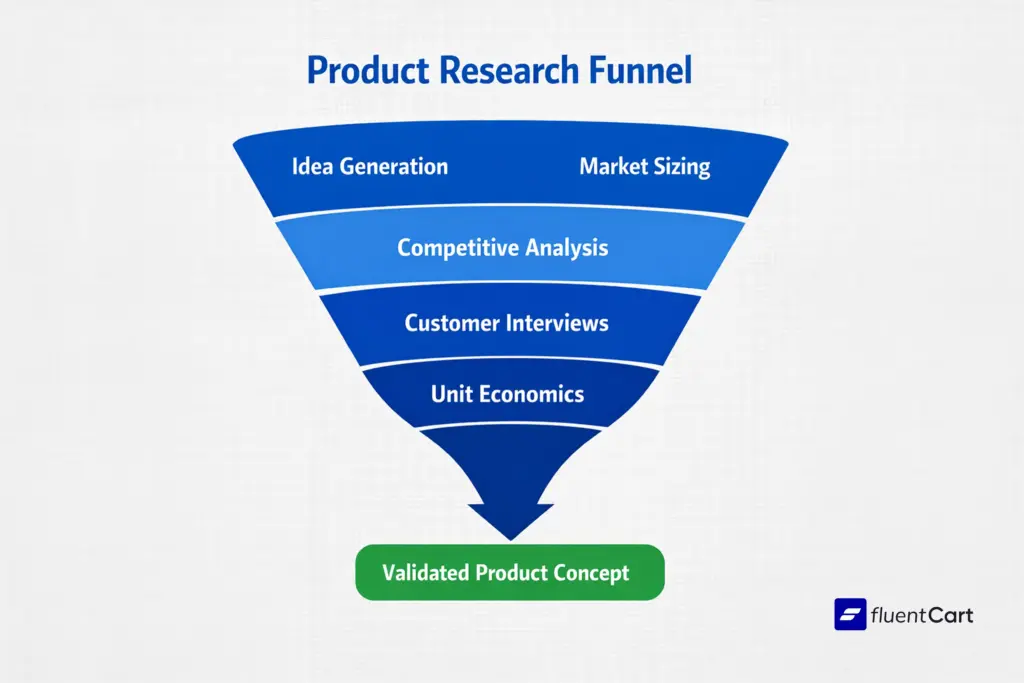
This is the 7 steps of product research before launching a new product.
Step 1: Define the problem space.
Before evaluating any specific product, get clear on the customer problem you’re solving. Who has this problem? How often? How much does it bother them? What do they currently do about it?
Step 2: Explore market size and trajectory.
Use Google Trends, industry reports, and basic keyword research to size the opportunity and assess whether it’s growing, stable, or declining.
Step 3: Map the competitive landscape.
Identify who’s already in this space, what they do well, and where they fall short. Look at their reviews, their pricing, and their positioning.
Step 4: Evaluate specific product criteria.
Run each product idea through the product-based criteria: margin potential, size and weight, seasonality, pain point alignment, and scalability.
Step 5: Talk to potential customers.
This doesn’t need to be formal. Ten to fifteen conversations with people who have the problem you’re solving is enough to surface patterns. Ask open questions. Listen more than you talk.
Step 6: Test before you fully commit.
Start small. Place a small order, run a limited launch, or use a fake door test to measure interest before locking in inventory.
Step 7: Validate your high-profit-margin product potential.
Confirm that after all costs are accounted for, the unit economics actually work for your high-profit-margin products. This is where the full cost model matters.
Where to Find Product Ideas
A lot of the guidance out there on this focuses on tools, but the best product ideas usually come from closer observation than that.
Trend publications and platforms
Like Exploding Topics, scan the internet for signals of rising interest before that interest hits the mainstream. The lead time matters. Spotting a product category twelve months before it explodes is worth something. Spotting it after every dropshipper on TikTok has already jumped in is not.
Niche forums and communities
They are one of the most underrated sources of product ideas. Reddit especially. A niche subreddit is a free focus group of highly engaged potential customers, openly discussing what frustrates them, what they wish existed, and what they’re currently making do with. Gaming communities, homesteading forums, running communities, home improvement groups, wherever people are passionate, they’re also revealing product opportunities.
B2B wholesale marketplaces
like Alibaba, AliExpress, and Faire let you cross-reference what’s trending in consumer demand with what’s actually sourceable at a unit cost that works. The key move: find a product that’s trending, then look at what’s available on Alibaba and figure out whether you can add a genuine angle that’s different from what’s already selling. Lots of dropshipping suppliers will help you figure this out
Social curation platforms
Give you demand signals through engagement. Pinterest Trends is free and shows you which product categories are gaining interest by region and demographic. TikTok’s Creative Center shows which product categories are performing well in paid ads, useful because advertisers only keep spending if they’re seeing returns.
Browsing trending products to sell online through a combination of these sources gives you a much more robust picture than relying on any single platform.
How to Do Amazon Product Research
Amazon is a goldmine for product research, not because you’re necessarily going to sell there, but because it’s a live, constantly updated signal of what people are actively buying.
Start with the bestseller lists. Amazon’s bestseller rankings update hourly based on actual sales. Digging through these by category shows you what’s performing right now, and the review counts give you a rough sense of how long something has been selling well. A product with 12,000 reviews and a 4.4 rating is a proven product. A competitor with 200 reviews and pricing 20% higher has left a gap.
Reading the negative reviews is where the real research happens. People complain specifically. “The strap broke after two weeks.” “The smell is overwhelming.” “The instructions make no sense.” That’s your product development brief. Address those complaints with your own version, and you’ve got a differentiator without needing to invent a new category.
Tools like Jungle Scout and Helium 10 add a layer of data on top of Amazon’s surface-level information. You can see estimated monthly sales volume, track keyword performance, identify seasonal patterns, and figure out which suppliers your competitors are using. Helium 10’s free tier gives you access to trending products and basic keyword data, while JungleScout plans start at $29 per month when billed annually and include sales forecasting.
One pattern worth watching: look for products with strong sales but thin review counts. That often signals a growing category where there’s still room for a well-positioned newcomer.
Product Development Research
Here’s the part most ecommerce guides gloss over. Data from tools and marketplaces tells you what’s selling. It doesn’t tell you why people buy, what frustrates them, or what they wish existed.
That’s where qualitative product development research comes in.
Customer interviews
They are the highest signal inputs you can get. Fifteen to twenty conversations with real potential buyers will surface patterns you’d never find in a spreadsheet. The goal isn’t to pitch your product; it’s to understand how people currently solve the problem your product addresses. Ask open questions. Listen for hesitations. The things people are almost embarrassed to admit are often the most valuable.
Surveys scale faster and work well once you already have a hypothesis you want to test. If you’ve spoken to a dozen people and heard a consistent pain point, a survey lets you confirm that pattern across hundreds of respondents. Focus groups offer a middle ground: structured discussion with a small group, useful for evaluating product concepts or packaging.
Voice of the customer analysis
It is the lazy person’s version of interviews, and it’s actually underused. Read the reviews. Not just your product category, read reviews for anything related to the problem you’re solving. G2, Amazon, Reddit threads, Trustpilot. People are remarkably specific and honest when they’re not talking directly to a company.
Fake door testing
It is a clever option for validating demand before building anything. You add a feature or product to your site, track how many people click on it, and when they do, they see a message explaining it’s coming soon. If the click rate is high, you have a real signal. Keep the testing window short; you don’t want to frustrate potential customers.
Competitive Analysis: Learn from Competitors
Competitive analysis isn’t just looking at who sells similar things. It’s a structured way of understanding what your market has decided it values, and where it’s left gaps.
Sign up for competitor products. Use them. Note what’s good, what’s frustrating, and what’s conspicuously absent. Read their reviews. Check their social media comments for complaints. Run a search on Ahrefs or Semrush for their domain and see which keywords are driving their traffic; that tells you what customer problems they’ve optimized their content and products around.
Tools like SimilarWeb give you a view into competitor traffic sources and audience demographics. Seeing that a competitor gets 40% of their traffic from organic search and 35% from social tells you where they’ve invested and where they might be vulnerable.
The question you’re trying to answer: if someone currently buys from this competitor, what would it take to switch to you? Price? Quality? Better positioning? A feature they’re missing? You need a clear answer before you launch, not after.
The Tools Worth Using
A quick, honest breakdown of what’s actually useful:
Google Trends
It is free and underused. Run your product category over the last five years and look at the pattern. Growing steadily? Flat? Declining? Spiking seasonally? That chart tells you more than most paid tools will.
Pinterest Trends
works similarly and skews toward a different demographic. If your product targets women 25-45, Pinterest is worth checking before you invest in anything.
Ahrefs or Semrush
Give you keyword search volume, difficulty scores, and competitor insights. The paid tiers are worth it if you’re serious. The free versions give you a taste.
Exploding Topics
catches trends early. It surfaces rising interest before it hits mainstream search volume, which gives you a window to move. Useful for anyone who wants to get ahead of a product category rather than chase it.
Niche Scraper and Dropship Spy
are specifically for dropshipping product discovery. They show trending products across platforms, sourcing costs, and ad performance data.
Helium 10 and JungleScout
They are primarily for Amazon sellers, but the data is useful for anyone. Sales estimates, keyword volumes, supplier identification, if you want hard numbers on how a product is performing on the world’s biggest marketplace, these are your tools.
For anyone building on WordPress, FluentCart handles the product listing, checkout, and payment side cleanly without the overhead of heavier platforms, worth considering if you’re ready to move from research into actually selling.
The Biggest Mistakes in Product Research
Confirming what you already believe.
The most common research failure isn’t a lack of data; it’s going into research with a conclusion already formed and looking for evidence that supports it. You’ll find it. And it’ll mislead you. Good research tries to disprove the hypothesis, not confirm it.
Confusing trend with fad.
Geiger counter sales spiked after the 2011 Fukushima disaster and collapsed within months. That’s a fad. Yoga products grew steadily over a decade. That’s a trend. The Google Trends line tells you which one you’re dealing with. Pay attention to the shape, not just the peak.
Ignoring the full cost structure.
A 1,200% markup sounds like money. Factor in packaging, processing, shipping, platform fees, advertising, returns, and customer service, and you might be looking at a 60% margin at best. Run the full unit economics before you fall in love with a product idea.
Skipping primary research.
Tools give you data. Conversations give you understanding. Knowing that 8,000 people search for “best travel mug” per month tells you demand exists. Talking to twenty travel mug buyers tells you they’re furious about lids that don’t seal and are willing to pay $15 more for one that actually works. That’s the insight tools can’t give you.
Stopping research at launch.
Your first product research tells you whether to go ahead. Post-launch research tells you how to stay relevant. Markets change. Competitors improve. Customer expectations shift. The businesses that thrive long-term treat product research as a continuous process, not a one-time gate.
What Good Product Research Actually Delivers
Done properly, product research doesn’t just reduce risk; it gives you a sharper competitive position. You’ll know which pain points your competitors have left unaddressed. You’ll understand what your customers value enough to pay more for. You’ll know how to position your product from day one instead of figuring it out after you’ve already spent on inventory and ads.
The cost of starting a business is high. Product research is one of the few investments that directly reduces the chance you spend that money on something nobody wants.
Over 30,000 new consumer products launch every year. The vast majority fail. The ones that don’t usually have one thing in common: someone did the homework before the launch, not after.
Product research isn’t the exciting part of building a business. But it’s the part that makes everything else worth doing.

Hi, this is Abir, a Deputy Marketing Lead, passionate product designer, and WordPress core contributor. Creating interesting content and products that ensure a 360-degree customer experience is my daily job.

Subscribe now
Related Articles and Topics
-
Digital Product Ideas for Passive Income: The Complete Roundup
Real digital product ideas, real numbers, and the honest truth about what passive income actually costs and what…
-
Digital Goods VAT OSS Guidance: The EU Rules Explained
This digital goods VAT OSS guidance EU walkthrough covers thresholds, rates, and reverse charge in plain English.
-

Best Dropshipping Niche: What’s Your Best Bet
We’ve listed 5 best dropshipping niche picks. But understanding a niche matters more than picking one. Here’s the…



Add your first comment to this post