
What Is a Persona: Meaning, Types, and How to Build One That Actually Works

Most teams already know they should have one. The problem is that most of the ones that exist are too vague to be useful, or were accurate when built and stale ever since. You end up with a nicely formatted PDF that nobody opens before writing the next campaign brief.
TL;DR
- A persona is a fictional but research-grounded profile of a specific customer or user type
- In marketing, a buyer persona captures goals, pain points, and buying behavior, not just demographics
- In product and UX, a user persona guides design by representing how real people interact with what you build
- Good personas are specific enough to feel like a real person, a named character with a named frustration, not a vague audience segment
- Buyer personas and user personas serve different teams but should describe the same underlying customer
- Building one takes five steps: research, pattern-finding, profiling, naming, and validating
- Personas need updating at least annually, and immediately when your numbers start shifting
What “Persona” Actually Means
The word comes from the Latin for “mask.” In ancient Roman theatre, actors wore physical masks to signal which role they were playing. The mask did not hide the actor, it communicated character to the audience instantly.
A persona in marketing works exactly the same way. It is not a real person. It is a constructed representation, a mask that captures who your customer is in a way your whole team can hold in their heads and make decisions around.
For a business context, two definitions do the heavy lifting: buyer personas and user personas. Understanding both, and how they differ, is where the practical value lives.
What Is a Persona in Marketing
Here is what actually goes wrong when this breaks down. A team builds a product, writes copy aimed at “young professionals who value quality,” runs ads, and results are underwhelming. They do not know exactly why. The answer is almost always that they were building for a demographic bracket instead of a person.
A buyer persona fixes that. It gives your ideal customer a name, a situation, a specific frustration, and a clear reason they would care about what you sell.
Parachute, the mattress brand, did not build their messaging around “adults who want better sleep.” They zeroed in on someone specific: the person already overpaying for rent in a big city, who cannot justify spending a month’s salary on a mattress but also does not want to feel like they are still sleeping on furniture from their first apartment. That tension, quality versus financial justification, is the persona. It drives every copy decision they make.
A well-built buyer persona covers:
- Name and age, one specific person, not a range
- Job title and income level, shapes what they can justify spending
- Primary goals, what they are trying to achieve, related to your product category
- Pain points, the specific friction your product addresses
- Buying behavior, how they research, who they trust, what finally pushes them to commit
- Preferred channels, where they actually spend time
- Objections, what makes them hesitate or walk away
The most common mistake is treating demographics as a substitute for psychology. A 28-year-old founder and a 54-year-old VP of Operations might share the exact same pain point around inventory tracking. Their age difference tells you almost nothing. Their shared frustration tells you everything.
According to a 2025 Shopify merchant survey, 21% of businesses conduct market research to validate their product idea before launch. Nearly 80% are still building on assumptions. That is the gap personas are designed to close.
Buyer Persona vs. User Persona: Same Person, Different Lens
These two get conflated constantly. They serve different teams and ask different questions, but they should describe the same underlying customer.
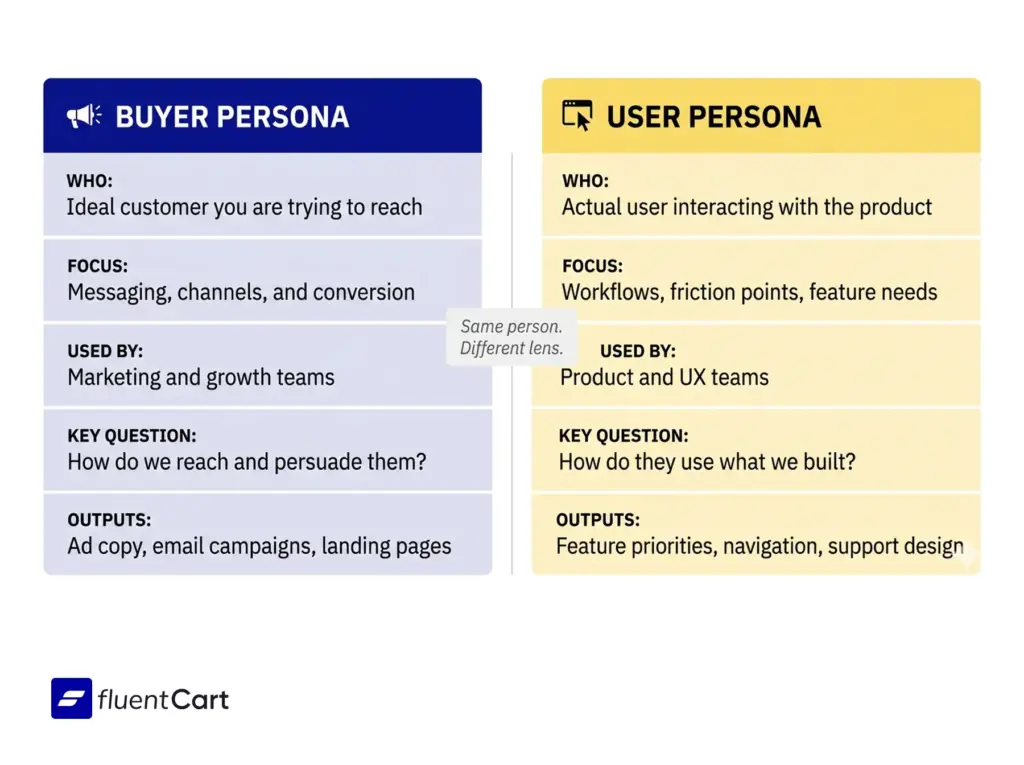
Buyer personas belong to marketing. They answer: how do we reach this person, what message resonates, which channel converts?
User personas belong to product and UX. They answer: how does this person actually use what we have built, and what do they need to succeed?
A thread on r/marketing put it simply when a newcomer asked what user personas even mean in practice:
“It’s a general summary of who will be using your product or service, and who it will be aimed at. When you know who you’re talking to, you can make sure the things you do appeal to, resonate with, and engage them.”
Source: r/marketing, u/bambalamalam
The failure mode is when buyer and user personas are built separately by teams that do not talk to each other. Marketing crafts campaigns for one imagined customer. Product ships features for a different one. That gap shows up in churn before anyone names the actual cause.
If you sell to multiple distinct segments, build a persona for each. Identify your primary persona, the customer type driving most of your revenue, and treat secondary personas as supporting context. Optimizing equally for everyone is the same as optimizing for no one.
The Four Types of Personas in Product and UX
UX teams work with four distinct frameworks, each suited to a different situation.
Goal-directed personas
It focus on what the user is trying to accomplish. Most useful when your product solves a specific functional problem and you need to design around the workflow someone follows to get a result.
Role-based personas
These are built for B2B products. A CFO and a marketing manager using the same analytics dashboard have radically different needs. Role-based personas capture how job responsibilities shape what someone needs, and who else is affected by their decisions.
Engaging personas
These go deeper into emotional context: backstory, values, aspirations. These work best for lifestyle brands where identity and aspiration drive purchasing alongside function.
Fictional personas
These are built from team assumptions rather than research. Useful as a starting sketch when no data exists, but they need replacing with research-backed versions as quickly as possible.
Most ecommerce and SaaS businesses run on goal-directed personas day-to-day. Role-based personas matter when selling to other businesses. Engaging personas earn their place when emotional resonance is part of what you are actually selling.
How to Build a Persona: Step by Step
This is where most guides get vague. Here is a clear process from start to finish.
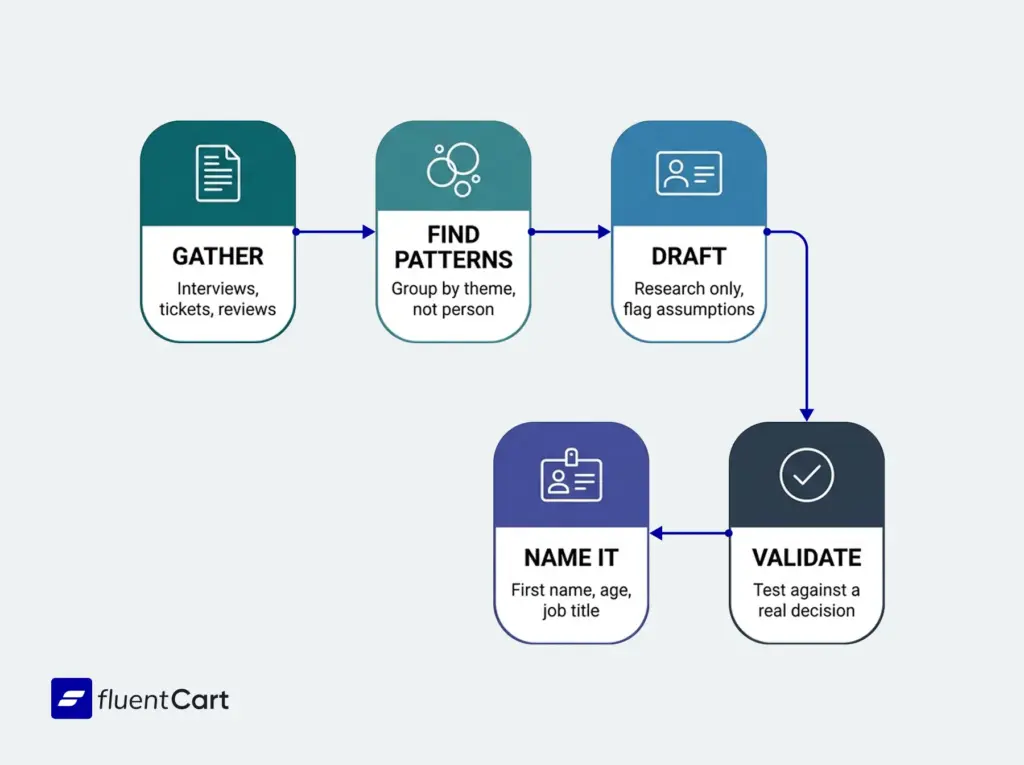
Step 1: Gather Raw Material
Do not start with a template. Start with sources. You are looking for patterns in real customer behavior and language.
Useful sources:
- Customer interviews, 5 to 10 reveals enough to find patterns
- Sales call recordings
- Support tickets, especially recurring complaints
- Post-purchase surveys
- Review mining, yours and your competitors’
- Communities where your customers discuss the problem you solve
The goal is to collect actual words real customers use. Not your interpretation. Their language. A customer who says “I waste two hours every Monday just figuring out what sold last week” is handing you a persona detail, a pain point, and a copy line in the same sentence.
Step 2: Find the Patterns
Look across your material for clusters. What frustrations repeat? Which goals sound similar? What triggered the purchase decision, and what almost stopped it?
Group findings by theme, not by person. Most businesses find two to four distinct customer types once they look closely enough. Pick the most valuable one to start.
Step 3: Draft the Profile
Fill in the template (below) using only what your research supports. Flag anything filled from assumption rather than data, that is a hypothesis to test, not a fact to rely on. Resist the urge to make it polished. A messy, specific persona beats a clean, generic one every time.
Step 4: Give It a Name
A name is a memory device. Your team needs to be able to say “would Marcus care about this?” in a meeting without pulling up a document. A first name, age, and job title are all it takes. Keep it neutral and memorable.
Step 5: Validate and Pressure-Test
Share the draft with your sales and support teams. Ask one question: does this feel like someone you actually talk to? If the answer is no, find out where the profile breaks.
Then test it against a real decision, which feature to build, which channel to invest in, what the homepage headline should say. If the persona does not change how you approach the decision, it needs more specificity. Validation is ongoing. Update it when the evidence says to.
Persona Template: What to Include
Use this as your starting framework. Copy it, adapt it, fill it with research.
PERSONA NAME: Role / Job Title: Age: Location:
Background One to two sentences about their professional situation and relevant life context.
Goals
Pain Points
Buying Behavior
Preferred Channels Specific platforms, publications, or communities where they spend attention.
A Day in Their Life Two to three sentences placing them in a real moment where your product would matter.
Quote That Captures Them One sentence in their own voice, pulled from real research, not invented.
That last field matters more than most people expect. A single direct quote from a real customer anchors the persona in reality in a way no demographic checkbox can.
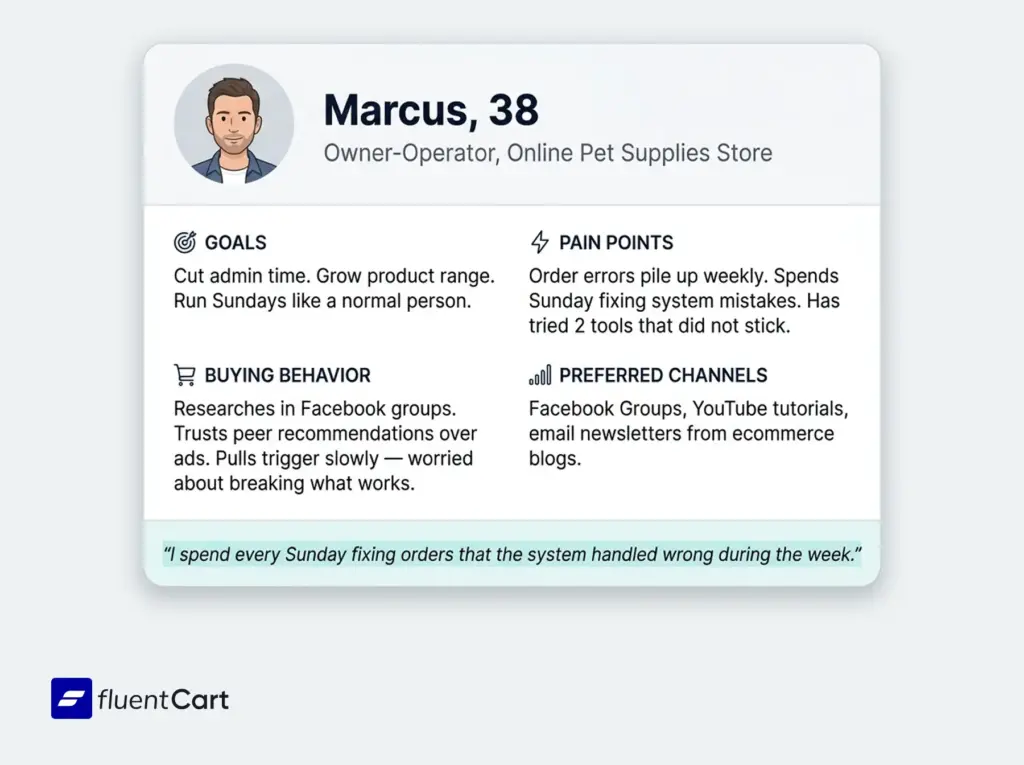
Here is what a filled-in example looks like:
Name: Marcus, 38 Role: Owner-operator of an online pet supplies store Background: Runs a 7-year-old business with 3 staff. Handles most of the marketing himself alongside day-to-day operations. Primary goal: Cut time on repetitive admin to focus on growing the product range. Pain point: “I spend every Sunday fixing orders that the system handled wrong during the week.” Buying trigger: Recommendation from another store owner in a Facebook group. Hesitation: Worried about migration complexity and breaking what is already working.
Marcus is someone a product team can build for. “Ecommerce business owners aged 30 to 50” is not.
If you are running on WordPress and building your store around customer types like Marcus, something like FluentCart handles the technical infrastructure so your team stays focused on strategy rather than setup.
Why Most Personas Fail in Practice
The gap between knowing what a persona is and using it well comes down to one thing: specificity.
“A busy professional who values quality” describes approximately every customer of every brand that exists. That profile tells you nothing about what to say, where to say it, or what to build next.
Here’s what’s actually happening in teams where personas work. They have named the exact tension their customer is navigating. They understand the emotional context of the purchase alongside the functional one. The persona is built around a pain point sharp enough to recognise immediately.
The moment a persona gets specific enough that it feels like a real person, not a type, is usually the moment it becomes genuinely useful. Understanding your customers’ user experience from the ground up is what turns a profile into a competitive edge.
When to Update Your Personas
Personas are hypotheses, not conclusions. They go stale without anyone noticing.
Refresh them when:
- Channel performance drops on platforms that used to convert
- Customers start using your product in ways you did not design for
- A segment churns faster than historical baselines
- A meaningful market shift happens, economic, technological, or behavioral
The practical cadence: a light quarterly review against your ecommerce KPIs, and a full rebuild once a year. Assign clear ownership, otherwise the persona quietly becomes an orphaned document no one updates.
The businesses that keep personas current share one habit: they treat support, sales, and community teams as permanent data sources. Ten consecutive support tickets raising the same issue is a persona update waiting to be written. Most businesses already have that data. They are just not routing it back.
What Is a Persona, in the End
A persona without specificity is just a demographic wearing a first name.
The businesses that genuinely understand their customers, in the particular, not the abstract, build better products, write sharper marketing, and retain customers longer. A focus group gives you raw material. A persona gives you a lens. What you build with that lens is the actual work.
What is a persona, ultimately? It is the clearest answer your business has to the question: who, exactly, are we doing this for? Getting that answer right, and keeping it current as your market moves, is not a nice-to-have.
It is a must.

Hi, this is Abir, a Deputy Marketing Lead, passionate product designer, and WordPress core contributor. Creating interesting content and products that ensure a 360-degree customer experience is my daily job.

Subscribe now
Related Articles and Topics
-
eCommerce Laws in 2026: The 8 Rules Regulators Are Fining Stores Over
The 8 ecommerce laws regulators fined stores over in 2025 and 2026.
-
Digital Goods VAT OSS Guidance: The EU Rules Explained
This digital goods VAT OSS guidance EU walkthrough covers thresholds, rates, and reverse charge in plain English.
-
How to Start a Wholesale Business: The Complete Guide
The full guide on How To Start a Wholesale Business, from the legal paperwork to sustainable sourcing, all…



Add your first comment to this post