
What Is a Trade Show? Meaning, Types, and Purpose Explained
Every industry has a moment when its products, ideas, and people gather under one roof. That moment is usually a trade show. Businesses still travel across cities and countries to stand at a booth for a few days, and the reason comes down to trust built face to face.
In this blog, we will cover the trade show meaning, the types that exist, who takes part, and why the format still holds up in a digital-first market.
TL;DR
- A trade show is an industry event where businesses display products and services to buyers, not the public.
- Exhibitors, attendees, and organizers are the three core participants.
- Trade shows differ from trade fairs and expos mainly by audience and access.
- Networking, lead generation, and market research are the main reasons companies attend.
- Costs vary widely depending on booth size, location, and staffing.
- Results depend on preparation, not just showing up.
Trade Show Meaning
A trade show is an event where companies within a specific industry gather to display and demonstrate their products or services. Access is usually limited to industry professionals, buyers, distributors, and press rather than the general public. The format centers on booths set up across a convention floor, paired with product demos and direct conversations between exhibitors and visitors.
Trade shows work as a shortcut for both sides. Buyers see multiple vendors in one place instead of researching each separately. Sellers get direct access to a room full of people already interested in the category. This mutual efficiency is why the format has survived for decades despite the rise of digital marketing.

3 Types of Trade Shows
Not every trade show serves the same audience or goal. The format splits into a few recognizable categories based on who attends and what the event is built for.
- Industry trade shows: These are built for business-to-business connections. Attendees are usually buyers, distributors, or partners within one sector such as software, manufacturing, or healthcare.
- Consumer trade shows: Some events open their doors to the public. Auto shows and home expos fall here, since regular shoppers attend alongside vendors.
- Virtual trade shows: Held entirely online, these let exhibitors and attendees connect without travel, often through video booths and chat-based demos.
Trade Show vs Trade Fair vs Expo
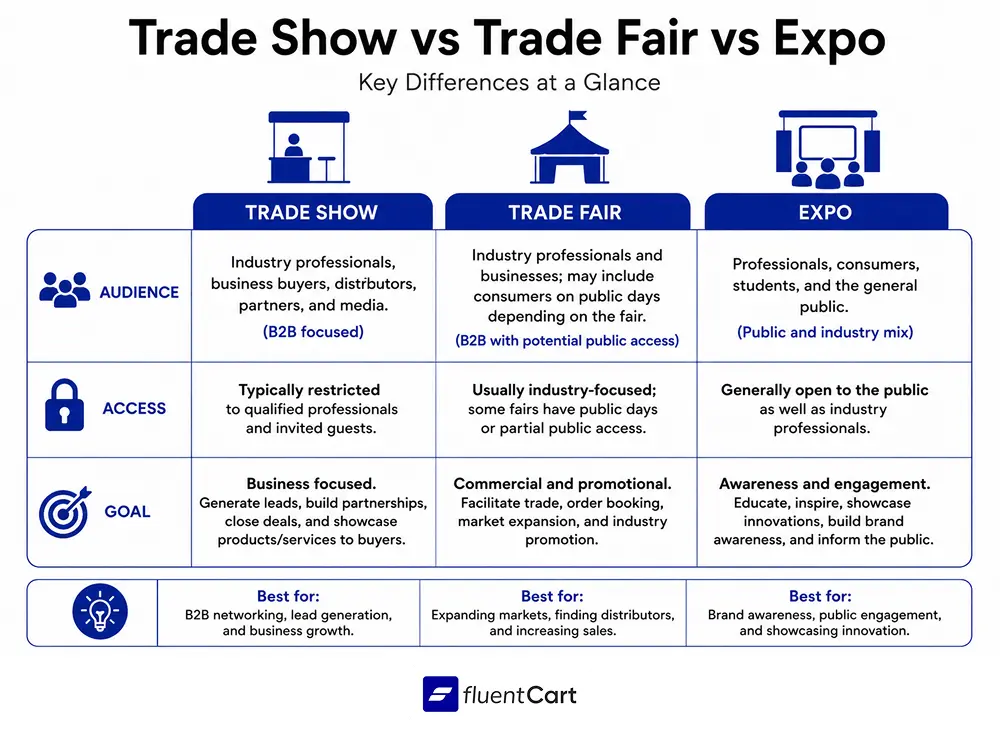
The terms overlap in daily use but carry small differences. A trade fair often runs longer and welcomes a broader mix of visitors. In some cases the public can attend too.
An expo leans toward mass exposure and education rather than direct sales. It tends to draw consumers as much as professionals. A trade show stays closer to pure B2B activity.
Access is tighter and the focus stays on deals and demos rather than entertainment. Knowing which label fits an event helps a business set the right expectations before it signs up as an exhibitor, since a trade show budget and a public expo budget rarely look the same.
Who Takes Part
A trade show runs on three groups working around the same floor plan.
- Exhibitors: Companies that rent booth space to display products, run demos, and talk directly with visitors.
- Attendees: Buyers, industry professionals, journalists, and sometimes competitors who come to learn, compare, and connect.
- Organizers: Associations or event companies that plan logistics, book the venue, and market the show to both exhibitors and attendees.
Each group has a different goal walking in. Exhibitors want visibility and leads. Attendees want information and contacts. Organizers want a full floor and a good reputation for next year’s event.
Why Businesses Attend
Companies rarely attend a trade show for one reason alone. A few goals repeat across almost every industry.
- Lead generation: Booths collect contact details through badge scans and conversations. That contact list feeds directly into sales pipelines through steady prospecting once the show ends.
- Brand visibility: Standing in front of a concentrated industry audience builds recognition faster than most digital campaigns.
- Competitor insight: Walking other booths shows what rivals are building and how they price it, a quick and low-cost form of market research done in person.
- Product feedback: Talking to attendees in real time works like an informal focus group. Reactions surface here that a survey rarely catches, since body language and tone carry information a form field cannot.
- Networking: Relationships formed over a booth conversation or a dinner after hours often outlast the event itself.
Inside a Trade Show Day
A trade show floor rarely runs as one long stretch of booth visits. Most events build a structured schedule around the exhibition hall. Keynotes and workshops open the day. They give attendees industry context before the floor opens to traffic.
Booth hours follow, where exhibitors run demos and qualify visitors. Breakout sessions split larger groups into focused discussions on niche topics. Evening mixers and networking events close the day, and these often produce the strongest connections since conversations move past a two-minute pitch.
A trade show marketing plan usually accounts for all four blocks rather than just the booth hours, since a keynote mention or a hallway chat can matter as much as the demo itself. Companies that treat these hours as one continuous strategy tend to walk away with sharper contacts and clearer notes for follow-up.
Cost and Planning Basics
Attending or exhibiting at a trade show involves a real budget on both sides.
- Exhibitor costs: Booth rental, design, shipping, travel, and marketing materials add up quickly, often reaching thousands of dollars for a mid-size presence.
- Attendee costs: Entry fees plus travel and accommodation are the main expenses, far lower than running a booth.
Planning timeline: Booking space six to twelve months ahead secures better placement and pricing. Pre-show outreach three to six months out fills the calendar with scheduled meetings instead of relying on walk-up traffic.
Post-show follow-up within 48 hours keeps leads from going cold, since interest fades fast once attendees return to their regular workload.
Is It Still Worth It
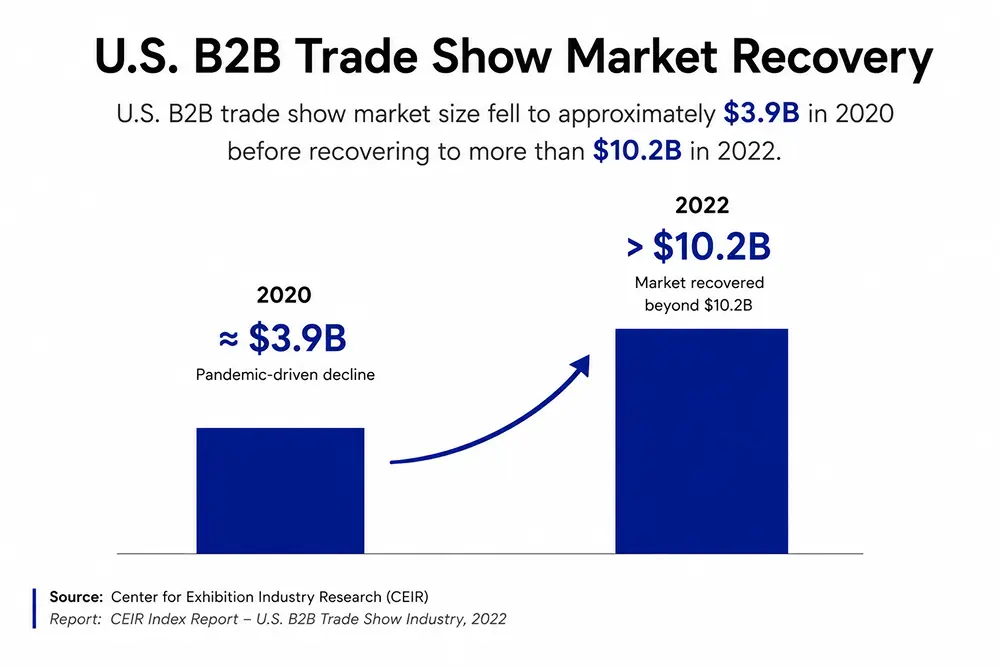
Opinions on trade show value split sharply, and the split usually traces back to preparation rather than the format itself. A well-known industry data point shows the scale involved.
The “U.S. B2B trade show market fell to roughly 3.9 billion dollars in 2020 before recovering past 10 billion dollars by 2022.” That recovery shows how much budget companies still commit to the format even after a sharp downturn.
Discussions among sales professionals on forums like Reddit echo a similar pattern. Some describe booths as a waste of money when leads never convert, while others report strong results when meetings are booked in advance and staff are trained to qualify visitors quickly rather than chase every badge scan.
The consistent theme across these conversations is that trade shows reward planning and punish improvisation.
Wrapping Up
A trade show brings an entire industry into one room for a few days of direct contact. The value depends less on the event itself and more on the goals set before walking in, the meetings booked ahead of time, and the follow-up that happens once the floor closes.
FAQs
What is an example of a trade show?
The Consumer Electronics Show in Las Vegas is a well-known example. It brings together technology exhibitors and industry buyers each year under one roof.
What is a trade show in marketing?
In a marketing context, a trade show is treated as one channel within a broader plan. Pre-show outreach, booth messaging, and post-show follow-up all count as part of trade show marketing rather than the event alone.
Is there an official definition of a trade show?
Yes. Standard dictionary sources describe it as a large exposition built to promote awareness and sales of new products within one industry, a definition that lines up closely with how the term is used across dictionary references and industry publications.

Deputy Marketing Lead, published literary author, and musician. I thrive on marketing for tech companies while composing music, collecting books of lasting depth, exploring cinema with a discerning eye, and studying the arts and history.

Subscribe now
Related Articles and Topics
-

eCommerce Laws in 2026: The 8 Rules Regulators Are Fining Stores Over
The 8 ecommerce laws regulators fined stores over in 2025 and 2026.
-
What Is a Payment Gateway? A Guide for WordPress Store Owners
Confused about payment gateways? Here’s what they actually do, which ones fit WordPress, and how to pick the…
-

GiveWP Alternatives: What Actually Replaces It
GiveWP’s future is shaky. Here’s what real GiveWP alternatives do better in donation-taking operations, and where they still…




Add your first comment to this post