
What Is a Fixed Cost? Definition, Examples, and Formula
Every business owner eventually asks the same question when they sit down to plan a budget. Which expenses will stay the same no matter what happens with sales, and which ones move with production?
Getting this wrong can throw off your pricing, your break-even math, and your entire cash flow plan. Fixed costs sit at the center of that question.
In this blog, we will define fixed cost, show you real examples, walk through the formula, and explain why the concept matters more once you start selling online.
TL;DR
- A fixed cost stays the same regardless of how much a business produces or sells
- Common examples include rent, salaries, insurance, and loan payments
- Fixed costs differ from variable costs, which rise and fall with output
- The fixed cost formula subtracts variable costs from total production costs
- Tracking fixed costs helps with pricing, budgeting, and break-even analysis
What Is a Fixed Cost
A fixed cost is a business expense that does not change when production or sales volume goes up or down. These costs are tied to time rather than activity, so a company pays them on a set schedule such as monthly or annually.
Fixed costs are also called overhead or indirect costs because they support operations without being tied directly to making a single unit of product. Rent, salaries, and insurance premiums are typical examples.
A fixed cost can still change over the years, but usually only when a contract is renegotiated or a new agreement replaces the old one.
Fixed Cost vs Variable Cost
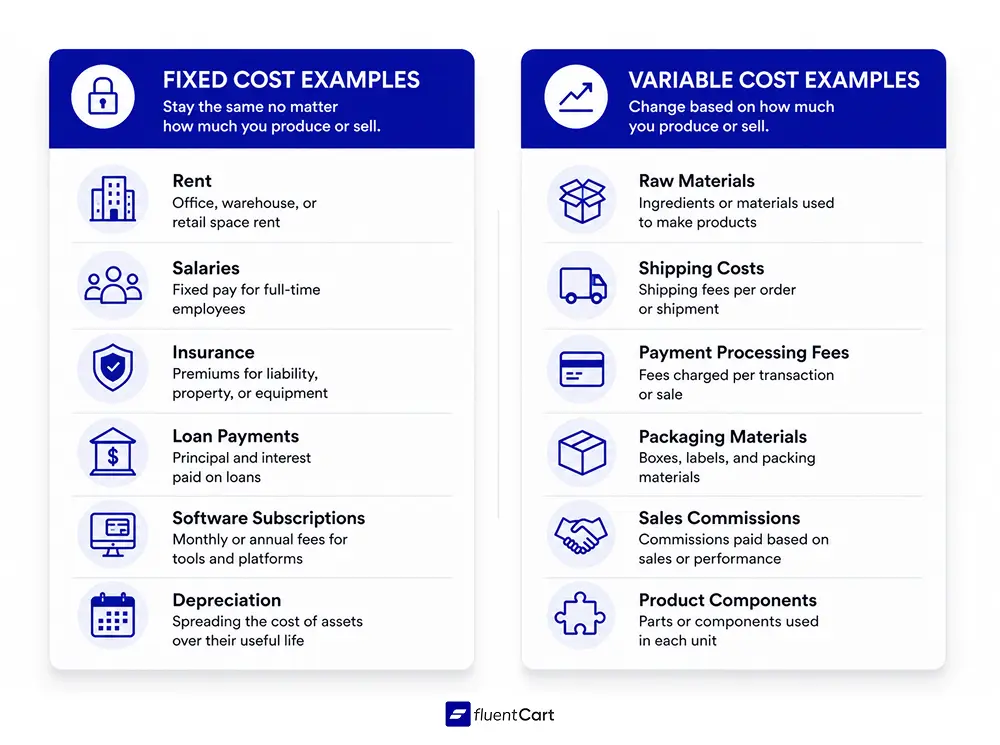
Fixed costs and variable costs make up a business’s total expenses, but they behave differently. A fixed cost is constant no matter what happens with output. Variable costs move in step with production, so they rise when you make more and fall when you make less.
A simple way to picture this is a bakery. The monthly rent stays the same whether the bakery makes 50 loaves or 500. Flour and sugar spending changes with every batch. Some expenses, like a phone plan with a base fee plus usage charges, blend both categories and are known as semi-variable costs.
Common Examples of Fixed Costs
Fixed costs show up across nearly every business type, though the amounts vary by industry and size.
- Rent: Rent covers office, warehouse, or retail space and does not shift with sales performance.
- Salaries: Salaries are fixed pay for full-time staff that stays consistent regardless of workload.
- Insurance: Insurance premiums for liability, property, or equipment are billed on a fixed schedule.
- Loan payments: Loan payments cover principal and interest at a set amount each period.
- Depreciation: Depreciation spreads the cost of equipment or property over its useful life.
- Software subscriptions: Software subscriptions charge a flat recurring fee unrelated to how much you use the tool.
Types of Fixed Costs
Not every fixed cost behaves the same way inside a business, and grouping them by type makes budgeting easier.
- Direct fixed costs: Direct fixed costs are tied to producing a specific good or service, such as factory rent for a single product line.
- Indirect fixed costs: Indirect fixed costs support the business overall but are not linked to one product, such as administrative salaries.
- Committed fixed costs: Committed fixed costs come from long-term obligations like property taxes or equipment depreciation that a business cannot easily avoid.
- Discretionary fixed costs: Discretionary fixed costs result from management decisions, such as marketing budgets or training programs, and can be adjusted from one period to the next.
How to Calculate Fixed Cost
The most direct way to calculate total fixed cost is to add every recurring, non-production-related expense together for a given period. Alternatively, you can work backward from total production costs using this formula.
Total fixed cost = Total production cost − (Variable cost per unit × Number of units produced)
For instance, a company spending $80,000 to produce 500 units, with a variable cost of $60 per unit, has a fixed cost of $80,000 minus $30,000, which equals $50,000.
Fixed Cost Per Unit
Fixed cost per unit shows how spreading a fixed expense across more output improves efficiency. Divide total fixed cost by the number of units produced.
Fixed cost per unit = Total fixed cost / Number of units produced
A $50,000 fixed cost spread across 500 units equals $100 per unit. Push production to 1,000 units and the per-unit fixed cost drops to $50, even though the total fixed cost has not changed at all.
Why Fixed Costs Matter in Business
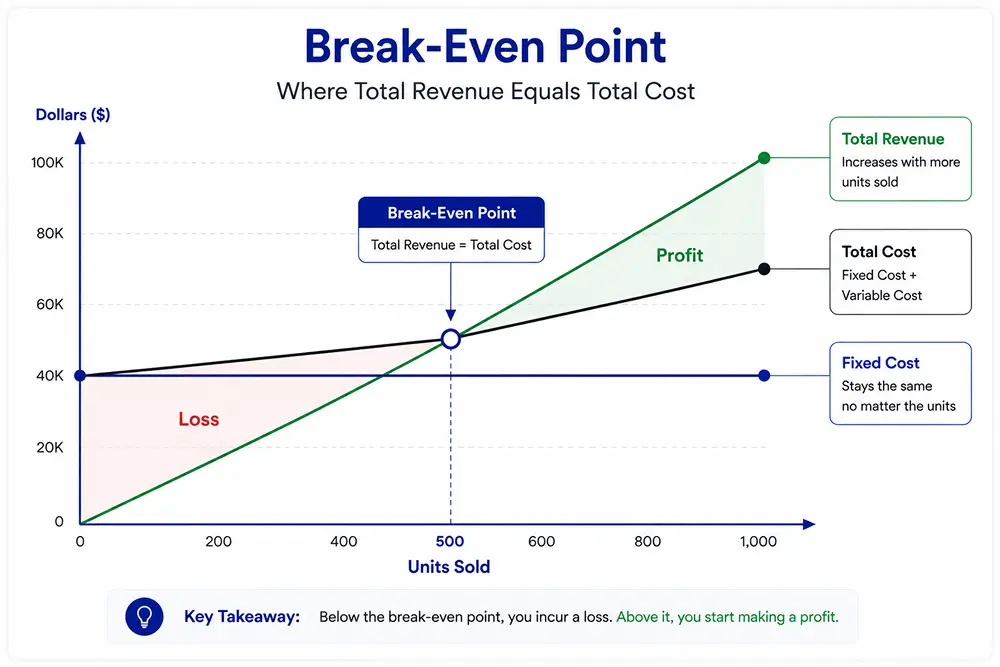
Fixed costs shape decisions well beyond the accounting department. They determine your break-even point, the sales level needed just to cover expenses, and they influence how much pricing flexibility you have. According to Ramp, fixed costs “remain stable within a relevant range” even when production or sales activity changes. This stability is exactly why they are useful for forecasting and budgeting.
Businesses carrying a high proportion of fixed costs relative to revenue face more pressure during slow periods, since those bills arrive regardless of how sales are performing. A leaner fixed cost structure gives more room to absorb a rough month.
Fixed Costs in eCommerce
Online sellers often carry lighter fixed costs than brick-and-mortar retailers, since there is no storefront rent to cover. Even so, hosting fees, software licenses, and core team salaries still count as fixed expenses that show up every month regardless of order volume.
Understanding this split matters when setting product prices or reviewing your contribution margin, since fixed costs need to be covered before any sale actually turns a profit.
Store owners tracking their eCommerce accounting regularly separate fixed and variable line items to get a clear read on where money is actually going each month.
Managing Fixed Costs as You Scale
Fixed costs tend to grow in stages as a business expands, moving from a lean setup with contractors and shared tools toward dedicated staff, office space, and long-term software contracts. Reviewing recurring expenses on a regular schedule helps catch unused subscriptions or contracts that are due for renegotiation before they quietly eat into margin.
Anyone mapping out early expenses should also look at the broader cost of starting a business, since fixed and one-time startup costs often get mixed together in early budgeting and that mix-up can distort break-even calculations later.
Wrapping Up
A fixed cost is any business expense that holds steady no matter what happens with production or sales. Rent, salaries, insurance, and loan payments are the classic examples, and separating them from variable costs is one of the simplest ways to sharpen your pricing and budgeting. Once you know your fixed costs cold, break-even analysis and profit planning both get a lot easier.
FAQs
What is fixed cost and example?
A fixed cost is an expense that stays the same regardless of production or sales. Rent and salaried wages are common examples.
What are the 6 fixed costs?
Rent, salaries, insurance, loan payments, depreciation, and property taxes are six of the most common fixed costs businesses track.
What are variable and fixed costs?
Fixed costs stay constant regardless of output, while variable costs rise and fall in direct proportion to production or sales volume.

Deputy Marketing Lead, published literary author, and musician. I thrive on marketing for tech companies while composing music, collecting books of lasting depth, exploring cinema with a discerning eye, and studying the arts and history.

Subscribe now
Related Articles and Topics
-
Bundle Marketing: An eCommerce Guide for Store Owners
Bundle marketing guide: types, pricing math, examples, and a FluentCart setup.
-

Membership Affiliate Programs: The Cost-effective, Integrated Setup
Run membership affiliate programs on WordPress with one integrated stack.
-
eCommerce Laws in 2026: The 8 Rules Regulators Are Fining Stores Over
The 8 ecommerce laws regulators fined stores over in 2025 and 2026.



Add your first comment to this post