
What Is Customer Segmentation? Stop Marketing to Everyone
Most businesses send the same offer to every customer on their list. A new parent and a retiree end up with identical emails even though their needs have nothing in common.
That mismatch costs sales and trust. Customer segmentation fixes this by grouping customers based on what they actually want instead of treating an entire audience as one block.
In this blog, we will cover what customer segmentation means, the main types, why it matters, and how to build a working strategy.
TL;DR
- Customer segmentation groups customers by shared traits or behavior.
- The core types are demographic, geographic, psychographic, and behavioral.
- Segmentation improves targeting, retention, and marketing spend.
- A working strategy needs a clear goal, clean data, and regular review.
- CRMs and ecommerce platforms make segmentation easier to maintain over time.
What Is Customer Segmentation?
Customer segmentation is the process of dividing a customer base into smaller groups based on shared characteristics. These characteristics can include age, location, spending habits, or interests.
Instead of marketing to everyone the same way, businesses use these groups to send offers and messages that match what each group actually wants.
The practice sits at the center of personalized marketing. A clothing brand might separate frequent buyers from occasional shoppers. A software company might separate free users from paying accounts. Each group then gets messaging built around its own behavior, not a generic blast.
Segmentation works because no audience is uniform. People buy for different reasons through different channels. Grouping them by what drives decisions makes campaigns more relevant.
Customer Segmentation vs Market Segmentation
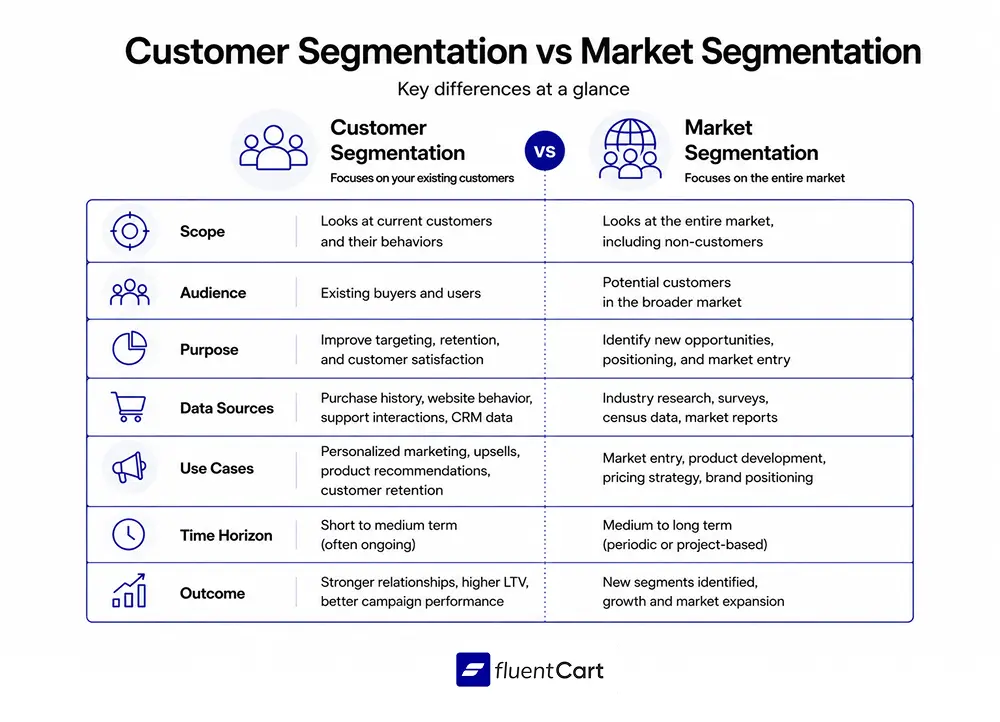
These two terms get mixed up often, but they cover different scopes. Market segmentation looks at an entire market. That includes people who have never bought from the business. Customer segmentation only looks at the people already in the customer base.
A car brand using market segmentation studies everyone shopping for a vehicle. The same brand using customer segmentation studies its own buyers and divides them by what they already purchased.
Market segmentation shapes broad positioning, while customer segmentation shapes day-to-day messaging and retention for people who already trust the brand.
Types of Customer Segmentation
Most businesses combine several types rather than using just one. Each type answers a different question about the customer.
- Demographic segmentation: Identifies customers based on characteristics such as age, income, gender, or job title. It helps define who your customers are.
- Geographic segmentation: Organizes audiences by location, climate, or language, making it easier to tailor shipping, regional campaigns, and localization.
- Psychographic segmentation: Focuses on values, interests, personality, and lifestyle to uncover the motivations behind purchasing decisions.
- Behavioral segmentation: Analyzes purchase history, cart activity, browsing patterns, and product usage to reveal buying intent and engagement.
- Technographic segmentation: Categorizes users according to the devices, browsers, operating systems, or platforms they rely on, helping optimize the customer experience.
- Needs-based segmentation: Centers on the specific problems customers are trying to solve, making it especially valuable for product development and messaging.
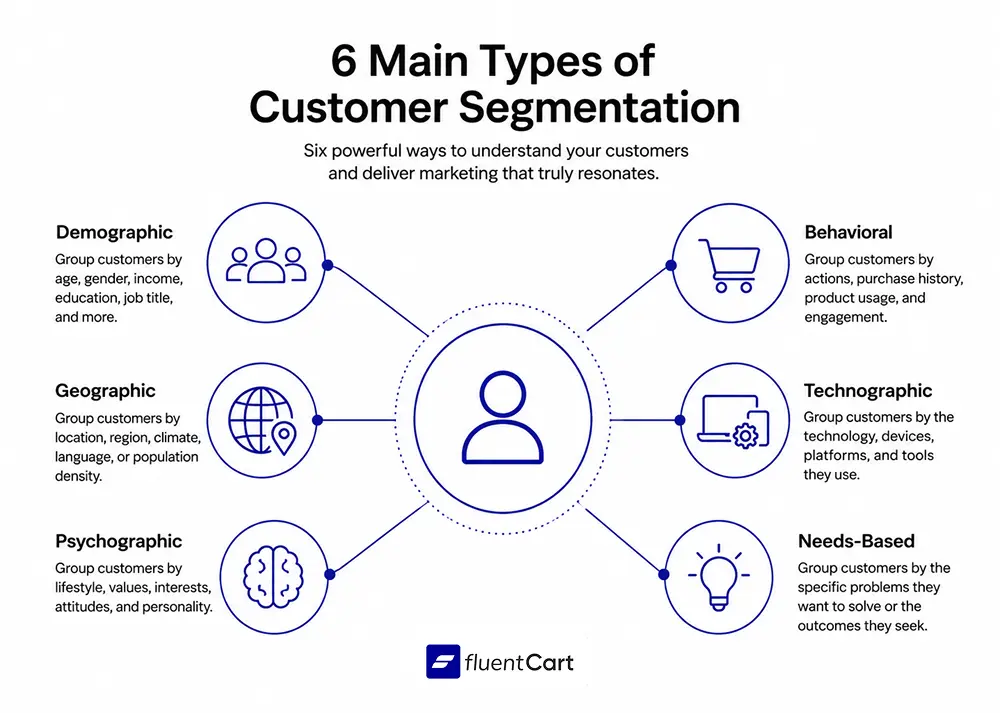
Note: You might notice other sources cite a different number here, anywhere from four to nine. There is no official standard for this, so the count depends on how finely a source splits the data. Four types cover the basics: demographic, geographic, psychographic, and behavioral.
This guide adds technographic and needs-based segmentation since both shape real targeting decisions, which brings the total to six. Sources that go higher are usually counting value-based, firmographic, or life stage segmentation as separate categories too.
Why Customer Segmentation Matters
Segmentation affects more than open rates. It changes how a business spends money, builds products, and keeps customers around. McKinsey research found that targeted promotions rank among the top purchase drivers for 65 percent of customers. A separate Epsilon survey cited by McKinsey found that 80 percent of consumers want a personalized retail experience.
- Better retention: customers who receive relevant offers stay longer because the brand feels like it understands them.
- Smarter spend: marketing budgets stretch further when campaigns target the segments most likely to convert.
- Sharper product decisions: segment data shows which features or products matter to each group.
- Stronger customer insights: ongoing segmentation builds a clearer picture of customer behavior over time.
How To Build a Segmentation Strategy
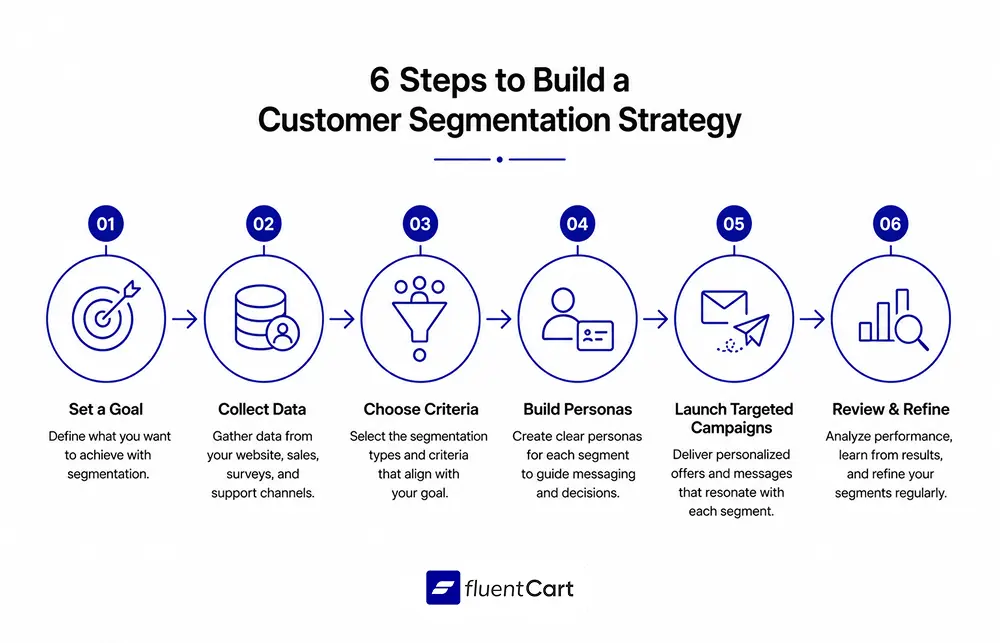
A segmentation strategy works only with a clear goal and clean data.
- Set a goal: decide what the segmentation should achieve, such as reducing cart abandonment or repeat purchases.
- Collect data: pull from website analytics, purchase history, surveys, and support tickets, with quick market research to fill gaps.
- Choose your criteria: pick segmentation types that fit the goal, whether behavioral, demographic, or psychographic.
- Build customer personas: turn each segment into a simple buyer personas profile the team can reference.
- Launch targeted campaigns: adjust offers, pricing, or messaging for each segment instead of one generic approach.
- Review and refine: check segment performance on a set schedule since behavior shifts over time.
Common Segmentation Challenges
- No strategy at all: skipping segmentation means missing easy wins, like sending the same email to every customer regardless of behavior.
- Wrong segment assignment: placing a customer in the wrong group leads to irrelevant offers and a weaker customer experience.
- Poor quality data: segmentation built on outdated or incomplete data produces inaccurate groups and wasted marketing spend.
Regular audits and centralized customer data fix most of these problems before they affect a live campaign.
Tools That Support Segmentation
Most segmentation work today runs through software rather than spreadsheets. CRMs collect purchase history and behavior in one place, while marketing automation tools use that data to trigger targeted campaigns automatically. AI-based segmentation goes further by spotting patterns in customer data that would take a team weeks to find manually.
For WordPress stores, this often means connecting an ecommerce platform with a CRM. A FluentCRM integration lets store owners track customer activity and build segments without leaving their existing setup. Segmentation stays tied to actual sales data instead of living in a separate, disconnected system.
Wrapping Up
Customer segmentation turns a broad audience into groups a business can actually serve well. The types matter less than the discipline behind using them.
Start with one clear goal, build segments from real data, and review the results on a schedule. That consistency is what makes segmentation pay off over time.
FAQs
What is an example of customer segmentation?
A retailer might separate customers who buy every month from those who buy twice a year, then send the frequent group early access to new products and the infrequent group a discount to bring them back.
How many types of customer segmentation are there?
Most businesses work with four core types: demographic, geographic, psychographic, and behavioral. Some add technographic and needs-based segmentation for more detail.
Does customer segmentation work for small businesses?
Yes. Even a small customer list benefits from basic segmentation, such as separating first-time buyers from repeat customers, since it allows more relevant follow-up without added cost.

Deputy Marketing Lead, published literary author, and musician. I thrive on marketing for tech companies while composing music, collecting books of lasting depth, exploring cinema with a discerning eye, and studying the arts and history.

Subscribe now
Related Articles and Topics
-

WordPress Coupons: How to Create and Manage Discounts
Set up a WordPress coupons plugin and manage discount codes in minutes.
-
Buy One Get One Free: A FluentCart Guide for WordPress Store Owners
A complete buy one get one free setup guide in FluentCart, using three methods, so you can pick…
-
What Is a Business Proposal? Things to Know in 2026
A business proposal is a formal document that pitches your product or service to a client. Learn its…




Leave a Reply