
What Is Retail Margin? Formula, Benchmarks & Tips

Every retailer eventually asks the same question after a slow sales month: are we actually making money on what we sell?
Revenue can look healthy on a dashboard while the store barely breaks even, and the gap between those two numbers almost always comes down to margin. Retail margin turns a jumble of prices and costs into one clear number you can track, compare, and improve.
In this blog, we will cover what retail margin means, how to calculate it, what counts as a healthy number across different store types, and the practical steps that raise it.
TL;DR
- Retail margin measures the profit left from a sale after subtracting the cost of the product.
- It differs from markup, which is based on cost rather than selling price.
- Margins vary widely by industry, from thin grocery margins to wide luxury margins.
- There is no single “good” margin. It depends on your category and business model.
- Track cost and price together for every product to protect margin over time.
What Is Retail Margin?
Retail margin is the percentage of a sale price that a retailer keeps as gross profit after paying for the product itself. If a shop buys an item for $25 and sells it for $50, the $25 difference is gross profit, and that profit measured against the selling price is the retail margin.
The formula excludes other costs such as rent, staff, and marketing, so it isolates how well a product is priced against what it cost to acquire. Retailers use this number to judge individual products, compare suppliers, and decide which items deserve more shelf space or ad spend.
A business that consistently sells below a sustainable margin runs out of cash no matter how many units it moves.
Retail Margin Formula
The standard formula is straightforward:
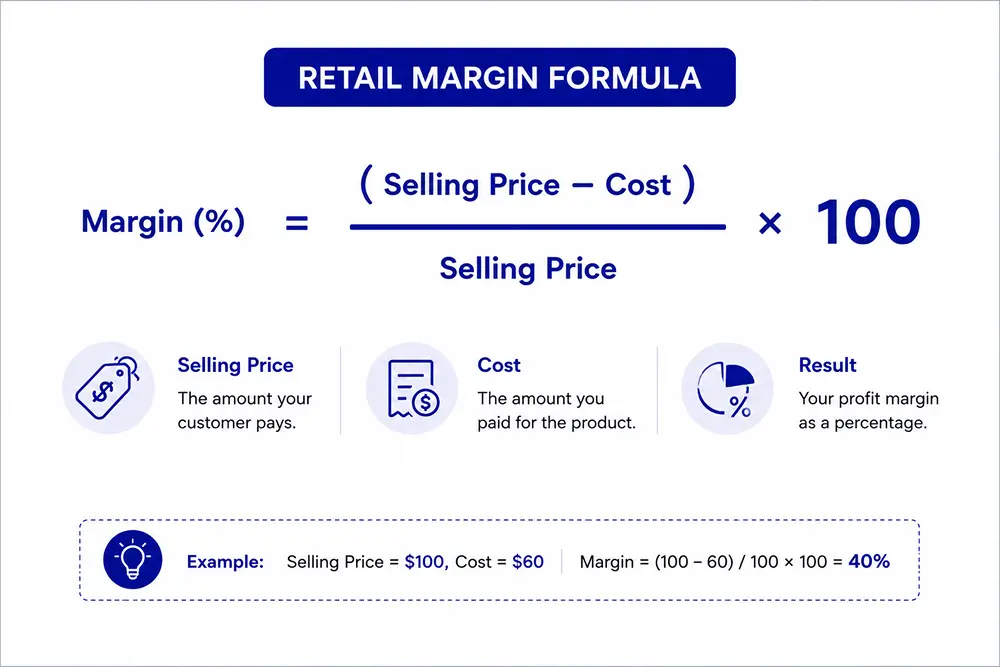
Retail margin = (Selling price – Cost of goods) ÷ Selling price × 100
Only two inputs matter: what you paid for the product and what you sold it for. Retailers plug revenue and cost of goods sold (COGS) into this equation daily, whether by hand or through a margin calculator. The result is always a percentage, which makes it easy to compare a $9 candle against a $900 sofa on equal footing. Retailers who skip this step often price by instinct, and instinct tends to underprice slow-moving or heavy items.
A Quick Example
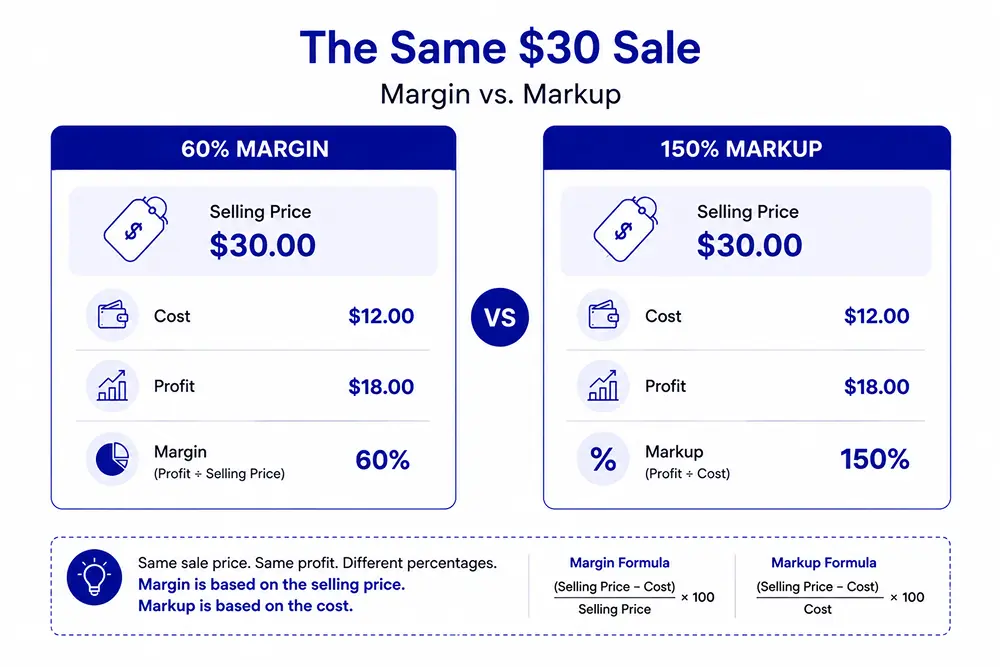
Say a boutique buys ceramic mugs for $12 each and sells them for $30. Profit per mug is $18. Divide that by the $30 selling price and multiply by 100, and the retail margin comes out to 60%.
That same $18 profit measured against the $12 cost, which is markup rather than margin, would show 150%. Same sale, two different numbers. Mixing up the two is one of the most common pricing mistakes small retailers make.
Retail Margin vs Markup
Many retailers use margin and markup interchangeably, but they measure profitability in very different ways.
- Margin: Margin is profit measured against the selling price. It tells you what share of each sale you actually keep.
- Markup: Markup is profit measured against the cost price. It tells you how much you added on top of what you paid.
The confusion between the two costs real money. Margin percentages are always lower than markup percentages on the same sale, because margin is calculated against the larger of the two numbers, the selling price.
A retailer aiming for a 50% margin who instead applies a 50% markup will price too low and quietly give away profit on every sale. A closer look at margin vs markup breaks this down further.
Average Retail Margin by Industry
There is no universal number for retail margin, and industry data confirms just how wide the range runs. According to average gross margins reported from NYU Stern research, “general retail carries a gross margin near 31% and a net margin closer to 3%.”
Building supply retailers tend to sit well above that average, while grocery stores operate on some of the thinnest margins in retail because of high volume and low price flexibility. Specialty categories such as jewelry and cosmetics often move in the opposite direction.
Their gross margins commonly reach 50% or higher because of premium pricing and lower price sensitivity among buyers.
By Store Type
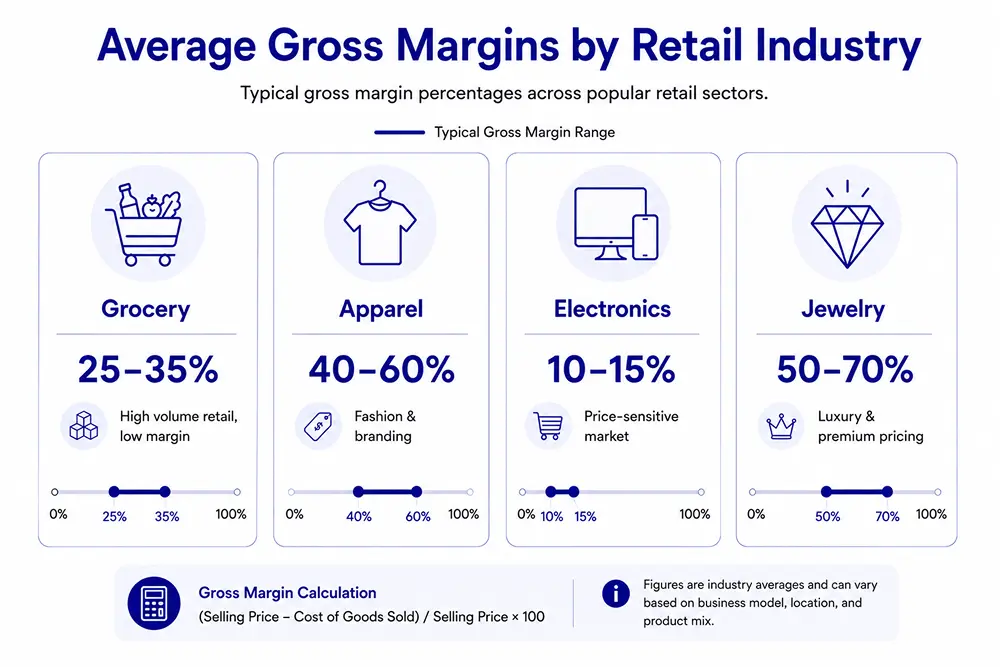
- Grocery and daily needs: Thin margins, often single digits, because pricing is highly competitive and shoppers compare constantly.
- Apparel and fashion: Mid-range margins, typically 40% to 60%, though heavy discounting during sales seasons pulls the real number down.
- Electronics: Highly uneven by product. A long-running retail forum discussion described a store manager losing money on game consoles after shipping costs and earning only a few dollars per new video game, while other posters put TVs and audio equipment at a healthier 30% to 60% markup. Accessories and used games were named as the real profit source instead.
Jewelry, cosmetics, and luxury goods: Some of the widest margins in retail, frequently 50% or more, supported by brand strength and limited direct comparison shopping.
What Counts as a Good Retail Margin
A good retail margin depends entirely on category, business model, and how a company competes. A grocery store running a 5% margin might be thriving, while a boutique running the same number is probably losing money once rent and payroll are counted.
As a loose reference point, a net margin under 5% typically signals a thin business, 10% is generally regarded as healthy for most retail categories, and anything above 15% to 20% counts as strong. Gross margin numbers run higher across the board since they exclude operating costs.
The more useful exercise is comparing your own margin against direct competitors in your category rather than chasing a generic target that does not match your business.
Why Retail Margins Stay Thin
Retail margins compress for a few consistent reasons. Price comparison is instant online, so raising prices without justification sends customers elsewhere.
Most retail spending is also discretionary, which means shoppers can delay or skip a purchase entirely if the price feels wrong, unlike categories such as groceries or fuel. Competition adds further pressure, especially in categories with many near-identical suppliers selling the same branded goods.
Rising freight and sourcing costs squeeze margin further when retailers cannot pass the increase along without losing volume.
None of this means low margins are a failure. Many large retailers accept thin margins on purpose and make up for it with high sales volume instead.
How to Improve Your Retail Margin
Renegotiate supplier terms: Better unit costs from vendors flow straight into margin without touching your selling price.
- Cut slow movers: Products that sit in inventory tie up cash and often get discounted eventually, which drags the margin down.
- Bundle strategically: Pairing a high-margin item with a popular low-margin one raises the average margin per basket.
- Price by value, not habit: Round-number pricing copied from a competitor ignores your own cost structure. A clear pricing framework keeps margin intact instead of guessing.
- Watch shrinkage and returns: Theft, damage, and returns quietly erase margin that never shows up on a standard price tag.
- Review pricing regularly: Costs shift throughout the year, so a margin that worked in January can quietly disappear by summer.
Tracking Margin as You Scale
Margin tracking gets harder as a catalog grows past a handful of products. A single spreadsheet works fine for ten items and becomes unreliable at two hundred, especially once suppliers change prices mid-season.
Store owners who track cost and sale price together for every product, rather than reviewing margin only at tax time, catch problems while they are still small.
This is also where the difference between margin and contribution margin starts to matter, since contribution margin accounts for the variable costs tied to fulfilling each order, not just the product cost itself.
Wrapping Up
Retail margin is a simple formula that carries a lot of weight. It separates guesswork from actual pricing strategy and gives every retailer, regardless of size or category, a consistent way to check retail profitability.
Track it product by product, compare it against your specific category rather than retail as a whole, and revisit it whenever costs shift. That habit alone prevents most of the margin erosion that catches growing stores by surprise.
Retail Margin FAQs
How is retail margin different from gross margin?
They describe the same calculation. Retail margin is simply gross margin applied specifically to a retail sale, calculated as profit divided by selling price.
Does retail margin include shipping costs?
Inbound shipping paid to acquire the product is usually folded into the cost of goods sold, so it does affect margin. Outbound shipping to the customer is typically tracked as a separate operating expense instead.
Is retail margin the same for every product in a store?
Rarely. Individual products can carry very different margins, so many store owners track a blended margin across the whole catalog alongside margins for individual products.
Is 60% markup the standard for retail?
No. A 50% markup is a more common reference point across general retail, and the right number varies widely by category. Luxury and specialty goods often run well above 60%, while thin-margin categories like groceries sit far below it.
Is a 70% profit margin high for retail?
It depends on which margin is meant. As a net profit margin, 70% would be extraordinary since most retailers net in the single digits. As a gross margin, 70% is high but realistic in categories with very low product costs relative to price, such as some beauty, jewelry, or handmade goods.
How do I calculate retail margin in Excel?
Put the cost in one cell and the selling price in another, subtract cost from price in a third cell to get profit, then divide that profit by the selling price and format the result as a percentage.

Deputy Marketing Lead, published literary author, and musician. I thrive on marketing for tech companies while composing music, collecting books of lasting depth, exploring cinema with a discerning eye, and studying the arts and history.

Subscribe now
Related Articles and Topics
-

eCommerce Laws in 2026: The 8 Rules Regulators Are Fining Stores Over
The 8 ecommerce laws regulators fined stores over in 2025 and 2026.
-

What Is a Payment Gateway? A Guide for WordPress Store Owners
Confused about payment gateways? Here’s what they actually do, which ones fit WordPress, and how to pick the…
-

GiveWP Alternatives: What Actually Replaces It
GiveWP’s future is shaky. Here’s what real GiveWP alternatives do better in donation-taking operations, and where they still…




Leave a Reply